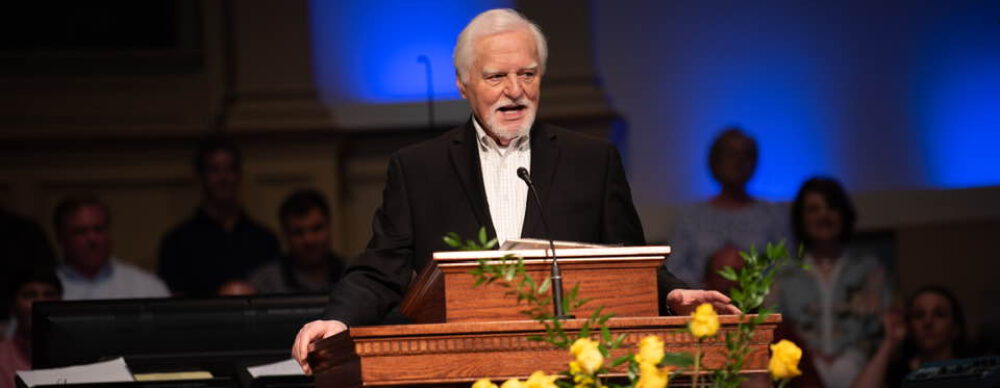
Humorous observations from a veteran preacher

Humor refreshes me.  You too? 

I like finding signs with misprints. The sign in front of a local neighborhood center announced: “A DULT DANCE — Thursday 7 pm.” It was repeated just like that on the other side.

I read that and wondered, “What is a dult? And why are they invited to the dance and no one else?”

In a book, this misprint gave me a chuckle: “They are up there hugging one anther.” Someone had written underneath, “I’ll hug an anther. Show me one.”

This brings to mind a bit of graffiti observed on a New York subway. Someone had scrawled on a poster, “I love grils.” Underneath, another had written: “I love girls.” And beneath that, a third person had penned: “What about us grils?”

In Reform, Alabama, after the Sunday morning church service, we were in line for lunch in the fellowship hall when a man gave me one of the best cartoon lines ever. He remarked to a friend, “I told my wife, ‘I’m coming back this afternoon and see if I want to sleep on this pew as bad as I think I do!’”

A critic said, “Reverend Jones’ sermons have too many points. Pastor Smith’s sermons are pointless.” You just can’t please some people.

The following bit of silliness embodies some of my peeves.  It’s not funny so much as vexing….

HAVE YOU EVER NOTICED…

–that the cheaper the preacher’s doctorate, the more gaudily he displays it?

–that the better prepared a sermon is, the less time it takes to deliver?

Continue reading

The missing element in the Christmas story?

I sat in the congregation listening to the Christmas sermon.  Something was missing and I couldn’t quite put my finger on it.

The minister had selected one aspect of the Christmas story and read a text supporting it, then brought his sermon on that subject.  His points were properly related to the text and no doubt most people left the worship center satisfied they had been spiritually fed.  It was only later that something occurred to me, what was the missing ingredient in that morning’s service.

The worship leader and musicians and the pastor all drew our attention back to that night in Bethlehem over 2,000 years ago, and they did a fair job of opening the text, explaining its message, and praising the Lord. But they omitted one major element as far as I could tell.

They forgot to give us the “so what” of the Christmas message.

They failed to drive home the continuing aspect of this most wonderful of all events in the history of our world.

He’s still alive.  He is with us.  He is Lord of the here and now. 

They told us He was God and the Son of God. They reminded us of the prophecies and told how they were fulfilled. They gloried in the appearance of the angels and we sang the same song they did, although presumably not as well or as big.  We praised and loved and enjoyed and worshiped. But then…

We left with the understanding that that’s all there is, that it was a history event and “wasn’t that wonderful!”.

They failed to tell us the “So What” of Christmas.  They omitted the lasting and eternal difference that this earth and its inhabitants have lived under ever since the Incarnation.

1) Jesus was born in Bethlehem, yes–but He is still alive and among us.

Even though this is historical and fixed to a date and time and place, it’s far more than that.  The church is not a Jesus Memorial Society. Jesus Christ is alive and He is in this place and we are His children forever.

Immanuel translates to “God with us.”  Present tense!

Continue reading

The little Christmas prayer made famous by a king

On Christmas Day, 1939, Britain’s King George VI, the father of Elizabeth II, decided to do something he detested.  He would speak publicly on the radio.

King George had a speech defect known as a stammer, but determined he would revive a custom his late father had started and deliver an annual message to the British people. This being the first Christmas of the war with Germany, he rightly thought they could use the encouragement.

While the king and his staff were working on his broadcast message, someone sent a clipping from the Times of London to Buckingham Palace. The little article contained a prayer of sorts that had been found on a postcard in the desk of a deceased Bristol doctor. That man’s daughter had used it on greeting cards, one of which was received by a Mrs. J. C. M. Allen of Clifton, who had kept it. Realizing the words were appropriate for her country at the outbreak of the war, she passed the postcard on to the newspaper.

Just after 3 pm on Christmas Day, King George began with these words to his people–

A new year is at hand. We cannot tell what it will bring. If it brings peace, how thankful we shall all be. If it brings us continued struggle we shall remain undaunted. In the meantime I feel that we may all find a message of encouragement in the lines which, in my closing words, I would like to say to you.

Then, he delivered the lines which had come their circuitous route, from the doctor’s office to his daughter, to Mrs. Allen who sent it to the Times, and thence to the palace. Now, those words were shared with the world, spoken by no less than the King of England.

Continue reading

Is suffering the achille’s heel of the Christian faith?

Join with me in suffering for the gospel according to the power of God.  (2 Timothy 1:8)

For you have been called for this purpose, since Christ also suffered for you, leaving you an example for you to follow in His steps….  (I Peter 2:21)

If you like your religious faith shallow and thoroughly thought-out for you without you needing to engage your brain for any aspect–that is, if you prefer a manmade and easy-to-digest religion–you’re not going to hang around in a real Christian church long.

The Christian faith is a lot of things, but shallow and neatly systematic it is not. Rather, it’s historical and complex and true. It is true-to-life. And it has been revealed to us in such a way that we are required to put our thinking caps on and engage the brain in order to appreciate what we have been given and how it all fits together.

If you say “Well, the Bible says what it means and means what it says” to explain difficulties, you and I have nothing to talk about, for you have chosen not to deal with the hard parts.

Take suffering, for example.

Adversaries and critics of the Christian faith–these Christopher Hitchens and Bishop James Pikes (google these if they are unfamiliar)–have always been with us, so don’t let the latest “smarter than God” genius upset you by saying the fatal flaw to our theology is suffering. Critics of the Christian faith are constantly insisting that the Bible does not adequately answer the question of suffering and pain in the world.

You read that and shake your head. Scores of books from Christian writers pour off the press every year dealing with just that subject, particularly after natural disasters like hurricanes and earthquakes and tsunamis. And the recent worldwide epidemic.

What the critics actually mean, but would not admit in a hundred years, is that Scripture has no easy explanation of suffering.  And they do want their religion to be easy.  And simple.

Which it is not.

Continue reading

Courage in God’s children is in short supply these days. Be strong, Christian!

What man is there who is fearful and fainthearted? Let him go and return to his house, lest the heart of his brethren faint like his heart. (Deuteronomy 20:8)

Cowards have no place in the Lord’s army.

Faintheartedness seems to spread from one person to another like a bad disease. Better to go forward with a small fighting force made up of champions than with a massive one infiltrated by cowards.

Fear and courage are brothers, we are told. They show up at the same time, often hand in hand. But, like many brothers, the competition between them is fierce. They struggle to see which will rule the day.

Fear and courage are both contagious.

Let someone start the conversation by pointing out how strong the enemy is and how weak our side is and how foolish we would be to go forward, and soon, his solo is drowned out by a chorus of like-minded fearmongers.

They had been waiting for an excuse to go home.

Let someone stand up and speak faith and courage, and often–not always, alas–others will step out of the crowd to stand with him. Ten warriors with courage–strong of heart and dead-set on victory–can do more than a thousand who are ruled by fear.

The twelve spies had returned from their forty days in Canaan. Israel’s multitude gathered around, eager for their report. There was good news a-plenty: the fields were fertile, the crops abundant, the orchards loaded, and the barns filled. But there was another side to the report: the land was well-populated, the cities were walled and protected by standing armies equipped with the latest technology. And if that wasn’t enough, there were giants in the land.

This could go either way.

It all came down to leadership.

Immediately after the report, faithful Caleb spoke up. “Let us go up at once and take possession, for we are well able to overcome it.”

Continue reading