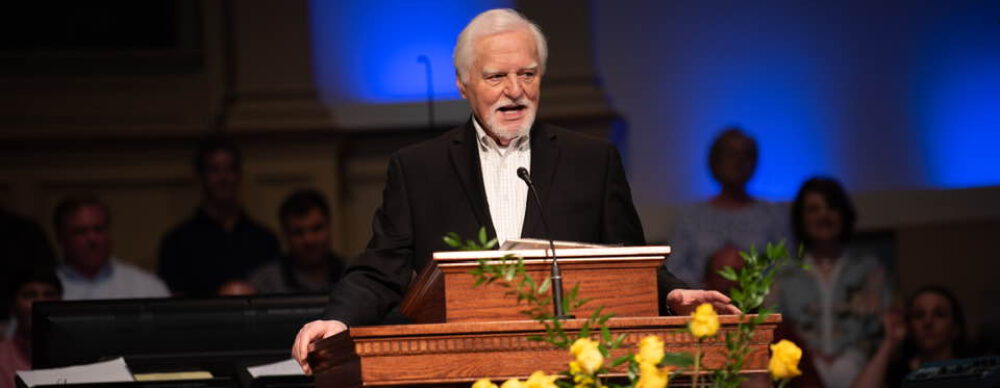
Why churches love their former pastors so much

“Most churches are two pastors behind in their appreciation.”  –Ron Lewis (taken from David Chancey’s response at the end of this article)

A cartoon shows a weary, embattled pastor standing beside a statue of a man on a horse.  The sign at the base reads, “Our former pastor.”  The preacher is saying, “Most popular guy in town.”

“They sure do love you here.”

The host pastor was talking to a former pastor, then the president of a theological seminary and celebrated as a distinguished denominational leader.  They’d invited him back for a special day, a homecoming or something.  Everyone was excited to see him and to hear him preach.  The attendance was good.

The distinguished guest looked at his host and said, “Really?  Did they tell you that?”

“Uh, yeah.  They say they really do.”

“Listen,” said the seminary president.  “That monument they built to me was made from the stones they threw at me.”

They threw stones at the preacher? And now they’re saying how much they love him?

Yep.  Ask any veteran pastor.

You serve a number of years at a church and have the typical experience of good and bad times.  You are loved by some and despised by others. It’s life.  It happens. And then, eventually, you retire or move on to another church.  After a few years and a couple of pastors, they invite you back for some big occasion.  And to hear them tell it, yours were the glory years for that church.  Those were the best times, you had assembled the greatest staff, everything was perfect back when you were here.  They rave about all the inspiring sermons you preached and the unforgettable moments in the history of the church.

That’s what they say.  And, we’ll give them the benefit of the doubt and say they probably mean it.

They suffer from a poor memory.

Continue reading

Paying the preacher: Doesn’t he do these things out of love?

A recent article for this website dealt with what to pay the preacher for weddings, funerals, and such.  Among the responses came one from a friend who belongs to a church I served years ago and whom I know as a generous and faithful sister in the Lord.

“Silly me,” she said.  “I thought preachers did the funerals out of love.”

I replied, “We do indeed do these things out of love.  But if someone gives the preacher a little money, does that negate the love?”

No preacher I’ve ever heard of charges for weddings and funerals and such.  Every preacher I’ve ever known has bills to pay and appreciates a little help with that.

And yes, there are a few of the big guys pulling down huge salaries from their churches–two or three of them, obscene amounts from what I hear–but I don’t know any of them personally.  (If I belonged to one of their churches, I’d not have to worry about what to pay the preacher for a wedding or funeral, however, because they don’t do them.  Their underlings take those tasks.  And I’m betting these guys are paid normal salaries and thus can use the financial encouragement of a hundred bucks after a funeral.  Just saying.)

Now, back to the subject….

Continue reading

Write a play for your church. A short, fun one that fits the sermon.

In the church I was pastoring in the 1990s, we began inserting the occasional drama into the morning worship service, something we had created to fit the sermon.

(Note:  If you do brief dramas like this, you don’t have to purchase them.  And neither do you have to buy videos.  You have a few people in the congregation who would love to do something creative and helpful like this.  Don’t do it more often than monthly, lest it grow old.)

Here’s one from Sunday, July 11, 1993.  We called it the “Low Self-Esteem Anonymous Group.”

Margaret called the meeting to order.

Julie stood and said, “My name is Dummy–and I have low self-esteem.  I’d planned to look for a job this week.  But I didn’t.  Probably wouldn’t have done any good anyway.”

David stood to his feet. “My name is Invisible and I have low self-esteem.  I thought about asking a girl for a date this week. But I didn’t.  Who would want to go out with me?”

Jennifer said, “My name is Zero–and I have low self-esteem.  I thought about going to church.  But I probably wouldn’t fit in, so I stayed at home.”

Throughout this, Neil sits aloof, off to one side, making derogatory comments (which brought laughter).  Finally, he has enough.  He stands up, points to the sign and says, “Look at that–‘Low Self-Esteem!’ I love the initials–L.O.S.E.  That’s what you all are. A bunch of losers! I’m out of here.”

As he turns to leave, Jesse calls to him, “Hey Buddy–Egomaniac Anonymous meets down the hall, third door on the left.”

Continue reading

What to pay the preacher for a wedding, funeral, etc.

“The laborer is worthy of his hire.”  (That’s in the Old and New Testaments.) 

People often ask whether we’ve written anything on this website concerning honoraria–what would be appropriate to pay the preacher for a wedding,  a funeral, a banquet, or for guest preaching in their church.

I haven’t…until now.

I suppose the reason is that this is so subjective, so hard to nail down.  Different regions of the country and different denominations will have their own customs and expectations.  But, for what it’s worth, I will give it a try.   I know full well that we will leave some questions unanswered, some subjects unaddressed.  But, here goes.

The last wedding I did, they paid me $550.

That generous, surprising amount was completely their decision.  Two months earlier, when the bride-to-be asked “How much do you charge?” I replied that “I don’t have a fee. Whatever you do will be fine.”  I may have suggested she ask her minister (they lived several states away and were coming to Mississippi for a family gathering and wanted to marry while everyone was together) what he thought was appropriate.

So, I might owe him a thank-you note.  (As a matter of fact, I do owe him one.  He did the pre-marital sessions, and even sent a note to that effect.)

Every pastor has his stories.  For one other wedding, I was paid $500.  But that was far and above the usual.  Back when I began marrying people, it was more like $10 or $20.  But that was when you could live on a hundred dollars a week.  (Yes, Ginger, there really was such a time in America.)  In recent years, the typical gift for a wedding was $100 or $200.

I remember a couple of times when I have had pity on the couple getting married in dire circumstances and assured them we would charge nothing, not for the church (with its huge a/c and electricity  bill, and janitorial costs) and not for me.  When they pulled up to the church in a limousine toasting each other with champagne, I felt like someone had just run a scam on me.

I’ve done funerals where the honorarium was not enough to pay my mileage.  And done a weeklong revival where that was also the case.  If the people were poor or the church was small, that was no problem.  But it rarely has been the case.  Thoughtless is more likely the culprit.

But every minister has done this.  It’s par for the course.  You don’t enter this work to get rich.

Continue reading

Something kind of wonderful in Mark 12

“After that, Jesus called His disciples to Him and said, “Now, that is the real deal right there!”  (Okay, that’s not exactly how He phrased Mark 12:43, but it’s the point.)

We who take God’s word seriously sometimes get caught up in the minutiae of word study.  As we isolate a parable or story for our Bible study, teaching lesson, or sermon subject, we often end up missing the larger context.  Mark 12 is a great case in point.

The chapter is a chronicle of one frustration after another for the Lord, starting with the chief priests, scribes and elders confronting and questioning Him at the end of chapter 11. Chapter 12 begins with Jesus’ parable to them, putting in context precisely what they were doing and the danger they were risking.

These however were people of power and influence. They weren’t interested in learning about God from a carpenter of Galilee.  God was their domain.  Teaching was what they did.  Receiving truth and wisdom from a common laborer was something they would not be doing today or any other day.

Mark 12:12 says, “And they were seeking to seize Him.  Yet they feared the multitude…. So they left Him and went away.”

Next came the Pharisees and Herodians, a motley merging of political enemies.  The Pharisees were the “moral majority” of their day, the religious right, while the Herodians were compromisers, Jews who supported the tyrant in the palace for the gain that would flow to them.  They are “sent” by the previous group (see 12:13), thus embodying the line about politics making strange bedfellows. What they have in common is a dislike for Jesus.  They asked their question and got their answer.

“Well!” they must have said to one another. “That didn’t go too well.”

Continue reading

How church members undercut their own best efforts and fail Christ

“Welcome the stranger within your gates. For you were foreigners in Egypt.” — The thrust of Leviticus 19 (see verses 10, 18, and 33-34)

This is one of the greatest frustrations and painful aspects of pastoring.  You try to do well–to prepare sermons blessed of God, to lead your team to present effective ministries, to build powerful worship services, to develop disciples, and reach those in darkness–and then your best people fail to do the smallest thing.  In so doing, they end up negating a thousand good things they do.

They fail to think of the outsider.  They look right past the newcomer.  They give no thought to the first-timer.

My blog from Monday, March 22, 1999—

“I made a number of visits tonight.  Left notes at three homes (no one there) and visited with Carol and Bob Coleman.  They’ve been visiting our church several weeks.  She said, “We love it.  Great music, etc etc–but only three people have greeted us!”

“Three!  Our people think they are friendly but in truth they are friendly to each other.  Bob told me he had volunteered to help Clyde with cooking the wild game supper at church.  Was brusquely turned aside with ‘We already have enough help.’  Then Bob came on to the dinner and brought a friend.  One hour later, they were back.  Said not a soul spoke to them.  So disappointing.”

That church, you will want to know, had a reputation from the previous decade as strong on evangelism and soul-winning.  In fact, when I had asked the congregation to do something heroic and go the extra mile–more than once, our people opened their home to mothers from Third World countries bringing critically ill infants to our Children’s Hospital in New Orleans–they always responded well.  So, they were not uncaring.

They were not uncaring.

They were unthinking.

Continue reading

Those little things you do when no one is looking

“God is Watching.”  –sign over the door of Gwen Williams’ home in Picayune, Mississippi.

John Ed Mathiston told his congregation in Montgomery, Alabama a story about kindness.

“Not long ago, a man from the Middle East walked into a new car showroom and asked to speak with a particular salesperson.  The receptionist called for him, the fellow walked to the front, and they greeted each other.

The foreigner said, “I’d like to buy some trucks.”

Some trucks. That caught the sales guy’s attention.

“What did you have in mind, sir?”

“I want to buy 750 heavy duty trucks and 250 pickups.”

The salesman is stunned.  Surely someone is pulling a prank.  This cannot be happening.

The Middle Easterner pulls out a letter of credit with a huge American bank.  It is legitimate. This is the real deal.

The salesman says, “Sir, you know you can go to Detroit and buy those trucks at a huge discount.”

Continue reading

When enough is enough: The pastor throws down the gauntlet.

“Freedom’s just another word for nothing left to lose.”  –a line from “Me and Bobby McGee,” an iconic song of the 1960s written by Kris Kristofferson and Fred Foster

There comes a time in a pastor’s ministry….

The Lord’s servant has taken all he’s going to take.  He has reached the point where getting fired from this church would be a relief.  And yet, he knows the Lord who called him into the ministry assigned him to this particular congregation, and he has no intention of walking away.  However, the time has come to speak out and tell God’s people what is going on.

A small but determined group of members is waging warfare against the preacher. They want him subservient to them, they want him different from who he is, they want him “out.” Snipers work in the darkness to undercut him.  A little group conspires to oust him.  Others simply detest him and are constantly voicing their displeasure with him.

Their work is crippling the ministry of the church and destroying the effectiveness of this minister.

And these are all leaders.

The trusting congregation loves the pastor and believes all is well.  They don’t have a clue.

God help your church!

(NOTE:  Whenever I post an article on the mistreatment of God’s servant, invariably someone will message me about some hot-shot preacher who mistreated a church, stole its money, and ran off with a deacon’s wife.  Please spare us.  We are well aware there are hypocrites in the pulpit as everywhere else in life.  But no one has a license to dishonor God by shaming the ministers He sends to lead His church.)

“The Holy Spirit makes the pastors the overseers of the church.”  That’s in Acts 20:28.  So, let’s establish this up front.

Continue reading

The pastor’s wife’s greatest ministry

“Let the wife see that she reverence her husband” (Ephesians 5:33).

(Disclaimer: I write as a Southern Baptist, where all our preaching pastors are male. While I know a few women pastors, they’re in other denominations and I know zilch about what goes on in their households and how they relate to the husbands. I respect them highly but for me to write about what they need would be presumptuous.)

A pastor’s wife’s greatest ministry is to her husband first, and her children second.

We were two weeks away from beginning a new pastorate.  A couple of days earlier, we had been informed that the church had voted 85% to invite me to become their new pastor.  After praying long and hard about such a less-than-unanimous call, we felt it was the Lord’s will that we accept.

It was a difficult time in our lives.  I had just come through the most difficult three years of ministry in my life, and the church to which we would be going was still reeling from a massive split just 18 months earlier. It was not going to get any easier.

Nothing about this was fun. We knew going in that we were bruised and that the people we would be shepherding were hurting.

My journal for Monday, September 3, 1990:

Continue reading

Pastors never know who’s in the audience

When a pastor stands to preach, he never knows who is listening to him. And if his sermon is recorded or broadcast, he has no clue who will be hearing his words. He will do well to make sure he knows what he’s talking about.

Case in point.

Last Sunday evening, I spent three hours with the deacons of a church near here.  At the conclusion of the two teaching sessions, I shared a favorite story.

Ted Traylor, pastor of Pensacola’s Olive Baptist Church, told this story to Leadership Journal back in 2001. For over a year, the pastor had tried to get a veteran staff member to make some needed changes in his ministry. But he refused all offers of help and all attempts to supervise him.  The staffer owned this particular phase of the church and no one was going to tell him what to do. So, finally and reluctantly, Pastor Ted terminated him.

The day he fired that staff member, the church held its regular business meeting that night.  A lot of people on that fellow’s team were incensed. “How dare the pastor do such a cruel thing!”  The anger was palpable.  The pastor’s name was mud. For weeks afterward, the bad spirit persisted. People would call the pastor’s home in the middle of the night, then hang up the phone.  Women said harsh things to his wife in the store.  Pastor Ted says, “Had a search committee from Toadsuck, Arkansas come, I would have gone with them.”

One night, as the pastor and his son were returning home, three men from the church were standing at the edge of the yard, waiting to talk.  Traylor sent his son into the house and walked back to where they were standing.

Even though these were among his greatest supporters in the church, Pastor Traylor figured they had come to ask him to leave.

Continue reading