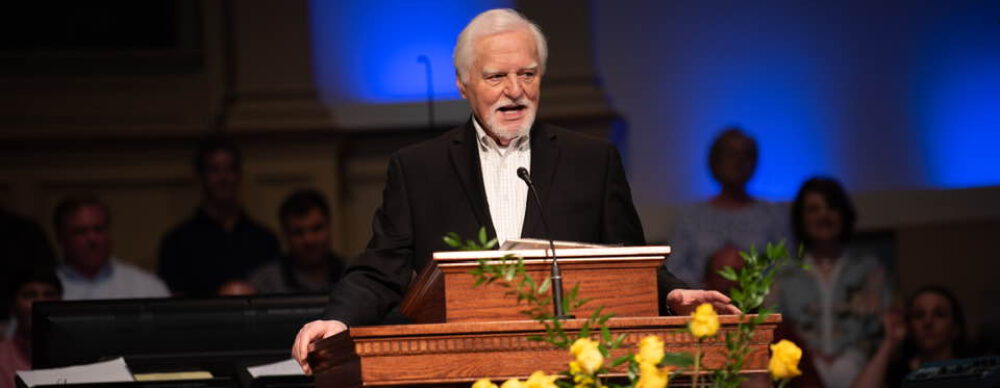
Sometimes the bully pastor gets a comeuppance

My friend Dave was pastoring a small church in a deep southern town while living some miles away in the city. During the week, he worked at the health department.

One day, his church leadership requested that Dave get ordained. He passed the request on to his home church pastor in the city.

The pastor said, “Dave, anyone in particular you want to preach your ordination?” Dave couldn’t think of anyone. “I’ll leave that to you,” he said.

The night of the big event, Dave entered the church sanctuary and spotted a colleague from the health department. As they exchanged greetings, the friend said, “Uh, Dave. Have you seen who’s preaching your service tonight?” He hadn’t.

As soon as he laid eyes on the featured preacher, Dave stood there in shock.

That preacher was a retired pastor who lived in the city. Only a few weeks before, Dave had served him with official papers demanding that he take care of some health issues on his property or face legal action. The preacher had defiantly cursed David out, creating quite a spectacle.

“He did take the remedial action we demanded, however,” Dave told me.

But even so. Such behavior from a man of God.

And now, the preacher who cursed David out is now about to preach his ordination service.

Continue reading

What the guy in the pew wishes his pastor knew about prayer

A typical worship service will be hemmed in by two prayers, the invocation and the benediction. In between may come a pastoral prayer, an offertory prayer, and occasionally an intercession involving some specific need. Some of those will be voiced by staffers or deacons, but most will belong to you, the pastor.

Pastor, could we talk about how you pray in the services?  The fellow sitting in the pews asked if I would say a word to you about how you pray.  Seriously.

Now, in many cases, he seems to have abandoned hope that you might invigorate your prayers with fresh thoughts and uplifting praise and strong intercessions. But, if I were a wagering man, I’d bet that the laity who read this will connect with it in a heartbeat.

What the guy in the pew wishes his pastor knew about his public prayers….

1) Remember that you are praying with me and for me.

This is not your private prayer time, pastor. You are voicing a prayer on behalf of the congregation. Therefore, say “We” and “our,” and not “I” and “my.”

At some point in recent history, some misguided influencer-of-preachers convinced them that no one can voice a prayer for someone else and that when you pray in public, you should use the first person singular pronoun. “I make my prayer in Jesus’ name, amen.”

My response is that this would be news to Jesus. He taught us to pray, “Our Father…give us…forgive us…lead us….”

So, make your prayers on behalf of the entire congregation. What are they feeling, where are they hurting, what do they need? What has God impressed you to request on behalf of your congregation? Then pray that.

Continue reading

Congregational phobia: The preacher’s occupational hazard

“Have I not commanded you? Be strong and courageous! Do not tremble or be dismayed, for the Lord your God is with you wherever you go.” (Joshua 1:9)

Did you see in the news where a schoolteacher is trying to get approved for medical disability because she fears the students in her class?  The anxiety is so strong that she is unable to function, she says.

If she is able to pull this off, watch as plenty of teachers as well as practitioners of other professions jump on that bandwagon.  I can see it now: doctors who fear their patients, parents who fear their children, drill sergeants with a morbid dread of recruits–all will be able to go home and start drawing their pay.

Someone told me about his pastor the other day. His first analysis was that his preacher is simply lazy. He preaches one sermon a week and often gets someone to fill in for him. He canceled the midweek service because so few people were coming, and turned over the Sunday night service to a layman. He moved his study into his home, but cannot be reached by phone because he turns his phone off and studies wearing headphones which bring in music.

As we chatted further, the man said, “This is the pastor’s first senior pastor position. Previously, he was a youth minister. I’ve noticed he has a great anxiety about facing the congregation on Sunday morning.”

Congregational phobia. There it is.

Continue reading

Half right, totally wrong: Shallow things religious people believe

But as for you, speak the things which are proper for sound doctrine.  –Titus 2:1 

We hear them all the time.  Something about these oft-repeated claims just does not seem right, we think.  Here are a few that have occurred to me. You’ll know others….

One. “Christianity is not a religion;  it’s a relationship.”

Sounds right, but it’s wrong.  Ask yourself one question:  As a follower of Jesus–by which I mean in a relationship with Him–would it be all right if I joined a religion and became a Buddhist or Taoist or a Jew or a Muslim? After all, as a Christian I’m not in a religion as such (according to this thinking) and there would be no reason not to.   Of course, those religions are incompatible with the way of Jesus Christ and that’s why we counsel believers to avoid them.

“The way of Jesus Christ”?  We call that The Christian Religion.

Friend, if it looks like a duck and walks like a duck, well….

A religion may be defined as a systemized practice of worship involving a God, a place or places of worship, a system of beliefs, and in most cases exclusivity (that is, it claims to hold The Truth).

Sure sounds like the Christian faith to me.

Continue reading

And now a special word to you who love to read. And you who do not!

“Write this down,” said God to Moses and various prophets, as recorded in Holy Scripture.  If He wanted His story written, God surely intended it to be read.

The sharpest people you know are readers; the dullest never crack a book.  My parents both read constantly. There was never a time in my growing up years when we did not take the newspaper, and sometimes more than one. In 2007, when God took our Dad the family had to cancel a half dozen subscriptions to magazines he was taking.  He was nearly 96.

At the moment, my bedside table holds books on history, politics, music, and westerns.  Every couple of weeks I go through those I’ve read and ship some off to family or make a delivery to Goodwill.  Otherwise, we would be running over with books around here.

And I love it.

In her book, Leadership in Turbulent Times, historian Doris Kearns Goodwin tells how several presidents came to develop their gifts for influencing others and leading the nation.  Early on, with Abraham Lincoln, there was a love for books.

Left on his own, Abraham had to educate himself.  He had to take the initiative, assume responsibility for securing books, decide what to study, become his own teacher.  He made things happen instead of waiting for them to happen. Gaining access to reading material proved nearly insurmountable.  Relatives and neighbors recalled that Lincoln scoured the countryside to borrow books and read every volume “he could lay his hands on.” A book was his steadfast companion.  Every respite from the daily manual tasks was a time to read a page or two from Pilgrim’s Progress or Aesop’s Fables, pausing while resting his horse at the end of a long row of planting. 

Then, Goodwin says about his technique:

Continue reading

Ten pointers for God’s people asked to pray in public

In a typical Southern Baptist church–if there is any such animal!–the ministers handle most of the pulpit duties. The times when deacons lead in public prayer are more likely to come prior to the offering and inside the Lord’s Supper.

When an inexperienced layman approaches the pulpit to lead in prayer, there is no telling what will happen. If it’s true that most pastors have never had training in public praying, it’s ten times as sure that the laypeople haven’t.

What we get when the typical layman leads a prayer in the worship service is often some or all of the following:

–trite statements he has heard other people pray again and again

–vain repetitions

–awkward attempts to be genuine and fresh

–uncomfortable attempts to admonish the congregation about some issue, usually their laxity in giving

–a complete unawareness of the time element. He/she may be too brief or go on and on and on.

The typical layman feels out of place doing this. There are exceptions, thankfully, and some wonderful ones. But in most churches, the deacons and other lay leadership would rather take a beating than to pray in public.

When a pastor friend announced to his deacons that they would no longer be leading offertory prayers, he expected resistance and was prepared to respond to it. Instead, without exception, they cheered the news. “They felt like a burden had been lifted off their shoulders,” he told me.

I understand that. But I regret it. In truth, this could be a wonderful time for a man or woman of the Lord to render service of an unusual nature to the congregation and indirectly to the Lord.

Continue reading

Playing our little games with Holy Scripture

“I did not send these prophets, yet they ran with a message; I did not speak to them, but they prophesied” (Jeremiah 23:21).

What if we sliced off a bit of scripture here, pasted it in there, omitted a reference over yonder, and pretended the result is what Jesus actually said?

That happens.

Fortunately–in my opinion–it happens rarely.  But it is done often enough to make it a concern to those who value God’s word and our integrity.

Here’s my story….

At a preachers’ conference, we heard a stem-winding brother drive the several hundred of us to our feet in a shouting, hand-clapping final eruption of praise and joy.  He was good, I’ll give him that.

His text was Hebrews 13:8, “Jesus Christ the same yesterday, today, and forever.”  His theme was that God’s people today have no trouble with Jesus Christ being “the same yesterday”–His birth in Bethlehem, His miracle-working ministry across Galilee and Judea, followed by His sacrificial death and His divine resurrection–and no trouble with Jesus Christ being “the same forever”–as we proclaim His return to earth, the judgment, and His forever reign.

The problem present-day Christians have, said the preacher, is with “Jesus Christ today.”

Okay.  So far, so good.

Continue reading

Envy: The sneakiest sin of all

Let us not become boastful, challenging one another, envying one another. (Galatians 5:26)

I find it funny how the Old Testament’s references to envy focus on God’s people looking outward to the world (“sinners”). They were not to envy wrongdoers, those on the outside.

However, the New Testament directs its instructions inwardly, warning believers against envying each other. For those of us who know the inner workings of church life, we fully understand the change.

Now, a confession first.

I have decided this “deadly sin” is not my problem, that envy is not a problem in my part of the world. I honestly don’t know anyone sitting around stewing over the neighbors having a car and wishing it was in their own driveway. I know of no preachers fuming because another pastor received a doctorate which he should have rightfully received. So, maybe envy is no longer a problem to moderns.

But hold on.  Not so fast.

Perhaps I’ve been defining envy too narrowly.

Continue reading

Pride: The sin that looks most like me

God is opposed to the proud, but gives grace to the humble. (I Peter 5:5)

When a British newspaper invited readers to submit their answers to the question “What’s Wrong With the World?” the inimitable G. K. Chesterton wrote: “Editors: I am. Sincerely, G. K. Chesterton.”

Whenever the so-called seven deadly sins are listed, pride invariably leads the parade. It’s the granddaddy of them all, the source of the other six. Consider how this is so—

–Lust is pride expressing itself sexually, as well as in other ways. It takes what it wants, uses it, and tosses it in the trash.

–Avarice is pride in the marketplace and in our culture. It wants more and more and is never satisfied.

–Anger is pride on the highway and in relationships. It didn’t get what it wants and wants revenge.

–Envy is pride casting an evil eye at its neighbor, wishing for what he has and that he had a wart on his nose. (An old childhood curse we would inflict in jest)

–Sloth is pride expressing its selfishness concerning work. None for him, thanks. He’ll sit this one out. Everyone owes him.

–Gluttony is pride at the dinner table.

Continue reading

Humility: It looks so good on you!

“God is opposed to the proud, but gives grace to the humble. Submit therefore to God” (James 4:6).

“Clothe yourself with humility toward one another, for God is opposed to the proud, but gives grace to the humble” (I Peter 5:5).  

“Humble yourselves therefore under the mighty hand of God, that He may exalt you at the proper time….” (5:6).

A Facebook friend said, “I’m very proud of my humility.”

I think he was teasing.

Humility is not a subject most of us would claim to know much about.  In fact, we would shy away from anyone claiming to be humble.  The very claim contradicts itself.

In fact, a truly humble person would probably be the last to know it.   So, when told that “You are a genuinely humble person,” the appropriate response might be something like “Who, me? I wish!”

Now, there are few traits more attractive in a leader than humility.  The Lord of Heaven and earth stooped to wash the feet of His disciples, in so doing forever disallowing His preachers from playing the royalty card (John 13).  “The Son of Man did not come to be ministered unto,” He said, “but to minister and to give His life a ransom for many” (Matthew 20:28).

Biblically.  Anecdotally.  And personally. The evidences of a truly humble person are no secret.

Seven traits of a humble person….

One.  An overwhelming sense of the blessings of God.  His generosity. His grace.  “Oh that men would praise the Lord for His goodness, and for HIs wonderful works to the children of men!” (That praise eruption of praise comes from Psalm 107 where it is repeated in verses 8, 15, 21, and 31.)

God is so good to me.  Far better than I deserve. “I feel like I’m God’s favorite child,” a friend says.  “My cup runneth over,” said King David (Psalm 23:5).

Words you will hear a lot from the truly humble: “Thank you!”

Continue reading