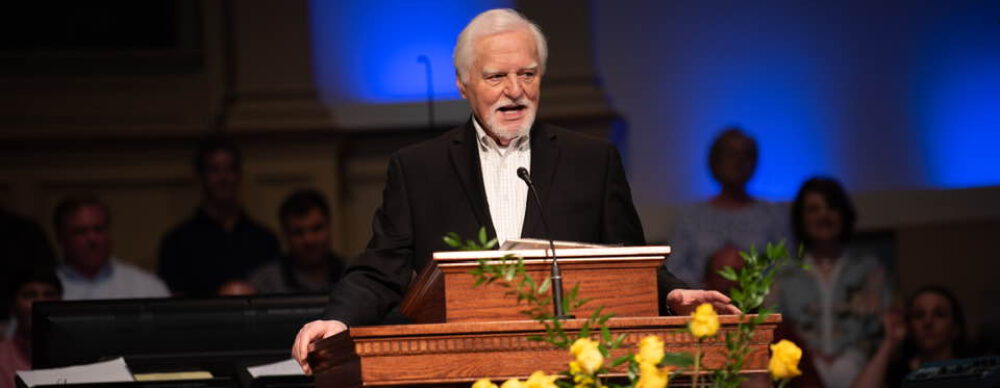
Not Again!

By David E. Crosby, Pastor

First Baptist New Orleans

The cancelations are rolling in. Formal Katrina remembrances are being replaced by an unstoppable barrage of unwanted, terrifying memories. Productive work is now on hold. All eyes are on the Gulf of Mexico and the unseeing, unfeeling specter of Hurricane Gustav.

He has me churning already. His powerful winds and deadly aim at New Orleans are dredging up suppressed memories of midnight runs, stranded plans, and emotional partings.

An emergency meeting to batten down the hatches turned into a torrent of tormented remembrances. Pets are a problem. The elderly need help. Temporary office accommodations are available in Montgomery, Alabama.

The post-Katrina newcomers are staring at me, maybe a little mystified. I am waving my arms too much. My voice is strained, and my animation seems bigger than the situation calls for.

Someone voices the “no evacuation” sentiment. A Katrina survivor who fished his loved ones out of the flood jumps back in his chair, shaking his head violently. “No, sir! I’m not staying.” No one knows how to escape this gaping fissure running through our collective lives.

Lunch is now the hour of dark speculation and ominous prediction. “If we flood again, that’s the end for New Orleans. No one will come to help us.”

Everything in me resists. I don’t want to do this, not even think this.

Continue reading

17 Ways A Pastor Can Shorten His Sermon Prep Time

1) Borrow.

In the secular world, this is called plagiarism. But we pastors know “God richly gives us all good things to share” or something like that. Fortunately, your people don’t read other preachers’ sermon books anyway, so they’ll never know. (Disadvantage: if the written sermon bombed, chances are yours will, too.)

2) Repeat.

Everyone knows repetition is a proven learning technique. Warning: do not call these sermons ‘repeats’ or ‘re-runs.’ “Previously preached’ is also verboten. If you have to put a label on them, try ‘Back by popular demand.’ It sounds better.(Disadvantage: some little sister in the church writes in the margins of her Bible every time you have preached a particular text, so you’ll need to vary your Scripture even if it’s the same sermon.)

3) Confess.

Tell a story out of your childhood and turn it into a microcosm of the universe, or at least of the gospel. Didn’t Phillips Brooks call preaching ‘truth through personality’? The advantages are that you are the authority on yourself, no one can contradict you, and very little study time is required. (Disadvantage: if nothing dramatic has happened to you, this can get boring quickly.)

4) Obvious.

Continue reading

Gustav: Time to Panic?

The internet news headline says the people of New Orleans are “nervous” about Hurricane Gustav which at this moment is battering Haiti, but is headed toward Jamaica and the Caymans and then into the Gulf. After that, who knows?

Well sir, all the prognosticators we check with show the storm coming this way. They’ll say that, then turn right around and say, “But no one knows; it’s too early.”

Local radio talk shows today are dealing with 90 percent Gustav and 10 percent the Democratic convention. They “take you live” to a briefing by the city, the parish, the highway patrol, this emergency board or that one, and they all say the same thing: “Too early to say where Gustav is coming, but it’s not too early for citizens to begin preparing to leave. Better start planning your exit and your destination.”

A friend in Jackson, Mississippi, has invited us to come to their place. My son Neil contacted his aunt Carolyn in Jasper, Alabama, to see if her guest rooms were available. Hotels up and down the interstates are working overtime taking reservations for the weekend.

Governor Bobby Jindal has indicated that if Gustav does come toward Louisiana, he will begin the contraflow on Saturday. For you highlanders, a contraflow is when all lanes of a highway become one way and that way is “out of here.”

I had lunch with a pastor today, Wednesday, who tells me his church is ready, that they have all the contact information on his church members in case they evacuate, and that they are fine financially if they have to miss a Sunday or two.

Lynn Gehrmann, our office’s administrative assistant, canceled a scheduled medical procedure set for tomorrow, Thursday, in order to handle some office financial things we need to have with us in case of evacuation and shutdown.

We think the city is safer than it has ever been, thanks to the steady work of the Corps of Engineers and FEMA over these three years, but the question no one can answer is, “Is it enough?”

Continue reading

Devastating: Taking No Prisoners (3rd Anniversary)

Over the last three years since Katrina did her work on our part of the world, I have wondered if I’ve been too hard in this blog on our city leaders for their failure to provide the visionary leadership the rebuilding effort has needed but not received.

Apparently not.

In Monday’s Times-Picayune, the front page features a far harsher assessment of the poor leadership of New Orleans than anything I’ve ever given. The speaker is General Douglas O’Dell, Federal Recovery Coordinator and the personal representative of President Bush down here. He succeeded Donald Powell in this position last April, after a long career in the Marines. As the Recovery Coordinator, O’Dell “troubleshoots recovery efforts among federal, state and local officials in New Orleans and across the Gulf Coast.”

Evidently the general is a fast read. He has wasted little time in getting to the heart of matters. Here’s the gist of his statements.

About Mayor C. Ray Nagin and his administration:

There is a growing frustration in the nation’s capital over the slow pace, inefficiency, and incompetence of City Hall’s efforts to manage the recovery of this city after the hurricane of August, 2005.

New Orleans’ recovery efforts are “convoluted” and “bewildering.” The gears do not “mesh at any level.” When O’Dell met with key leaders several months ago, he found them “as bewildered as I was.”

About the city’s recovery czar, Dr. Ed Blakely:

Blakeley is often absent, unavailable, and does not return phone calls. He produces “ethereal visions” of great recovery plans that are unrealistic and cannot be financed with federal dollars. O’Dell said, “I’m basically asking Blakely, who’s probably getting paid a whole hell of a lot more money than I am, to do his damn job.” (Excuse me, Mom.)

Continue reading

Generations and Regeneration

My eight grandchildren have been buying school clothes and getting ready for new adventures. Their situations are all different, with the three local children (Grant, 14, and Abby & Erin, 11) going to a Catholic school which started classes last week, the two North Carolinians (Darilyn, 11, and Jack, 6) being home-schooled, and the three in New Hampshire (Leah, 18, Jessica, 17, and JoAnne, 10) going to a public school. Leah will be starting at the local community college this winter.

When Leah turned 13, we were chatting on the phone. “I’m growing up on you,” she said. I’ve never forgotten that line and the sadness that washed over my soul. It’s so true. Much too fast for grandpa.

I wasn’t through enjoying their childhood and now they’re leaving it behind so swiftly you’d think they didn’t know how precious it was and how nothing will ever be like it was.

I still remember the day I was pushing Grant on the swing in his front yard. I said, “Grant, in two weeks, you will be three years old. And then what’s going to happen?” His folks were planning a birthday party and I knew he would be excited.

“Gum!”

I said, “What?”

He said, “When I turn three, Daddy’s going to let me chew gum.” He was excited about that.

Each generation seems to get a little finer, grow a little taller (Grant is an inch over me, we noticed last night), and be a little smarter. And we wouldn’t have it any other way.

The kids call my Mom “Granny,” which has always seemed strange to me because that’s what we called her mom, who died in February of 1963. I still call her “Mom.”

She keeps asking, “Have you thanked the people on your blog for sending me all those birthday cards?” I keep meaning to. At last count, she’d received around 75. (I guarantee she still has every one of them, in a basket somewhere in the dining room.)

So, I thank you on her behalf. I’m not promising we won’t do the same thing again next year, understand. With her numbers now entering the stratosphere, each birthday becomes more rare and more precious than all the others before it.

This morning I was lying in bed pondering why mom still goes to church. She hurts all over and has trouble walking. The walker sits near the front door for use when she leaves the house. Getting ready for church takes longer and longer.

Most of the people I know would have quit going a year or two ago. If you’re looking for an excuse to get out of church, she has the best one: she’s just not able. Yet she goes.

Continue reading

Love a Seminary Student

Back when Margaret and I were in seminary, the major cost was just living. Tuition and books were so inexpensive as to be neglible, if you can believe that. These days, like everything else in our world, nothing comes cheap.

I recall we ran up a big bill at McCune’s drug store around the corner from the seminary. Forty dollars. Seems funny now, but it wasn’t at the time. These days, my one prescription for lipitor costs three times that every month.

Back then, we would periodically receive a check from one of Margaret’s aunts, Winona Franklin of Eutaw, Alabama. It might be five dollars and it might be fifty. Down in the lefthand corner, she would write, “For love.”

I told that story at her funeral a couple of years ago and suggested we could engrave those two words on her tombstone, for everything she did in life was love-driven.

A Sunday School class at Central Baptist Church in Tarrant, Alabama, where I had been on staff for six months prior to seminary sent us monthly checks for a few dollars over the first year until I became pastor of a church near New Orleans. They didn’t write “for love” on them, but they might as well have. We knew.

David grew up in one of my pastorates and he says I led him to Christ, although I have no memory of that. I do recall performing his marriage to Tammy. They later went off to seminary in Fort Worth, Texas, where he got a masters degree and they began serving churches. Recently, they moved back to campus after a difficult three years in a church they served.

“This is a good time to get a little more education,” David said, and told me the area he would be studying. They have had a hard time finding jobs, so I contacted the church he grew up in, and the pastor sent some financial help. Today, as I write, David e-mailed that he is working part-time in Best Buy and loving it. Tammy is still looking.

Oddly, before turning on the computer this morning, I had them on my heart and had decided the Lord wanted me to forward to them a little of the financial blessings He has sent my way. Then I received Dave’s e-mail note and followed through.

Down in the lower left corner of the check, I wrote “For love.” Aunt Winona would be pleased.

Continue reading

Ten Things (3rd Anniversary Stuff)

These are mostly unrelated, but are matters you might be interested in.

10) Do other states have this problem?

Just inside Metairie, 30 feet from New Orleans on a tiny spit of land jutting out into Lake Pontchartrain, stood SidMar’s restaurant for as long as I’ve been in New Orleans. It was a place for fresh fish and great po-boys and was mostly a tavern, I suppose. I ate there once but it wasn’t my style. Katrina put them out of business with damage to the building, then the state came in and took over all that land so the Corps of Engineers could construct the most massive floodgates you’ve ever seen right where the lake and the 17th Street Canal intersect. I’ve heard one billion dollars mentioned as the cost of that one project.

Anyway, the owner of SidMar’s was in the news this week saying the state does not want to reimburse him for his property. Turns out the property was never his, the state says, due to an old law that established all the land along the lake and certain other places as belonging to the state. “Then why,” the owner asks, “have I been paying state taxes on that restaurant all these years if it wasn’t mine?”

In the last session of the state legislature, lawmakers addressed this and many wanted to do the right thing and give the man the money due him, but a majority felt it would open the state up to similar claims throughout the southern portion of the state where the same situation prevails.

In Jefferson Parish, if you drive River Road (which borders the Mississippi River) down to where you enter Orleans Parish, you’ll find a small driveway that crosses the levee. Signs warn you not to enter, but if you do, you find a half dozen ancient fishing camps alongside and even over the river. I’ve been told these were grandfathered in many years ago and that the people who live there do not officially live in Louisiana, but only in the United States.

If they are ever washed away, the residents can forget about the government paying for the property.

9) The vacant city?

Continue reading

Katrina-Land No-Brainers (3rd Anniversary Stuff)

In the days following Hurricane Katrina’s devastation to our part of the world, I began calling on pastors and churches to see who was still in business and who needed our immediate help. At the First Baptist Church of Luling, Pastor Todd Hallman gave a brief tour of his fellowship hall which they had turned into a distribution center, supplying necessities for storm victims. Boxes and boxes of clothing and supplies sent from all over the nation were stacked along three walls. In the hallway, small refrigerators lined one wall, gifts from a California hotel that was being renovated. Volunteers were everywhere and a constant stream of people flowed in and out of the buildings, entering empty-handed and leaving heavily laden.

Todd said, “One of our leaders returned from evacuation and saw all this and became indignant. He wanted to know who gave me the authority to turn the church into a distribution center.”

He smiled. “I told him it was a no-brainer.”

That’s as good an answer as any, and probably all the man needed. Some things do not need explaining, discussing, or being voted on. You just do it.

Over the past three years since the August 29, 2005, hurricane, we have found ourselves confronted by a number of no-brainers.

Among them are these….

1) This city and its businesses need strong visionary leadership if we are to make a comeback.

Some sectors of the city have been led capably; others not at all. For the most part, what we have received from our elected leadership has been promises, pronouncements, controversy, and blame, but very little in the way of courageous leadership.

2) We need outside help in extreme measures to recover from an emergency of this size.

Continue reading

A Question of Authority

Saturday night, stuck in the checkout line at the local Rite-Aid, I became involved in a little scene.

The checker was ringing up the purchases of a man about 40 years old who had a small child with him. On the other side of the checker, near the front door, stood an older man, perhaps 75 or 80, who was trying to get her attention. “Ma’am,” he kept saying, “Is it all right if I take this out to the car to show my wife?” He was holding up some item from the store. The checker was giving her attention to the man and child in front of her.

Finally, the customer at the checkout snapped at the older gentleman, “No! It is not all right to take that outside!” The old man was flustered and said, “She’s in the car. I just want to see if this is what she wants. I’ll be right back.”

“No, sir!” said the younger man. “You’re not allowed to take things outside you haven’t paid for!”

The old man said, “Well, what if I leave my umbrella? I’ll be right back.”

“No!” the young man said. “Leave your drivers license.”

While this was going on, those of us in the checkout line were silently watching this scenario and fascinated at the attitude of the customer who was bullying the old guy.

The old man said to him, “Are you a manager of this store or something?”

The younger fellow said, “No, I’m not. But I know how these things are done!”

I’d taken about all of this I could. From the back of the checkout line, I called out to the old man, “Sir! You may ignore the customer. Do what you have to do!”

The younger man stared at me contemptuously, took his child by the hand, and left.

As he exited the door, the manager came over and took care of the older gentleman. The woman in front of me turned and said, “Who in blue blazes did that fellow think he was, talking to that old man that way?” I laughed and agreed that he was definitely a buttinsky.

When I got home and told me wife this little tale, she–filling the role of a wife so neatly–said, “And who did you think you were, rebuking him like that?”

My Scripture reading that very morning from the first chapters of Mark’s Gospel had been on this same subject: authority. That little word deals with who we think we are, who we really are, and what gives us the right to do what we do.

Consider these instances from the first days of Jesus’ ministry….

Continue reading

What a Champion is Not Thinking

Watch her on the diving board in that moment just before she springs. I cannot tell you exactly what is going through the mind of this world-class champion diver, but I can guarantee what she is NOT thinking.

“I can’t do this. I have no right to be here. I am unworthy. Who do I think I am standing before millions of people representing the United States of America? There are so many others worthier and better divers than I. Oh, Lord, help me get through this.”

Not if she wants to do well, she doesn’t think that way.

And yet, untold numbers of God’s people approach the tasks of their days in just this way. The odd thing is we call it humility and somehow think God approves of such an attitude. Not so.

“Oh, why was I chosen to sing the solo in this year’s pageant? So many others sing better than I do. I am unworthy. O God, use this worthless servant. May my poor effort be a worthy offering to Thee.”

“I have no right to be sitting in your living room witnessing to you about Jesus Christ. I’m a failure in so many ways. If I got what I deserved, I’d be in hell. But, I’ll go ahead and do my best.”

“I know I’m the poorest Sunday School teacher in the church. My class is infinitely patient with me. I hope the pastor finds someone more capable who is willing to teach this class. Maybe it will grow if someone else were in charge.”

Sound familiar?

Continue reading