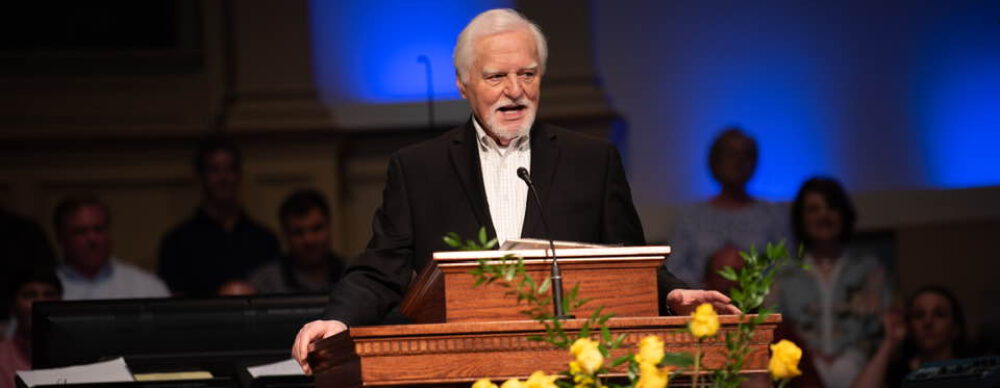
The preacher said something I disagree with. Horrors!

“…they received the Word with great eagerness, examining the Scriptures daily to see whether these things were so” (Acts 17:11).

When I asked where he went to church, the man working on my house said, “I used to go to church across the river.  But the preacher said something I disagreed with.”

It was all I could do not to laugh out loud.

But he was serious.

After giving him a moment to elaborate, which he did not do, I said, “Man, I would hope so.”

He seemed interested.

I said, “Wouldn’t it be terrible to have a preacher who said only the things that I know and taught only what I believe? What would be the point of going to hear him if I already knew what he was going to say? There’s so much more to God than what little I already know!”

Lord, make us teachable.

It’s a mark of maturity to welcome correction, to recognize and appreciate constructive insights to make our lives better. The godliest person comes to church hoping to hear something that blesses, something that corrects him, something that inspires her, whether they had previously known it or agreed with it or not. 

A quick scan of Scripture produces a long lineup of people who heard God calling their name, who made themselves available to Him, and then were told something they didn’t want to hear!

Continue reading

The pastor feels under-appreciated. What to do.

Give honor to whom honor is due.  –Romans 13:7

The elders who rule well are to be considered worthy of double honor, especially those who work hard at preaching and teaching.  –I Timothy 5:17

In my denomination October is “Pastor Appreciation Month.” I suspect most of our churches work at observing it. In social media I see where pastor friends are expressing thanks for being recognized and honored.

It’s good to be appreciated.

But what if you aren’t?

What is a pastor to do when the time of appreciation comes and goes without one word of affirmation from his congregation? The denomination suggested everyone show appreciation to pastors and ministers on staff and the silence was deafening.  The anniversary came and went without any recognition from the church.

Should he take the slight personally?  Should he be offended?  Take it as a sign that he should be looking for his next place of service?

A pastor said to me, “Is it all right if I feel hurt?”

I’m perhaps not the right one to answer this, as my pastorates all did a fair job of showing appreciation when it was called for.  One church celebrated my tenth anniversary with a huge dinner at the city auditorium where the featured guests were people from my past who had influenced me–Sunday School teachers, my college president and his wife, classmates.  Then, they presented my wife and me with all-expense paid tickets to the Holy Land.  (I served only one other church more than ten years and don’t recall what they did. But I’m sure they did something.)

To the pastor who called me feeling under-appreciated, there are three points to be made.  I offer them here humbly.

Continue reading

Church staffs: Rules to live by

I asked some of my minister friends for their advice concerning church staff relationships.  Here in no particular order are their responses.

1. Jim says, “Be very careful whom you trust completely.”

In over 3 decades of ministry, Jim says he has been brutally betrayed at least 3 times. It has made him wary about trusting anyone with anything confidential.

I’m recalling a time two churches ago when the personnel committee and I were dealing with a sensitive issue, long since forgotten. I said, “Can I say something in here and it not go any further?” The chairman said, “Pastor, I wouldn’t say anything in here you do not want to get out.”

That was a courageous thing for him to do. As subtly as he knew how, the chairman was warning me off from trusting some of the people in that room. In time, I learned he knew whereof he was speaking.

2. Andy says, “First, pastor the staff. Be their shepherd.”

Something inside us wants to protest, that, well, the staff are all ministers and they don’t need pastoring. They do. In fact, preacher, so do you.

Continue reading

Those frustrating times with some church members

Pastoring God’s people can be exhausting.

Even when you do your best to serve God by ministering to His people, some are not going to give you the benefit of the doubt on anything nor forgive you for not living up to their impossible expectations.

You didn’t do it their way, weren’t there when they called, didn’t jump at their bark.

Those are the exceptions, I hasten to say to friends who wonder why we overlook the 98 percent of members to focus on the 2 percent who drive us batty.  It’s the 2 percent of drivers who are the crazies on the highways and ruin the experience for everyone else.  It’s the 2 percent of society who require us to maintain a standing army to enforce laws.  Rat poison, they say, is 98 percent corn meal.  But that two percent will kill you.

I say to my own embarrassment and confess it as unworthy of a child of God that I remember these difficult moments with God’s headstrong people more than the precious times with the saints.  Perhaps it’s because the strained connections and harsh words feed into my own insecurities.  Or maybe it’s because there are so many more of the blessed times.

Even so, here are two instances from my journal that stand out….

Continue reading

When church isn’t fun any more

My journal records one of those pressurized times in a church I served some years back.

Consider that the church was still recovering from a split five years earlier, leaving us with a diminished congregation but an all-consuming debt.  Consider that some of our people still carried guilt over their actions during the fight, while others nursed hurts and anger from the same tragic event.  I’d not been around during that catastrophe, I’m happy to report, but the Father had sent me in to help the congregation pick up the pieces and return to health and usefulness.

It was hard.

I was weak personally, having just emerged from a brutal three-plus years trying to shepherd another congregation that was divided.  So, I came in gun-shy, hoping to avoid conflicts with church leadership and the demoralizing griping from church membership.

Naïve, huh?  Probably so.  People are going to look and act like who they are.

Daily I was being undermined by the angry, criticized by the hurting, ostracized by the pious, and scrutinized to the nth degree by leaders, self-appointed and otherwise.  When I tried to do a few things I considered normal and healthy, these also were thrown back in my face.

The journal records my efforts to bring in community leaders for a forum during which the guest would speak and be questioned.  Our people could not understand why in the world I would want to bring a congressman, for example, to our church.

I was stunned.  They don’t see the need? Aren’t they citizens who vote and who are affected by the actions of political leaders? Do they not care?  Where have these people been?

Continue reading

How to grow a small church

“It doesn’t matter to the Lord whether He saves by the few or by the many” (I Samuel 14:6).

Depending on a number of factors, growing a small church may be one of the more do-able things pastors can achieve.

Those variable factors include…

–the health of the church.  You don’t want a sick church to grow; you want it to get well first!  I once told my congregation, “There’s a good reason no one is joining this church.  I wouldn’t join it either!” Believe it or not, those words were inspired and they received them well, and repented. Soon, the church began to grow.

the attitude of the congregation.  If people are satisfied with the status quo, they would not welcome newcomers.  I’ve known Sunday School classes composed of a small cluster of best friends who felt imposed on by visitors and new members.  No one wants to go where they’re not wanted.

and the location of the facility.  A church situated five miles down an isolated road, at the end of the dead end trail, can almost certainly forget about growing.

The great thing about pastoring a healthy, small church is you can make a big difference in a hurry.

My seminary pastorate had run 40 in attendance for many years. The day the little congregation voted to call me as pastor, I overheard a man saying to another, “This little church is doing all it’s ever going to do.”  I was determined to prove him wrong.

Within one month, we hit 65 in attendance.

What had happened is this…

Continue reading

Turning sarcasm into “sic ’em!”

“Jesus said, ‘No doubt you will quote this proverb to me, “Physician, heal yourself! Whatever we heard was done at Capernaum, do here in your hometown as well.” No prophet is welcome in his own hometown’” (Luke 4:24). 

John Fogerty’s group Creedence Clearwater Revival is unforgettable to anyone who has owned a radio in the last 50 years.  Several years ago, in an interview with newsman Dan Rather, Fogerty was remembering a key moment in the 1960s.

The group was one of many bands to perform at a particular event.  As the final group to warm up, and thus the first band to appear on stage, suddenly CCR found they had been unplugged.  John Fogerty yelled to the sound man to plug them back up, that they weren’t through.  The technician did so reluctantly, then added, “You not going anywhere anyway, man.”  Fogerty said, “Okay.  Give me one year.  I’ll show you.”

One year later, the group was so hot with hit record after hit record (“Proud Mary,” “Born on the Bayou,” “Bad Moon Rising”) that “we were too big to play in that place any more!”

Turning sarcasm into a healthy sic ’em!  Something to spur you onward instead of allowing it to crush your spirit and keep you down.

Continue reading

When a pastor is called to an ignorant church

“But grow in the grace and knowledge of our Lord and Savior Jesus Christ” (II Peter 3:18).

“By this time you ought to be teachers, but you need someone to teach you again the elementary principles of the oracles of God, and have come to need milk and not solid food” (Hebrews 5:12).

The pastor had been called from his rural church to another part of the country. He was excited about the new challenge, as he well should have been. In a parting comment to a friend, he assessed the state of spirituality of the church members he was leaving behind:

“There is enough ignorance in this county to ignorantize the whole country.”

What happens when a pastor gets called to a church like that? A church where the members and leaders alike do not know the Word of God and have no idea of how things should be done (what Paul called “how one ought to conduct himself in the household of God”–I Timothy 3:15), or why it all matters.

A church that exists to condemn sin and sinners, that knows only slivers of Scripture, that sees ministers as slaves of the whims of the congregation, and that is ready to reject as a liberal any minister who wants the church to feed the hungry in the community, take a stand for justice, or invite in the minority neighbors–the ignorance takes all kinds of forms.

We wish we could say such congregations are few and rare, but they aren’t.  Veteran preachers have stories of those churches, tales of run-ins with those leaders, and scars from the battles they have waged to set matters right.

–One pastor told the group of ministers meeting in his fellowship hall, “This building is actually owned by a member of the KKK. We rent it from him.”  The rest of us were naive and thought the Ku Klux Klan had died out ages ago. Here they were living among us in our own southern town.

–One lady visible in church leadership told her pastor, “I don’t know what the Bible says but I know what I believe.”

Continue reading

The number one failure of 90 percent of pastors

The four-year-old who says, “I can do it by myself” has a lot in common with many a pastor.

Pastors are notorious for their lone ranger approach to ministry. I call that the number one failure of 90 percent of pastors. They prefer to go it alone.

Even Jesus needed a buddy. “He came to the disciples and found them sleeping, and said to Peter, ‘So, you men could not keep watch with me for one hour?’” (Matthew 26:40)

Sometimes it helps to have someone nearby, praying, loving, caring, even hurting with you.

The word paracletos from John 16:7 is translated “Comforter” and “Helper” in most Bible versions. The literal meaning is “one called alongside,” the usual idea being that the Holy Spirit is our Comforting Companion, a true Friend in need. And each time that word is found in the New Testament–John 14:16,20; 15:26; 16:7; and I John 2:1–it always refers to the Lord.

However, here’s something important.

Continue reading

How to awaken a sleeping church. 20 suggestions.

“Awake thou that sleepest and arise from the dead, and Christ shall give thee light” (Ephesians 5:14).

A pastor I know has a problem.  It’s not unlike that experienced by a large group of his peers, I imagine.

He has deacons who are undisciplined, church members who do not take care of the hurting in their midst, and in general, a congregation of unmotivated people.  When he preaches evangelism or discipleship or ministry in their community, the way they sit and stare makes him wonder if the language he’s using might be a foreign tongue to them.

Sound like your church?  Sounds like some I’ve pastored and a whole lot I’ve known.

The pastor of that unresponsive bunch asked for my advice.  Had I written anything on how to revive a comatose church?  Does our website have any help for him?

I asked him to give me a day or two to reflect on the subject and seek the Lord’s guidance.  (More and more, I keep thinking: This is an uphill task, wakening a sleeping church.  If it were easy, every pastor would do it and no church would be stagnant or declining. )

Here are my suggestions on how to transform a collection of comatose do-nothing members into a thriving, caring, loving church of the Lord Jesus Christ. And, since every church is both similar and different, we will use a lot of generalities and broad-sweeping statements.  Pastors should take anything that fits their situation and skip the rest.

One.  The bad news: You will encounter this same problem to one degree or another in every church you serve.  No church is without the sleeping, the dormant, the complacent.  It’s the human thing. In high school physics we learned that a body at rest prefers to remain at rest, while one on the move wants to keep traveling.  So, the question is how to arouse the church that seems cemented to the floor, how to get it up and going.

Continue reading