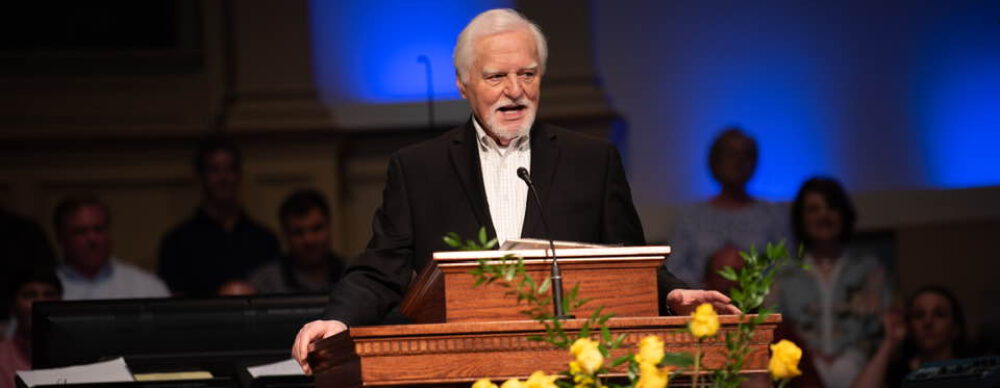
What I needed as a young preacher

At 73 and no longer pastoring churches, I’m going hither and yon to preach as the Lord leads and the invitations arrive.  It’s a satisfying life, the kind of retirement (if you insist on calling it that) I would have dreamed of had I known such was available.

Observing my host pastors as they lead the congregations, I remember so vividly experiencing the same life they know with its delights and demands, its burdens and blessings. My heart goes out to them.  (In case anyone wonders, I do not arrive at a church handing out advice to host pastors, acting as some kind of inexhaustible fountain of wisdom to these good men. I come to do whatever they ask–to teach or preach or train, draw my pictures, or tell my stories–and if the Lord chooses to turn it into more than that, well and good.)

And frankly, looking back over my own lengthy pastoral ministry, sometimes my heart aches for the young McKeever, the pastor I was in my late 20s and 30s.  I wish I could go back and give that eager young man a good pep talk, a needed bit of advice, a big hug, and a swift kick in the pants.  The young Joe needed all of these at one time or other. (A few friends who have stayed with us from all those years will read this and smile and think, “At last, he gets it.”)

1) I wish I could tell that young pastor (which I was) to quit living and dying by the numbers from each Sunday.  You know about those numbers–our attendance today, what the offerings were, did we have any additions, and how all this compares with last year.

Continue reading

Beating the pastor-blues on a Saturday

(I’ve worked on this piece for several weeks, can’t get it right, but keep coming back to it. Maybe I’m having trouble because the subject itself is depressing. A friend of mine, Dr. Larry Kennedy, once wrote a book he titled “Down With Anxiety.”  I loved Larry–he’s long in Heaven now–but could not help but think the title itself was a downer.  At the moment, I’m almost through reading George Orwell’s first book “Down and Out in Paris and London,” a little paperback novel in which he tells how it felt to be desperately poor in the 1920s in those major cities. I am so ready to be finished with this book and to watch a Marx Brothers movie or something! Anyway, on this Saturday, for what it’s worth, I am sending this little article on its way with a prayer that it will connect with someone who needed its word.) 

Saturday is the worst of all possible days for a preacher to be down emotionally. He is about to tackle his heaviest assignment of the week–to stand before the flock and declare the counsel of the living God–and for that he will need all the strength and energy he can muster.

To prepare himself for tomorrow’s challenge, he needs his faith intact, his vision clear, and his confidence strong, and he needs it today, Saturday.  He needs to be free of pain if possible, free of worry if practical, and free of stress if that is achievable.

But what if he has the blues? What if the preacher is down in the dumps, is sad, feels something called an angst, which I take to mean a free-floating anxiety?

Continue reading

How the preacher can find more time for study

Responding to something we had written, a pastor said, “My problem is finding the necessary time to study for sermons. Tell us how to do that.”

I’m tempted to say you have the same 24 hours in your day the rest of us have in ours. But in addition to being obvious, that might also come across as uncaring.

So, herewith a more thoughtful (and I hope, considerate) answer to the question of finding time to study….

1) Priortize. 

Learn to say no to lesser things, unnecessary things, and even good things in order to elevate sermon-study to a higher priority in your life.

2) Prune.

Turn loose of some outside activities that are time-killers, energy-drains, and mind-troublers.

Continue reading

This pastor’s favorite guilty pleasure

Everyone knows what a pleasure is. A guilty pleasure is some activity that you enjoy but over which you feel a tiny pang of regret, as though perhaps you should not be enjoying it quite as much as you do.

Okay with that?

Most of my pleasures are completely unrelated to guilt. I love a good meal, a wonderful visit with a friend, an old 1940-ish black/white movie, a ball game, an hour on the patio enjoying watermelon with my grandchildren, and a social at church with two dozen freezers of home-made ice cream in every flavor imaginable.

But I do have one guilty pleasure.  This activity makes me feel good but I feel a tinge of guilt associated with it, like maybe I shouldn’t.

I love to watch a bully get his comeuppance.

Continue reading

Bearing the storms’ scars in our lives

“I bear in my body the marks of the Lord Jesus….” (Galatians 6:17).

My son is trying to find a good used car for his daughters. Since their big brother graduated this year, Abby and Erin will be driving themselves to school this fall.  Twice Neil has found possibilities, but wisely took the cars to a trusted mechanic for his appraisal.

Today, it fell to me to drive the second of these cars to the repair shop. Our mechanic friend studied the car, drove it a bit, then recommended we not buy it for a number of reasons. Then, he said, “Come here, Reverend. I want to show you something.”

“See those dirty stains on the seats?”

Each seat carried rust-colored stains in wavy lines.

“This car has been flooded,” said Rick.  “And here is something else.”

There were scratches–horizontal, odd-looking lines–on the hood and the trunk. “This is where things scraped over the car,” he said.

I thought of the 100,000 automobiles that were ruined in Hurricane Katrina’s floodwaters. In many cases, the water was six to ten feet deep, and lingered for weeks. I’ve seen photos and heard stories from friends who drove boats over parking lots where all you could see were the tops of cars. It’s easy to imagine something being dragged across a flooded car.

Eventually, the cars were towed and left under bridges and interstates for months before being disposed of.

Later, we learned that some people were doing hasty repair jobs on the flooded cars and passing them off as normal. “Buyer beware” became the mantra.

I said, “Thank you, Rick. I would not have known what to look for.”

Our mechanic friend saved us a lot of headaches and heartaches, and doubtless a good deal of money in repair jobs.

People go through storms in this life, and like that car, carry the scars and stains for the rest of their days.

Some of those stains and scars are visible, if you know what you are looking for….

Continue reading

What to do after your moronic two minutes

Pastor, have you ever had a meltdown in the pulpit?

In the news this week, two Atlanta radio jocks were fired for the on-air mocking they did of a New Orleans icon, former Saints football player Steve Gleason who has ALS (Lou Gehrig’s) and lives in a wheelchair and speaks through a computer.

They made fun of him, parodied his situation, and someone role-played Steve speaking of his coming death and such.

It was the ultimate in offensive.

In the article which ran here in New Orleans, one of the terminated idiots (I’m so objective in this story, as you can see) said, ‘What were we thinking?” The jocks apologized, and in a subsequent story, Gleason said he accepted their apology.

One of the men called it “a moronic two minutes.”

No argument.

I have had a few moronic two minutes in my long lifetime, and expect some of our readers have also.

Continue reading

Suggestions for the young pastor: Your pulpit speech

Most young people mumble.

I’ll be sketching children and young adults and try to engage them in conversation or learn their names and have to ask someone what they said.

And the problem is not my hearing either!

When you come across the exception–a person who looks up, looks you in the eye, and speaks up clearly and confidently–you know you have a winner here.

Some of the best advice we can give to anyone, young or old, is to learn to stand up straight, look into the eyes of the person we are addressing, and speak up clearly. Enunciate.

How much more necessary it is for those whose very lives involve speaking to get this right!

Young minister, give some serious attention not only to what you say from the pulpit but also to how you say it.

Continue reading

10 pointers on giving an invitation

“Come unto me, all you who labor and are heavy laden…” (Matthew 11:28)

“…as though God were entreating you through us, we beg you on behalf of Christ, be reconciled to God” (II Corinthians 5:20).

A pastor I once knew said Second Corinthians 5:20 changed forever how he extended an invitation following a sermon. “We beg you on behalf of Christ,” Paul said. As a result, the pastor said, he no longer gives unemotional and passive invitations, but pleads with people to come to Jesus.

In the wing of the Christian faith where I dwell and minister, when a pastor preaches, he expects people to respond, either publically at that moment or later in private. Or both.

Continue reading

Pastor, that was a great message…if we could have only heard you.

“Let everyone be quick to hear….” (James 1:19)

Patricia Clarkson is an award-winning Hollywood actress and a well-loved native of our New Orleans. Her mother Jackie is a longtime political leader in the city. In Friday’s “The Advocate,” Patricia was reminiscing about when she first became aware she could act.

“I’ve had this distinctive voice since I was 5,” she said. “I remember the first play I did, in 8th grade, I brought the house down. I don’t think it was because I was good.  It was because I was the only person who could be heard in the auditorium! Deep voices are on my father’s side of the family. My grandmother had a beautiful deep voice.”

The only person who could be heard!

Continue reading

Sermons are easy; the hard part is having a word from God.

“Is there a word from God?” (Jeremiah 37:17)

Any one can “get up a sermon.”

When you are first beginning in the ministry, the “art”–if you want to call it that–of finding, creating, and building sermons seems mysterious and difficult.  In time, however, you work out the formula for sermons and your life becomes less stressful, sermon-building easier.

“What is the formula for sermons?” someone asks.

There’s no one formula, but each preacher works out his own according to his own style.

It goes something like this…

Take a random verse of scripture: “Some of the scribes answered and said, ‘Teacher, you have spoken well.” (Luke 20:29)  Can we build a sermon on that?  You bet. Nothing to it, if all we want is a sermon.

Continue reading