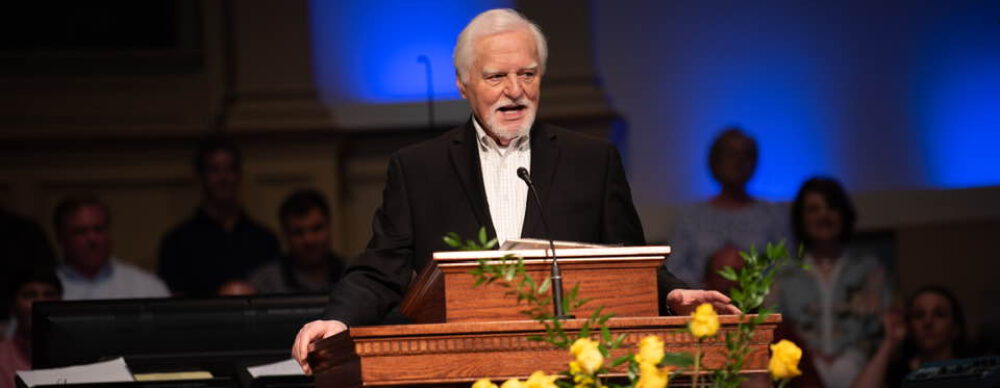
The pastor who teaches the congregation to pray

Now, it came to pass, as He was praying in a certain place, when He ceased, that one of His disciples said to Him, ‘Lord, teach us to pray as John also taught the disciples.’  (Luke 11:1)

The Lord’s people want to pray.

Most of the Lord’s people want to learn to pray.

You are the one to teach them effective praying, pastor.

You do know how, don’t you?

Granted, none of us do it very well. Even the great Apostle Paul said, “We do not know how to pray as we should” (Romans 8:26).  So, we are not saying any of us do it as well as we should, only that we know enough to be able to help others.

Here are some thoughts on the subject….

One. Model good praying for your congregation, pastor. “Being examples to the flock” (I Peter 5:3).

Two. Pray faithfully in the privacy of your home/office/car without ever telling anyone.  Let this be between you and the Lord.  Anything less turns us into hypocrites.  Telling people to do what we are not doing is never good.

Three. But in worship services, understand that people will be learning from you how to pray. They’re listening, and they are learning.

Four. Therefore, give advance thought to your public prayers.  Work on praying better and more effectively.

Five.  Always be aware that people are not only praying with you, but listening to how you pray so they will know how to do it better.  Even if they are not aware of it, they will be copying some of the things you do.

Six. . Teach them these things about public prayer:

Continue reading

10 signs your church is unhealthy

Recently, when an online magazine sent me an article on “5 signs you’re part of an unhealthy church,” I opened it eagerly. This subject is dear to my heart.

I am passionate about strong, healthy churches.

The writer’s five signs were good, as far as they went. No argument. I did not leave a comment one way or the other in response.

What I felt, however, is that my experience seems to be of another nature from the writer’s.

First, from that article here are “5 signs you are part of an unhealthy church”–

1) Leadership has no clear vision.

2) Leadership can never be challenged.

3) You are comfortable but never challenged.

4) Members are content with being pew warmers.

5) Outreach is never planned or preached.

All of these are true. But there is so much more.

Here, then, is my version of “10 signs (evidences, indications) that the church to which you belong is unhealthy”–

1. Prayer, if offered at all, is a formality, an afterthought, a burden.

While spending a long weekend at a pastors/wives retreat in Italy, I was struck by something. By the time I rose to speak, the service–by then a half-hour long–had experienced at least five prayers. The worship leader had followed a couple of songs with prayer, the presiding leader had prayed, and at least two more people with roles in the service had prayed. Each prayer had been spontaneous, heartfelt, and a joy. I knew then we were in for a rich time of Christian fellowship.

On the other hand, it pains me to remember the Sunday morning worship services where I was the guest preacher and noticed that by the time I stood to preach, not a single prayer–not one!–had been offered.

There is no more accurate indicator of a Christian’s spirituality or a church’s health than the vitality of our prayers.

Continue reading

What I hate most about my preaching

No one enjoys second-guessing himself, what Warren Wiersbe called “doing an autopsy on oneself.”

It’s possible to work ourselves into the psych ward or an early grave by over-analyzing every single thing we do and questioning the motive behind each word we speak.

No one is suggesting that.

And yet, there is much to be said for looking back at what we did and learning from our mistakes and failures and omissions.

That’s what this is all about.

It’s best done in solitary. (One of the worst things we preachers do is to ask our wives, “How did I do?” Poor woman. She’s in a no-win situation. Leave her out of it.)

A recording of our preaching helps. (But we have to promise to stay awake during the playback.)

That said, I’ll get to the point.

What I hate most about my preaching is when I intrude too much into the message.

Continue reading

What’s the worst part of pastoring?

“What’s the worst thing about being a pastor?” she asked. “What is your worst nightmare?”

She and I were Facebooking back and forth about the ministry when she threw this one in my direction.

She gave me her own ideas. “People writing nasty letters complaining? giving you advice? criticizing what you wear?”

I laughed and thought, “Oh, if it were that simple. No one enjoys getting anonymous mail trying to undermine your confidence in whatever you’re doing, but sooner or later most of us find ways of dealing with that.”

“It’s worse than that,” I typed. Then I paused to reflect.

Hers was such a simple question, one would think I had a stock answer which had been delivered again and again. But I don’t remember ever being asked it before.

Now, I have been asked plenty of times variations of “What’s the best thing about pastoring?” My answer to that is not far different from the response most other pastors would give: the sense of serving God, the joy of making a difference in people’s lives for Jesus’ sake, that sort of thing.

You knock yourself out during the week counseling the troubled, ministering in hospitals, visiting in their homes, conducting funerals and weddings, all while you are working on the sermons for Sunday, meeting with staff members planning upcoming events, and handling a thousand administrative details. Then, you stand at the pulpit twice on the Lord’s Day and give your best. And you see doubters begin believing, the fearful becoming courageous, the lost getting up and coming home to the Father, people saying God has led them to join with your flock, and broken homes restored –it doesn’t get any better than that.

You are in your glory.

Worst nightmare? Thankfully, I don’t have those. But I suppose my friend was asking for the scariest scenarios, the most frightening circumstance for a pastor. I have an opinion on that.

Here’s my response.

Continue reading

I prayed for my preaching–and got answers I did not expect

(This is a reprint of an article I wrote for Leadership magazine sometime around 2001. It was later picked up and included in “The Art and Craft of Biblical Preaching,” edited by Haddon Robinson and Craig Larson, published by Zondervan, 2005. In conversations with pastor friends, I’ve learned that many never saw the article and some have asked where they could get a copy. Please feel free to copy and pass along to other servants of the Lord.)

I had been preaching for more than two decades, and I should have been at the top of my game. The church I served ran up to 1,500 on Sunday mornings, and the live telecast of our services covered a fair portion of several states. Most of my colleagues thought I had it made, and if invitations to speak in other churches were any sign, they thought I could preach.

But I didn’t think that.

My confidence was taking a beating as some of the leaders let me know repeatedly that my pulpit work was not up to their standards. Previous pastors carried the reputation of pulpit masters, something I never claimed for myself. To make matters worse, we had numerous vacancies on staff and my sermon preparation was suffering because of a heavy load of pastoral ministry. But you do what you have to do. Most days, my goal was to keep my head above water. Every day without drowning became a good day.

That’s when I got serious about praying for my preaching. Each night I walked a four-mile route through my neighborhood and talked to the Father. My petitions dealt with the usual stuff–family needs, people I was concerned about, and the church. Gradually, one prayer began to recur in my nightly pleadings.

“Lord,” I prayed, “make me a preacher.” Asking this felt so right I never paused to analyze it. I prayed it again and again, over and over, for weeks.

Continue reading

When the church bully happens to be the pastor

Shepherd the flock of God among you, exercising oversight not under compulsion but voluntarily, according to the will of God; not for sordid gain, but with eagerness;  nor yet as lording it over those allotted to your charge, but proving to be examples to the flock.” (I Peter 5:2-3).

A friend wrote me about his pastor.

His pastor demands his way in everything, tolerates no dissent, and ousts anyone not obeying him.  He intimidates church members and dominates the other ministers.  His opinion is the only one that counts.

We could wish this were a rare phenomenon.  It isn’t.

The definitive bully in Scripture is Diotrephes.  I wrote something to the church, but Diotrephes, who loves the preeminence (“loves to be first among them” (NASB), does not accept what we say…. unjustly accusing us with wicked words; and not satisfied with this, neither does he himself receive the brethren, and he forbids those who desire to do so, and puts them out of the church (III John)

That’s the bully:  loving preeminence, rejecting outside interference, bringing accusation against the opposition, and putting people out of the church when they oppose him.

Invariably, when confronted, such a bully blames it on God.  “He put me in charge.”  “I’m the undershepherd of the church, answerable only to Jesus.”  “If you don’t like it, there are plenty of other churches where you would be welcome.”

Continue reading

The “poor me” pastor with the inferiority complex

“Why is everybody always picking on me?”  –1950s song by The Coasters

The biggest egotist in the room may be the wallflower who sits alone, absorbed in killer thoughts about his isolation.  “Why does no one talk to me?”  “They’re all snobs.”  “Why did I bother coming to this thing anyway?” I, I, I, me, me, my, my.

Over the years I’ve met quite a few pastors who were being victimized and brutalized by their own low self-esteem and their inferiority complex.  It’s tempting to say here that “it’s not a complex if you’re really inferior,” but that would be cruel.  This person afflicts enough mental cruelty upon himself/herself without outside aid.

The poor-me pastor is usually in one of three situations…

–In a dead-end assignment, pastoring a church with no prospects for a future in this world, at least.  He feels abandoned by the Lord and neglected by friends of influence who could give his name to other churches.

–Without a church.  He has been ousted by several churches in a row and now is considered radioactive.  No search committee wants to touch him.  As a result, he feels angry at God, bears a grudge toward his so-called friends, and is jealous of pastors who are succeeding and being acclaimed.

–Serving a church where the leaders and congregation refuse to respond to his leadership for one reason or the other.  I suspect that he is too negative and takes out his negativity on those around him.

This servant of the Lord is wrapped up in himself.  “I deserve better,” is a constant refrain.  “The other preachers have turned against me.”  “The denomination is not doing right by me.”  “For this I got a seminary education?”  “Why did I go to all the trouble and expense of getting my doctorate?” Why me? Why not me?  Pity me.  Poor me.

Pray for his spouse.  God bless her.

Continue reading

Oh servant of God, what were you thinking?

“…they exchanged the truth of God for a lie…” (Romans 1:25).

A pastor with a fine church, great respect, challenging opportunities, and a good income does the strangest thing. He arrives home from the monthly meeting of a denominational board and turns in his expenses (air fare, hotel, taxi, meals) to the church bookkeeper. She writes a check to repay him.

Eventually, it comes out that the denominational agency was also reimbursing him. He has been charging both the church and the agency for his expenses.

For a few thousand dollars a year, the man of God was willing to risk everything. (He was dismissed, as he should have been.)

What was he thinking?

A pastor with a great church and incredible potential discovers he can pull down an additional $20,000 a year by taking several groups to the Holy Land.  All his congregation sees is that their pastor keeps pushing these trips as a way to deepen their commitment and broaden their vision. They are not told that the travel company is paying him a commission.  When the membership finds it out, most are unhappy.  Nothing illegal was going on; this is accepted business practice. The problem was the pastor’s moonlighting and using his position of influence to pad his income on the side, without informing his leadership.

Continue reading

10 lessons about leading the Lord’s church I’ve learned the hard way

This is not the final list. I’m still learning.

Most of what follows about leading God’s church is counter-intuitive. Which is to say, it’s not what one might expect.

In no particular order….

One. Bigness is overrated.

“It doesn’t matter to the Lord whether He saves by the few or the many” (I Samuel 14:6).

Most pastors, it would appear, have wanted to lead big churches, wanted to grow their church to be huge, or wanted to move to a large church.  Their motives may be pure; judging motives is outside my skill set. But pastoring a big church can be the hardest thing you will ever try, and far less satisfying than you would ever think.

Small churches can be healthy too; behold the hummingbird or the honeybee.

Trying to get a huge church to change its way of thinking can be like turning around an ocean liner.  Even so, the Lord’s teachings about the mustard seed (see Matthew 13:31-32 and Luke 17:6) should forever disabuse us of the lust for bigness.

I will spare you the horror stories of pastors who have manipulated God’s people and lied about numbers in order to create the illusion of bigness.  Forgive us, Father!

Two. Lack of formal education in the preacher is no excuse.

Continue reading

20 things pastors should not love too much

“Do not be excessively righteous or overly wise” (Ecclesiastes 7:16).

I read somewhere that this was a favorite verse of Martin Luther, someone who apparently worried he would become too-religious-for-his-own-good.  No danger for most of us.

Here are some other areas you and I may want to be careful of…

One.  We should not be in love with the sound of our own voice.

The preacher who delights too much with his own voice will outtalk everyone in the room and drone on far longer in sermons than is wise.  Better to tame that critter, then put him to use in the service of the Lord.

Two. We should beware of loving those extra desserts.

More and more these days, the overweight preacher is the norm.  Sometimes the culprit is that he announced from the pulpit his favorite dessert to be lemon icebox pie or banana pudding, and now well-meaning church members keep him supplied.  Sometimes, it’s the church dinners where ladies bring a dozen or more home-made desserts that would tempt a saint.

Continue reading