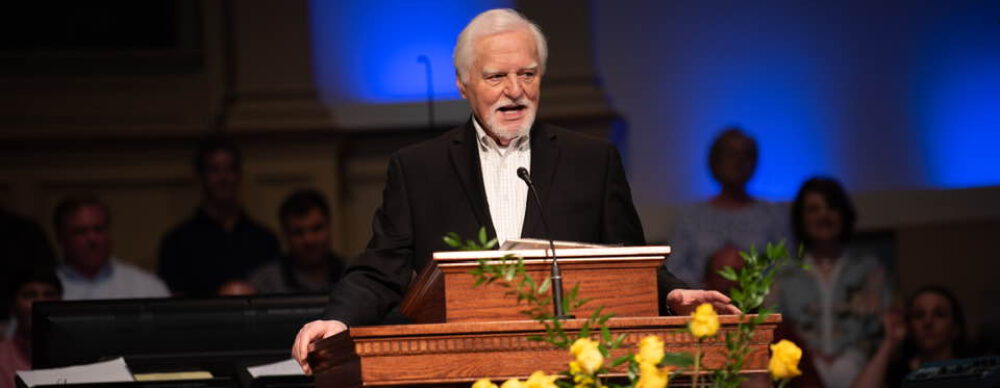
When the criticism of the pastor is unfair, what to do

If you can’t stand the heat, get out of the kitchen.  –President Harry Truman

Everyone who does anything will be criticized.  As a rule the critics are the do-nothings, the nay-sayers and spectators who sit in the grandstand and feed off each other’s negativism.

The man in the arena is the achiever.  As Theodore Roosevelt said, It is not the critic who counts, not the man who points out how the strong man stumbles, or where the doer of deeds could have done better.  The credit belongs to the man who is actually in the arena, whose face is marred by dust and sweat and blood, who strives valiantly, who errs, who comes short again and again, who spends himself in a worthy cause, who at the best knows in the end the triumph of high achievement, and who at the worst, if he fails, at least fails while daring greatly, so that his place shall never be with those cold and timid souls who neither know victory nor defeat.  

Here is how the great apostle put it–

We are hard-pressed on every side, yet not crushed; we are perplexed, but not in despair;  persecuted, but not forsaken; struck down, but not destroyed–always carrying about in the body the dying of the Lord Jesus, that the life of Jesus also may be manifested in our body.  (2 Corinthians 4:8-10)

That is your manifesto, Christian worker.  Take those words to heart.

Now….

Continue reading

The narrowness of the Lord Jesus Christ

All truth is narrow.  I heard that somewhere, and have not scientifically tested it to see if it’s always true, but  believe it to be the case.

People say of us Christians, “You are so narrow.”  And one said to me, “The Christ I know is not nearly so narrow-minded as you.”

I reply, “Where did you find this Christ? The only one I know of is found in Holy Scripture and He is nothing if not narrow.”

Consider these statements….

“No one has ascended to Heaven but He who came down from Heaven, even the Son of Man…””  John 3:13  Jesus is our authority on things celestial since He Himself is a native of that land.  Heaven is His hometown.

“No one knows the Son except the Father.  Nor does anyone know the Father except the Son and those to whom the Son reveals Him.”   Matthew 11:27 and Luke 10:22. Had we claimed that Jesus is the sole revealer of God, people of all the other religions would have complained.  But Jesus said it.

Continue reading

Christmas: Not the way we would have done it, Lord!

Imagine yourself as a living house. God comes in to rebuild that house. At first, perhaps, you can understand what He is doing. He is getting the drains right and stopping the leaks in the roof and so on; you knew that those jobs needed doing and so you are not surprised. But presently He starts knocking the house about in a way that hurts abominably and does not seem to make any sense. What on earth is He up to? The explanation is that He is building quite a different house from the one you thought of – throwing out a new wing here, putting on an extra floor there, running up towers, making courtyards. You thought you were being made into a decent little cottage: but He is building a palace. He intends to come and live in it Himself. –C. S. Lewis, “Mere Christianity”

God rarely does anything as we would have done it or expected it.

In the 8th century B.C., God told Israel, “Your thoughts are not my thoughts, neither are your ways my ways.  For as the heavens are higher than the earth, so are my ways higher than your ways and my thoughts than your thoughts” (Isaiah 55:8-9).

So, when God got ready to put His earth-saving plan into effect, we may expect it to be different.  Vastly different from how we would have done it.

The problem is spelled out in Psalm 50:21.  God says the people lied and cheated and did a hundred bad things.  Then, “These things you have done and I kept silent.  And you thought I was just like you.”

We think God is like us.  The ultimate folly.  We expect Him to do what we would do.  It just seems reasonable.

Continue reading

The cultural accommodation crowd has a lot to answer for

Do not marvel, my  brethren, if the world hates you…. They are of the world.  Therefore, they speak as of the world, and the world hears them. We are of God…. (I John 3:13 and 4:5-6),

First, they told us our language was too churchified and we would need to jettison such terms as justification, sanctification, and washed in the blood.

I remember Arthur Blessit. The hippie-looking, jive-talking, cross-carrying brother in Christ took the young churches by storm.  We stayed most of the night with Arthur at the local youth hangout witnessing for Christ, trying to look and sound cooler than the teens, picking up the drug culture’s language in an attempt to bring the gospel into a foreign land.  Heaven alone knows whether we did good. 

Then, they came at our music. Away with organs and pianos, and in with drum sets and keyboards and guitars.  Amplification on steroids and heavy metal, ear-assaulting, nerve-rattling instrumentations were not far behind.

No one is insisting that pipe organs and upright pianos are scriptural. But when ushers have to hand out ear plugs at the door, something is bad wrong. 

Continue reading

Why the righteous suffer

…and the prisoners were listening to them.  (Acts 16:25)

They’re always listening.

The world is constantly watching when God’s people go through disasters, experience heartaches, and deal with bankruptcies and setbacks.  How will the so-called “God people” handle these trials?  Will they grow angry and curse, lose their temper and drown their sorrows in the bottle? Or will they live up to this heavenly rhetoric they’ve been spouting?

The world wants to know whether our faith in Jesus Christ is just so much talk, just another religious alternative, or the real deal.

God is going to give us the opportunity  to convince them.

This might not be pleasant.  But it will be worthwhile.

Continue reading

The most difficult person in your church: The ungrateful one.

Why should I be grateful when things aren’t going to suit me? 

The woman “stood at His feet behind Him weeping, and she began to wash His feet with her tears, and wiped them with the hair of her head; and she kissed His feet and anointed them with the fragrant oil” (Luke 7:38).

There is the picture of a grateful person.  She is worshiping, humble, thankful, fully yielded to the Master.

Want to see a photo of an ungrateful individual?  Find any reference to a Pharisee and you have it. For instance…

“The Pharisee stood and prayed thus with himself, ‘God, I thank You that I am not like other men–extortioners, unjust, adulterers, or even as this tax collector.  I fast twice a week, I give tithes of all that I possess” (Luke 18:11-12).

Without knowing any more, you find your spirit recoiling from this guy.  He’s proud of his righteousness and will be harsh and judgmental toward anyone less committed.  He addresses God as an equal.  He is unteachable, unleadable, incorrigible.

Pity the pastor with Pharisaical leaders.  They are ungrateful, self-righteous, demanding, and a pain to live with.

Continue reading

Give thanks today. Rejoice now.

When we all get to Heaven, what a day of rejoicing that will be!

When we all see Jesus, we’ll sing and shout the victory.  (E. E. Hewitt, 1898)

Last Sunday, as we sang that wonderful old song, something occurred to me.  Sure, we’ll “sing and shout” the victory when we see Jesus face to face.  Anyone would.  But He wants us to “sing and shout the victory” now, in the middle of the battle.

Anyone can celebrate after the final whistle when the score is set in stone and no further plays are run.  But how many can celebrate the victory at halftime when battles are yet to be fought, when enemies wait to be faced?

Rejoice in the middle of the contest. Scripture is loaded on this subject…

–“He giveth songs in the night.”  (Job 35:10)  “In the night His song shall be with me–a prayer to the God of my life” (Psalm 42:8)

Continue reading

What you and I do with words

“Take words with you,” said the 8th century prophet Hosea, “and return to the Lord” (Hosea 14:2).

Does the Lord want to hear words?  Evidently.

Words are mighty important.

The Psalmist prayed, “Let the words of my mouth and the meditations of my heart be acceptable in Thy sight, O Lord, my Rock and my Redeemer” (Psalm 19:14).

Before Job’s friends launched into the attack against him, one set him up for the fall.  You used to be something special, said friend Eliphaz.  But look at you now.

Surely you have instructed many, and you have strengthened weak hands.  Your words have upheld him who was stumbling, and you have strengthened the feeble knees. (Job 4:3-4)

Imagine that, having the power to stand someone on their feet by the power of words.

Continue reading

The best church in every state

You see these come-ons all the time—

The best restaurants in every state.  The best small towns in every state.  The best town for retirees in every state.  The best beaches, best whatever.

So, don’t be surprised if you look up one day and someone has compiled a list of the best churches–best small churches, best mega-churches, whatever–in every state.  People are so shallow as to think such a list could be compiled and many will buy into it.

I’m by that the way I am the college football rankings.  Today, as I was driving back from a ministry assignment, for an hour or more I listed to the Sirius XM station where spots guys discussed last night’s college football rankings. LSU was one, Ohio State two, and so forth.  Back and forth they went: Shouldn’t Alabama be lower than 5th? Shouldn’t Baylor be higher than they are? Wisconsin too?  People called in and for an hour or more they argued.

For absolutely nothing.  Next week there will be a new ranking, based on this weekend’s games, and they’ll start all over again.  It’s what these sports-talk guys get paid to do.

But it’s so much foolishness.

Continue reading

What skills does a bi-vocational pastor need?

Paul was a tent-maker.  James and John, Peter and Andrew were all fishermen.  Matthew was a tax-collector.

Were they bi-vocational in their service for Christ?  Did they support themselves by working for a living while they spread the Word?

More and more, I hear pastors say that bi-vo is the way to go.  By supporting themselves they can start a church from scratch without having to solicit funds from supporting congregations until they become self-sustaining.  By supporting himself, a pastor cannot be held hostage by a church bully–or a committee of controllers–who insist that he do things their way to keep from losing his job and throwing his family into financial crisis.

What are the skills a bi-vocational pastor would need most?  Most, I expect, are the same abilities and strengths he would need in a full-time pastorate.  For instance…

Continue reading