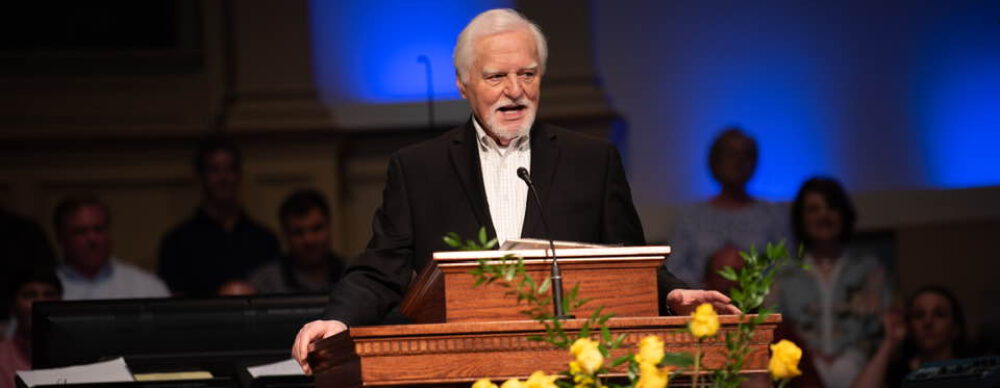
Shy? Sorry, No Place for That Around Here.

We all have our pet peeves. This is one of mine: People who excuse themselves from obeying the Lord or doing difficult tasks that would require them to stretch because, “I’m shy” or “I’m just not able to do that.”

Get over your shyness, friend. There is no place for shyness in the Kingdom of God, not if you’re planning on being obedient to the Master.

The Lord is going to be asking from you things you cannot easily do, and you will be forced to decide whether to give in to your reserve or to obey Him. You will not be able to do both.

The Lord will ask you to step out of the crowd and confess Him. “Who touched me?” Jesus asked, and called a woman to step forth and admit that it was she who had stretched out the hand of faith to the Savior (Mark 5:31).

For some of us, that means responding to the invitation at church next Sunday morning and stepping forward, into the aisle, to publicly affirm that Christ is our Savior and Lord.

The Lord will ask you to go into your world and confess Him. He said, “You shall be witnesses unto me both in Jerusalem and in Judea….” (Acts 1:8).

He said, “Whoever confesses me before men, him the Son of Man will also confess before the angels of God” (Luke 12:9).

He may ask you to suffer for Him. “Beware of men,” Jesus said, “for they will deliver you up to councils and scourge you in their synagogues” (Matthew 10:17).

Clearly, if one’s natural shyness is dominant, if it keeps us from letting others around us know of our commitment to Christ, if it silences us when to speak out would be costly or hard, our discipleship is going to suffer.

I’m only a Baptist preacher, let me admit here, and not a psychiatrist with insights into human personalities and psyches. So, what follows is not the last word on this subject, but if it moves the discussion along and helps someone to leave their cubicle of withdrawal for Jesus’ sake, it will be worth the effort.

Continue reading

The Bi-Vocational Pastor Assembles His Staff

A friend in Georgia who had read these articles on church staffs raised a good question: “How do do you begin to build a staff when the pastor is the only employee of the church, or even when you are bi-vocational?”

I sent the note to a friend in Alabama who knows all about the bi-vo business. While working full-time for a government agency, Bo has another full time job: pastoring a Southern Baptist church. And, a growing one at that. In fact, Bo’s church is sufficiently large to have two or more ministers on board full time. And yet, he and every member of his staff are bi-vocational.

A word about definitions. Bo called my hand on saying he is part-time at the church. “Hey, no minister is part time! No matter where you are, and no matter what you are doing, you are a minister of the gospel. There is no such thing as a part-time minister.” Good point.

So, how does Bo go about assembling a staff? Before telling you what he said, let me point out that he seems to have a great concept of whom to hire. The times I’ve preached for him, I’ve been impressed by the quality of the leadership of his team.

All right. Here are the eight principles that guide this bi-vocational pastor in seeking staff members….

Continue reading

The Happiest People in Town

Do you ever read a newspaper article that ticks you off?

In this morning’s USA Today, a full page is devoted to what they call “the Well-Being Index.” A beautiful 50-year-old skinny lady named Mary Claire Orenic is shown stretching yoga-like in front of a lush garden area. The caption across the top of the article asks, “Is this America’s happiest woman?”

She might be. I hope she is. However, not enough information is given for the reader to make that determination.

What information is given? What is the “Well-Being Index?”

I’m glad you asked.

It’s divided into three sections: Work, Health, Relationships.

Under “Work,” some of the ideals are: a college degree with some grad school; professional or executive class, and a family income of $120,000.

You didn’t finish high school? and you make considerably less than that? Sorry. You can’t be as happy..

Under “Health,” ideals are–and this is good–excellent physical and emotional health, BMI (body mass index) under 30 (30 and above is obese), and you exercise for 30-45 minutes at least 6 days a week.

Too bad if you are overweight or skinny and don’t belong to a gym. Can’t be happy.

Under “Relationships,” ideals are “married and never divorced,” 2 children (“Gives birth between ages 27-36); no caregiving for young children or sickly parents, in-laws or spouse; has 4-12 intimate friends.)

You have to take care of elderly parents or a handicapped child? Sorry, Charlie. Your happiness potential just tanked.

You can see why I did not care at all–not at all!–for this little exercise.

Now, to be fair, I imagine the author–well-known writer Gail Sheehy–would say she did this to spark the very kind of discussion we’re having here. That she didn’t mean it to be the final word on the subject.

Good thing. Because it ain’t nearly the final word.

Continue reading

Church Staffs: Rules to Live By

Recently I requested of some minister friends their advice and lessons learned concerning church staff relationships. What follows are some of the best of the responses. In no particular order.

1. Jim says, “Be very careful whom you trust completely.”

In over 3 decades of ministry, Jim says he has been brutally betrayed at least 3 times. It has made him wary about trusting anyone with anything confidential.

I’m recalling a time two churches ago when the personnel committee and I were dealing with a sensitive issue, long since forgotten. I said, “Can I say something in here and it not go any further?” The chairman said, “Pastor, I wouldn’t say anything in here you do not want to get out.”

That was a courageous thing for him to do. As subtly as he knew how, the chairman was warning me off from trusting some of the people in that room. In time, I learned he knew whereof he was speaking.

2. Andy says, “First, pastor the staff. Be their shepherd.”

Something inside us wants to protest, that, well, the staff are all ministers and they don’t need pastoring. They do. In fact, preacher, so do you.

I have heard that the typical ministerial staff wants the pastor to be their friend and the congregation’s pastor; the congregation, however, wants him to be their friend and the staff’s pastor.

My answer is: be both. I can pastor friends.

Continue reading

The Most Important Person In Your Office

The receptionist–the one who greets the public–is in many ways your most important staffer.

She is the first person most people see when they walk in, the voice they talk with on the phone, and the only one a lot of outsiders will deal with from your church.

Pastor, she can make you or break you.

She can be a light to someone coming in from the dark, lift the spirits of a visitor who ran out of hope miles up the road, defrost the spirit of Jack Frost himself, and protect the beleaguered pastor who desperately needs an hour of study time without interruptions.

She can do all these things and more. But she can also run people off faster than Sunday’s lousy sermon or Wednesday night’s cold ham and peas.

Where does one find a receptionist sent from Heaven?

Answer: Heaven.

Ask God. He knows them all, has full resumes on each person on the planet, and runs the best placement service ever. Pray.

Continue reading

The Pastor Assembles a Staff: Scary

Is there scriptural evidence for church staffs?

There is no text that says “Thou shalt employ other ministers on your staff to take some of the work from you.”

However, there is plenty of biblical evidence for multiple pastors in churches, and that may be (or may not be; our information about those churches is sketchy at best) all we require to proceed in this area.

(Of course, that brings up the question of whether we even need scriptural precedent for every decision we make, every ministry we branch into. Last Saturday night, in a restaurant in North Alabama, I met a group of Primitive Baptists. They were plenty nice, but once they found out I was a Southern Baptist pastor, it got strangely quiet.

In the few discussions I’ve had with leaders of that denomination over the years, they were defiantly insistent that everything they did had scriptural precedent and such things which churches like mine do but theirs do not are without biblical justification. It makes me think of the business of some people not eating meat; one wonders just how far they want to push that. Animal rights advocates have to decide whether to wear leather shoes and whether to swat that fly. Primitive Baptists–and all who insist they do nothing except on scripture’s command–may want to show us where in the Word they find justification for electric lights and machine printed Bibles.

I mean, the Lord gave us a brain and expects us to use it. Excuse me, I digress.)

In Acts 20, the Apostle Paul met with the elders (20:17) and overseers (20:28) of the Ephesian church. They are told to “shepherd” (pastor) the “church of God which He purchased with His own blood.” This is one of several scriptures that imply a multiplicity of pastors in the early church.

John MacArthur says, “In the NT, the words ‘bishop,’ ‘elder,’ ‘overseer,’ and ‘pastor’ are used interchangeably to describe the same men (Acts 20:17,28; Titus 1:5-9; I Peter 5:1,2).”

So, are staff members pastors of the church? In the larger sense, they are. They are extensions of the primary teaching/leading pastor. They are under his authority and their ministries extensions of his.

Show me a church with staff members not accountable to the lead pastor and I’ll show you a church asking for trouble. If there are exceptions, then please note that they are just that: exceptions.

In this and subsequent articles, I’d like to pursue the matter of pastors and their staffs. First, let’s consider what happens when a minister decides to seek out an addition to his ministerial staff. Even though the process can be wonderful and inspiring and can result in significant growth to the church, it is also perilous. Scary, even.

Continue reading

My Pastor Needs a Time Out!

Recently, a friend told how she was in a conference at her church in which various leaders were sitting around haggling over some issue. When one of the guys grew a little irritable, his wife said, “All right, Bobby. You’re in time out!”

The wife is a kindergarten teacher.

Pretty good idea, I think. Someone crosses the line and begins behaving badly, and we put them in time out. Maybe like hockey’s penalty box.

A pastor sent me a note, asking for my (ahem) famous instant assessment on his situation. He’s losing his passion for his ministry even though he knows he’s in the right place and there is nowhere he’d rather be. His sermon preparation is uninspired and much of the work of the ministry is drudgery to him.

I said, “This is a no-brainer. You are fatigued. You need rest.”

He did not argue, but started telling why his church was not going to allow him time away.

What would you think was the major reason the church will not grant him some quality time off? Answer: He’s bi-vocational.

What that means is that in addition to pastoring the church, he also holds down a full-time job in the secular world. So, to the congregation–this is him talking now–he’s part-time at the church. And what could possibly be stressful about a part-time job?

Faulty reasoning. Seriously faulty. His full-time employment carries a full quota of stress and pressure. As for the church job, there is no such thing as a part-time pastor. You are always the pastor and always on call. The work is never far from your mind. Your sermons are always incubating inside you, whether you’re having lunch at your desk or driving to the office. Church members rightfully feel if they need you, day or night, they can call.

Try telling them, “I’m not on duty right now. I’m part time.”

The fatigued pastor needs some time out.

Continue reading

How the Preacher Can Know If He’s Lazy

This should be a no-brainer, but apparently, it’s not.

I wrote a recent article on this website called “Things the Lazy Pastor Doesn’t Know–But is About to Find Out,” and was surprised at the reactions to it.

Now, I’ve done this enough to know that positive reactions usually go unsaid. That’s fine. Only the negatives draw responses as a rule.

Several pastors wrote to say that they’re not really lazy but stressed or pressured or unwell, and so the quality of their work has been suffering lately.

I understand, guys, believe me. Been there, done that. Forty two years of pastoring six churches, three years on the staff of another, and then five years as the director of missions working with over one hundred churches and their pastors. I know about pastors being under stress, dealing with pressure, and being too sick to perform their duties.

That’s not lazy, my brother. Not even close.

So, at the risk of offending another group of sincerely struggling pastors–the last thing I want to do, believe me–let me try another approach.

Let’s look at it this way: Ten Ways a Pastor Can Know He’s Just Plain Lazy. How’s that? (On Facebook, I’d put a smiley-face here.)

Continue reading

Self-Interest: Not a Bad Thing In Itself

An article in a recent TIME magazine looked into why people invest in self-destructive ways. I read it and thought, “They do all kinds of self-destructive things–from the way they invest to how they eat and vegetate on the couch and express their anger on the highways to neglecting their spiritual lives.”

“What Was I Thinking?” is the title of the TIME (October 4, 2011) article, written by Gary Belsky and Thomas Gilovich. Subtitle: “Why we often have trouble acting in our best financial interests.”

I was hooked by the title.

According to the authors, people are willing to walk several blocks to save $25 when buying an item selling for, say, $100. However, if the purchase is in the neighborhood of this time, say, $900, they are unwilling to walk the same distance to save the same amount of money. Why?

The answer lies in the field of “behavioral economics,” a relatively new area of study which considers how and why people make financial decisions. Since people often behave irrationally, behavioral economists look into the reasons why.

The reason people will walk blocks to save $25 for a small purchase, but will not do the same for a costlier one is also the reason people who are buying a $25,000 car will casually add on an optional feature costing $750, because, “Hey, what’s a measley $750 compared to the cost of the car as a whole?” And what’s $25 when compared to a $900 purchase?

Blind spots, the authors call them. Working against our own financial best interests.

Since the authors wrote the book, Why Smart People Make Big Money Mistakes–and How to Correct Them, we may assume the three reasons for the self-destructive investing patterns of people in the TIME article are just the tip of the iceberg.

After giving the three reasons, let’s draw some parallels in the spiritual realm.

Continue reading

5 Questions, 5 Answers On Giving to the Needy

1. People are calling our church office wanting help. They might be sincerely in need but they may be running a scam. Do we help them or not?

Every church on the planet deals with this. If your church is located near a freeway or close to an inner city neighborhood that has seen better days, the line of people seeking help can be unending. If that’s your church, I suggest you pull together a team of your very best people to work up a church policy on this ministry.

But, as to whether to give or not, we have a longer, more involved answer and a shorter, simpler one for you….

Longer answer: Most churches wanting to honor the Lord and bless the needy will work out a system of verifying the identity and need of individuals asking for help. Our church keeps a record of every person we minister to, so that no matter which minister or secretary deals with the needy one, they have the history in front of them. Another approach–one we recommend–is to join hands with other churches in your area and create a single community ministry staffed by great volunteers in order to treat needy people responsibly and honorably. When done right, this ministry can often create additional ways to bless the needy: job placement services, English as a second language classes, etc.

Shorter answer: “Give to everyone who asks from you” (Luke 6:30). –Jesus.

Now, that word from our Lord does NOT mean we have to give them a) what they ask for or b) as much as they ask for. The Lord does not send us into the world to be brainless or gullible. But neither does He send us to be heartless.

We are to give them “something.” And one more thing. If we must err in the church office, let’s err on the side of generosity, rather than cheapness.

It’s impossible to know about every person asking for help. Even if we get all the information and keep great records, once in a while we will be taken advantage of. The folks in the church office should take that as a fact of life; it will happen. But this does not mean we are failing and it’s no reason to refuse assistance to the next person.

2. What about giving to the homeless? Won’t they just squander it on booze or drugs?

Continue reading