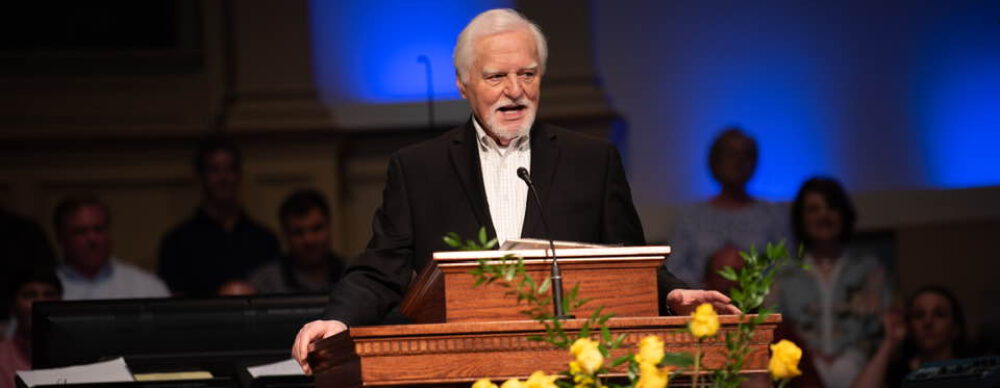
My Father’s Day Sermon: “What Do You Know?”

Our daughter-in-law Julie was teaching her girls–Abby and Erin, twins, they were 8 at the time–about childbirth. Abby did not like what she was hearing.

“I’m not going to have children, Grandpa,” she said. “It hurts too bad.”

I could not argue with that. I’ve been in the hospital numerous times over the years when my wife or my daughter or my two daughters-in-law were in labor. Nothing about it was easy on them or fun for them. They bring us into the world at great personal cost.

I said to Abby, “Yes, it does hurt. But the pain goes away and you’re left with this beautiful child. And you decide that it was worth it.”

This child looked me in the eye and said, “You’re a man. What do you know?”

When I picked myself up off the ground, we had a good laugh over that.

“You’re exactly right,” I told her. “I don’t know a thing about childbirth other than what the women in my life have told me.”

You’re a man. What do you know?

What do you really, really know? What do you know for dead certain? Not, what do you think or believe somewhat. Not, what is your opinion or even your conviction. Not, where is your membership or what is your affiliation.

What do you know?

The Apostle Paul answered that this way. “Yet I am not ashamed, because I know whom I have believed, and am convinced that he is able to guard what I have entrusted to him for that day.” (II Timothy 1:12)

Paul says, “I know the Lord Jesus Christ. I have total confidence in Him. I am dead sure that I have not believed in vain.”

When the Apostle John wrote about knowing Jesus, he said, “We know that we know him” (I John 2:3).

I know Jesus. And I know that I know Him.

Can you say that?

Where is the evidence that you know Jesus? I want to suggest three evidences or proofs that any of us know the Lord.

Continue reading

Why We Require Theologians

A friend from bygone days tells me why she is put out with most of the churches of her denomination. “There is this male/female thing. You cannot tell me that God in Heaven would rather have a fat, bloated, smug, egotistical know-it-all man as pastor of a church instead of a sharp Godly woman.”

I did not argue with that, and in fact, find that hard to argue with, if those are the choices.

If we asked, she has scripture to back up her position, too. The Apostle Paul put it like this: “For as many of you as are baptized into Christ have put on Christ. There is neither Jew nor Greek; there is neither slave nor free; there is neither male nor female; for you are all one in Christ Jesus.” (Galatians 3:27-28)

Open and shut case, right? Not hardly.

It’s true Paul said those things. The problem is he said a lot of other things too. He told how he does not allow women to speak in church (I Corinthians 14:34), cautions women who are prophesying (without ever telling precisely what that means) to cover their heads (I Corinthians 11:5), and then he really does it. The reason the man does not have to cover his head is “he is the image and glory of God,” whereas the woman “is the glory of man” (I Corinthians 11:7).

He said it and left it that way for us to deal with it the best we could.

The next time you hear someone panning the Bible as the result of some council that got together and made all this up, ask why they didn’t take the hard places out, but left them in to befuddle us for the rest of time.

Continue reading

Rhapsody on a Well-Loved Cliche

This happened years ago but David and I still laugh about it.

David was a deacon, a lawyer, and a young Christian who wanted to grow in his usefulness to the Lord. One day he asked to accompany me on my hospital visitation. “I’d like to get more comfortable visiting in the hospitals,” he said. “Sure. Great.”

A good thing for a deacon to do. For any of us to do.

The next morning around 7:30 we met in the medical center parking lot. We greeted each other and I made a couple of suggestions. “The first few patients we see, I’ll introduce you, but don’t say anything. Just pay attention.” Then, we went upstairs.

In 99 percent of the cases, hospital visitation is not rocket science (cliche!). It’s merely a Christian friend calling on another friend. Sometimes it’s big brother ministering to a hurting brother, and often nothing more profound than two old buddies chatting. Normally, my plan was to visit with the person no more than a couple of minutes, and if all was well, to share a verse of scripture (memorized, not read) and lead in a brief prayer of praise and commitment.

After the third or fourth visit, in the stairwell heading upstairs, I said, “David, in the next room, I’ll call on you to pray.” Fine.

A few minutes later as we left the patient’s room, in the hallway he said, “How was that?”

I said, “Well, normally that’s a good thing to pray. But I don’t think that a hospital room when a person is getting ready for major surgery you want to pray ‘Lord, help us to live this day as if it were our last.'”

He said, “Did I say that?” I laughed, “It’s all right. She didn’t seem to mind.”

It’s a cliche’ and not a bad one. The line was first spoken sometime in the decade of A.D. 170-180, thanks to the Roman emperor Marcus Aurelius. (He lived April 26, 121 to March 17, 180. He was a Stoic philosopher and seems to have been the type of ruler Plato had in mind with his concept of “philosopher-kings.”)

The exact quote from Marcus Aurelius: “And thou wilt give thyself relief if thou doest every act of thy life as it were the last.”

A note about cliche’s. They grew to be widely accepted and well-worn figures of speech for good reason: they served a useful purpose.

But as with most generalities, you don’t want to push them too far. An episode of “The Simpsons” bears this out.

Continue reading

Why Are You Still in That Church?

I’m about to raise a question I have no answer for.

A friend whom I’ve not seen in decades called yesterday. In the course of the conversation, when I asked what church he attends, he said, “There’s a tiny church near my house. I’m not sure why I still go there, they’ve had so many fights and splits over the years. When someone asked why I stay, I told him, ‘The Lord hasn’t led me to leave.'”

Why is he still there? Why hasn’t everyone left?

Up in the country, in the land of my youth, a number of longtime friends attend a historic church that meets only Sundays at 8 o’clock. The building has no heat or air, as I recall, and maybe no electricity–not sure about that. Yet, the crowd packs out the little building. They have their service and adjourn to their homes or to some breakfast restaurant. No Sunday School, no evening service, and nothing else as I understand it.

Why do they keep coming? What’s the attraction?

This week, a minister from another state introduced himself over the internet as a bi-vocational pastor of a country church. “Sunday morning only” is how he put it. The people stay for lunch–dinner, they probably call it–and go home. The pastor named another church, with membership in the thousands, where he attends Sunday nights and Wednesday nights.

I find myself wondering why the members of his church aren’t coming to the big church with him. What is the attraction to the small church with very little to offer?

Continue reading

Sometimes the Salt of the Earth Needs Sweetening

While researching a subject on-line the other day, I found myself reading some preachery attacks on other ministers. These men of God, assuming that’s what they are and I’m not saying they’re not, were taking no prisoners.

“That pastor is a liar!” “Preachers lie to you when they say….” “Ten lies preachers tell you.” “That preacher is an agent of hell!”

That sort of thing.

When those sent by the Father to be shepherds of His sheep use such blistering rhetoric, we fail our assignments in many ways: we dishonor the Lord, we shame the church, we needlessly slander our brethren, we set poor examples for the people in the pew, and we hold the gospel up to ridicule by the world.

How about a little sweetening, I wonder. And then I remember something.

Waylon Bailey, beloved brother who pastors the First Baptist Church of Covington, Louisiana, says there are two kinds of preachers: those who enter the ministry whole and those who enter in order to become whole.

Give me the first kind any day of the week. The second group can be scary and dangerous.

Continue reading

The Toughest Job in the Church

There are few easy jobs in the typical congregation and plenty of really difficult ones. My candidate for the hardest “elected” position is chairman of deacons.

The absolute toughest and most critical, of course, is the position of pastor. He’s the point man and so much rides on his faithfulness. A close second to that is the deacon chairman.

I say this in full recognition that in our denomination at least–the Southern Baptist Convention–deacons are a varied lot. What they do and how they minister is strictly up to the individual church. Some function as boards of directors, some are teams of servants, some work as a steering committee composed of chairs of every committee in the church, and some are true spiritual leaders.

But there is one thing true in 99 percent of our churches: the chairman of deacons is the number one lay position within the congregation.

On paper, the deacon chair is simply the moderator of the monthly meeting of his group. But in actuality, he (and in the rare instance, she) is the go-between for the pastor and the congregation.

The congregation is having a major problem that involves the pastor. Someone has to visit the shepherd for a confrontational sit-down with him. It falls to the deacon chairman.

Someone or some group within the congregation is out of line. They are attacking the pastor unfairly. For the shepherd to confront them seems self-serving and puts him on the defensive. Someone else needs to do this. The chairman of deacons inherits the job by default. There is no one else better situated.

When you are nominated by the church as a deacon, they convene a council to examine you, then the church ordains you. It’s a big deal. We need to do something just as significant when the deacons choose their leader. The job is the weightiest in the church when done well.

A deacon chairman needs four qualities; if he misses even one, the church could be in trouble.

Continue reading

Don’t Call It a Sugar Stick!

A church asks you to preach at the last minute and you pull out a tried-and-trusted sermon you’ve given several times and feel strongly about.

Another church asks you to preach months in advance and you preach that same sermon.

What’s going on here?

Some would say you are taking the easy way out by recycling an old sermon. “Grabbing something from the barrel.” “Preaching your sugar sticks,” they call it.

They are dead wrong. You are doing exactly what you ought to be doing and here’s why.

Continue reading

Pastor: What to Put On Your Resume’

During the years I served as director of missions for the Baptist churches of metro New Orleans, I must have received a hundred or more resumes from aspiring pastors. Some simply wanted to relocate, but most planned to attend our Baptist seminary and hoped to find a local church to pastor.

The resumes ran the gamut–everything from multi-paged mini-biographies to one-page skeletons. When I responded with a suggestion or two on how to make the bio more helpful to a search committee, the minister would sometimes answer that this is how he was taught to prepare a resume.

My response was: In the business world, maybe so. But sending a resume’ to a church is a different ball game.

Pastor search committees are rarely composed of professionals with a great deal of experience in combing through stacks of resumes. Most are salt-of-the-earth laypeople who do not understand the complexities of denominational abbreviations or the different types of seminaries and theological degrees. They are often easily misled by the unscrupulous.

You will want to be crystal clear, absolutely honest, and as helpful as possible in the way you compose your resume.

The “Jobs” section of our local Sunday paper frequently runs hints on preparing effective resumes. This week, the suggestions ran along the lines of: Length (one page is preferable), Priorities (leave out the insignificant stuff), Keep it Professional (do not list hobbies, numbers of children, etc), and Prepare Multiple Versions for different companies.

Almost none of that is applicable to a minister.

No doubt someone somewhere is advising young ministers on how to prepare helpful resumes. But knowing none of them personally, I will offer my take on the subject.

Continue reading

Old Books and New Insights

I confess. I am a bookaholic, a bibliophile. New books, old books, it doesn’t matter. Turn me loose in a convention hall where the public library is selling off their excess and I’m in heaven for two hours.

In Cincinnati, I discovered a used bookstore that filled several floors of an ancient downtown building. I could have moved in.

I know where the best used bookstore is in Jackson, Mississippi, and in Birmingham, Alabama, and never pass either city without a brief stop-in.

But there is reason to this madness. And it’s far more than a nostalgia kick. (There is that too, but it’s not the major thing.)

Take the 1943 book I finished today. Purchased for 5 bucks somewhere–I forget where–“They Call It Pacific” is an eyewitness account of the opening days and months of the Second World War by Associated Press reporter Clark Lee.

Reading the book was a delight simply because it was not history. Lee was there, he saw it, he told of the conversations, described the people, and let us feel what he felt.

And like a preacher ought, I received several good sermon illustrations from the book. But more than that, these are “life” illustrations, not just grist for the sermon-making mill.

But first, a little background….

In the late 1930’s and early 1940’s Lee worked out of Japan. He saw the build-up to war first-hand and was friends with a number of government officials and military officers who later became our hated enemies. He escaped the country in November, 1941, just ahead of Pearl Harbor and full-scale war.

Clark Lee was in the Phillipines when MacArthur was forced to flee and the Japanese captured the country. Along with other leaders, he relocated to the island of Corregidor and went back and forth to Bataan to interview American soldiers who were fighting alongwith the Filipinos. Then, as those last bastions fell, he hopped a boat to Australia. He arrived back in Hawaii six months after Pearl Harbor and described the recovery going on. Then, he was assigned to an aircraft carrier that took part in the fight for Guadalcanal.

The book ends after the first full year of American involvement in WW II. I found it fascinating on several levels, some of them because of illustrations the book provides.

Continue reading