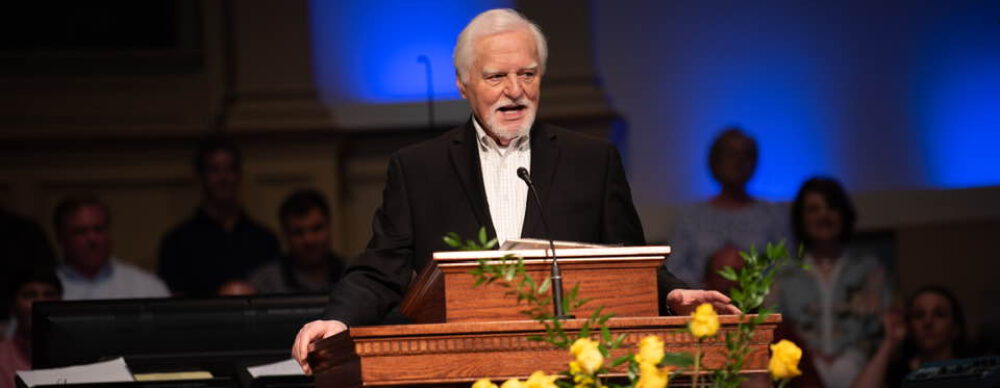
Praying Prayers of Faith

What if you tried this some Sunday soon….

While the pastor is in his Sunday morning prayer or a deacon is invoking the blessings of the Almighty on the offering, interrupt them.

“Pastor.” (Or, “Deacon.”)

“May I interrupt you for a moment?”

This is not normally done, so don’t be surprised if it takes a moment for it to get through to the one praying that he’s being summoned.

“What?” he says. “Shhh. I’m praying.”

“I know you’re praying. That’s what I want to ask you about.”

“You want to ask me about my prayer? Couldn’t this wait until after church?”

“No. It needs to be asked right now, in the middle of your prayer.”

“All right. What is it?”

“I just wanted to know what you think you’re doing. I mean, what is the point of this prayer? Where are you going with this?”

“I beg your pardon.”

“Well, your prayer sort of touches on half the issues in the world and doesn’t really dwell on anything, and I was just wondering. What exactly do you want the Lord to do?”

“What I want Him to do is to bless us, to bless this world. To be with us today, and to make this worship service special.”

“Oh. That’s good. You could have fooled me. I suppose that somewhere in the middle of all those words you were flinging heavenward there was that. But those requests were buried in the wordiness.”

“Uh, friend, are you rebuking me right here in front of the entire church?”

“No, not really. Because you see, I’m not really doing this. I’m just fantasizing about it. This is not really happening, pastor.”

“Well, good. Now, if you will excuse me, I’d like to get back to the morning prayer.”

Now, since we all agree that this scenario is not going to occur, I have an alternate suggestion.

Do it to yourself, to your own prayers. Interrupt yourself. Ask, “Where am I going with this? What am I seeking from the Lord? Or am I just filling the space with religious words, trying to make this worship service impressive to someone other than the Lord?”

We church people have created categories of prayers. We have invocations and benedictions. In between, we have pastoral prayers and offertory prayers. And, in most of our churches, that’s about it.

I have one more suggestion: how about prayers of faith?

Continue reading

On Your Way Out the Door

Nothing reveals the true character of a person–an employee, a boss, a pastor, a politician–like the way he/she exits a position, particularly when the experience has not been a good one.

In one church I served, they’re still talking about the way a former staff member exited–this was before my time, so I have no personal knowledge of him or the event–with great venom. The church was without a pastor at the time and the staffer had filled the leadership vacuum. When he left to go to another church position, he used his final pulpit time to unload on the leadership.

What causes a person to do that? What good do they think can possibly come from it? Or, at they just venting and trying to unburden themselves of their anger?

We have such a situation plaguing the city of New Orleans now.

We’ve written on these pages over the last three years of the so-called Recovery Czar brought in to organize the city’s rebuilding work after the devastation of Hurricane Katrina. His name was (and is) Dr. Ed Blakely. The mayor paid him big bucks, he sported a resume that was the envy of every city planner in America, and he walked in making with the big talk.

He became a laughing stock. An expensive laughing stock.

Continue reading

Why We Need Parables

Dwight L. Moody used to remind pastors to “put the cookies on the bottom shelf so everyone could reach them.”

What he meant–and what he practiced as well as it could be done–was, “Keep the message simple.” Make it accessible to everyone.

How many times have we sat in a class or church service that was numbing our brain and lulling us to sleep because of its “precept upon precept” style of presentation, when the speaker/preacher said those magic words that jerked us back to life: “Let me tell you a little story….”

We sat up and listened for a dozen reasons. We are built to enjoy a story (which is nothing in the world but a recount of how someone other than ourselves dealt with life; it’s how we learn), we love a good laugh, we devour great insights, and we appreciate the break in the flow of the lesson that day. But what we especially appreciate is that the story may help us grasp the contents of whatever principles the speaker was sharing.

Case in point….

Continue reading

How Jesus Learned to Love Parables

No one automatically comes into this world with their teaching techniques firmly in hand. We learn them from the people who teach us, we learn them by trial and error, we figure out for ourselves what works best.

Even though the Lord Jesus Christ was Who He was when He arrived–with all that the Incarnation means–we can safely assume that He learned somewhere along the way, growing up in Galilee, the value of a well-placed story.

But more than any other way, the Lord Jesus learned to love parables from Scripture. And by Scripture, we mean the Old Testament, since that was the only sacred text available at that time.

The parable has played a leading role all through the years of God’s dealings with His people.

Continue reading

Reaching Your Community’s Bill

Previously on these pages, I have told you about Bill, the carpenter who recently was saved and baptized in our church. I can’t get him out of my mind.

Bill had expressed to a fellow carpenter the spiritual hunger in his heart. He had no clue what to do with it. The friend said, “Come go to church with me.” Bill’s reply haunts me to this day: “How do I do that?”

The friend was as incredulous. “You just come. You park your car and walk in the front door and take a seat like you owned the place.”

Bill: “Anyone can just walk in?”

“Yep. Anyone.”

Bill did, heard the gospel preached, and responded enthusiastically.

I keep wondering how many other “Bills” there are out there in my community–and in your neighborhood.

You and I who have been going to church literally all our lives (and some of us several months prior to our births!) had no idea Bill existed. Surely, we thought, everyone in my town knows about our church, knows the gospel of Jesus, knows how to be saved, and knows they would be welcome where I worship.

Evidently, that’s not the case.

I grant you that it staggers our minds that anyone in our society could miss out on the Lord’s message with churches on every block and preachers on every station. But that may be the problem. They’re everywhere, so no one notices them any more.

In the months following Hurricane Katrina several of our New Orleans churches came up with some innovations that could hold the clue to reaching the “Bills” in my community and yours. I wrote something about them in the article dated January 15, 2007, (see the archives on our blog) and today went back and reviewed it for this piece.

Continue reading

For Believers Only

“The first account I composed, Theophilus, about all that Jesus began to do and teach until the day when He was taken up to heaven, after he had by the Holy Spirit given commands to the apostles whom He had chosen….” (Acts 1:1-4)

People sometimes wonder what Jesus was doing in the 40 day period sandwiched between His resurrection and ascension. We may not know all the answer to that, but we are given a lot of information in the first chapter of Acts.

During that time, Luke says, Jesus gave four things to his disciples: Commandments, Proofs, Insights, and Promises.

What makes this unique is that each of these is given only to believers, no matter how we would like to stretch it or spin it. Certain blessings and responsibilities are provided only to people of faith, and no one else.

The fact that the four gifts of Acts 1:1-4 are given only to believers sends a much-needed message to the Lord’s people today.

Continue reading

What I’d Like to Tell Your Church Leaders

We’re supposing here.

Suppose your church assembled a group composed of the following people: the pastor and staff, the office staff, the deacons, Sunday School teachers, committee members, and program leaders. And suppose I have 30 minutes to say anything on my heart. We meet in a room ideal for that size a group with no electronic devices or amplifications. I set up my easel in front and begin.

Now, supposing I had the undivided attention of the group, I would begin by telling this from Scripture.

A few weeks before Moses retired from the scene and Joshua stepped in to lead God’s people out of the wilderness into the Promised Land of Canaan, Moses had some final words.. The Old Testament book of Deuteronomy is the essence of what he shared, a recap of where they had been and what had happened in their recent past.

Moses strongly felt the need to impress one huge thing on God’s people as they were about to possess “a land of milk and honey.” We would call this a warning, in fact.

“You are about to come into a land filled with everything you’ve ever wanted. You’ll move into houses you did not build.

You’ll harvest crops you didn’t plant or cultivate.

You’ll drink from wells you did not dig.

You’ll gather grapes from vineyards and olives from groves you did not plant.”

“You will eat and be satisfied for the first time in your memory. And when that happens…

Beware lest you forget the Lord.”

Prosperity has a way of fogging up the spiritualities. Deadening the spirit. Dulling the memories. Derailing the well-intentioned.

Do not forget God. (Deuteronomy 6:12)

Do not desert God. (Deut. 6:14)

Do not test God. (Deut. 6:16)

Rather, be careful to obey Him. Do what is right in His sight.

And just in case anyone did not get that the first time, Moses repeated these words in Deuteronomy 8:12-14.

Leaders, your church is prosperous in a hundred ways. Your community is thriving. Personally, you are living at a higher standard than your grandparents ever dreamed of attaining. Furthermore, you do it with hardly a thought, as though this were the norm and anyone could do it if they worked as hard as you do.

You and I have forgotten how blessed we are.

Leaders, it’s time once again for you to:

–renew your thankfulness to God for His abundant blessings upon you, your church, your community, and this nation.

–recommit yourself to be faithful with what He has given you.

–restructure your lives to practice the faith you say you believe. The old structures (like some ancient bridges in this country!) do not hold up forever, but must be constantly inspected and often replaced.

Now, let me admit to you my minor disappointment with what Moses said.

Continue reading

Parables: “They Answer A Question”

(Southern Baptists are studying the parables of Matthew’s Gospel in 2010, and as we’ve done for several years, I’m leaving a few thoughts on the subject and we’ll have some cartoons here…if I can get them done. I was making better progress on the drawings before retiring, and since then I haven’t had the time!)

Consult the various texts and commentaries on parables–there is no lack of them–and you’ll find scholars are not in agreement on what constitutes one. Is a parable a story and always a story, the way they appear so often in Jesus’ teaching? We think of “The Prodigal Son” and “The Good Samaritan,” two of the Lord’s parables that are so well-known they have contributed expressions to the everyday speech of cultures all over the world.

No one doubts that those are parables, but what about “You are the salt of the earth” and “you are the light of the world”? (Matthew 5) Are those parables, too?

What about “whoever hears these words of mine and acts on them will be like a wise man who built his house on a rock”? (Matthew 7:24) That’s not exactly a story, but more of a hypothetical situation. Most collections of parables include it.

At this point, my temptation is to issue something of a disclaimer and say, “Now, not being a Bible scholar, but merely a preacher of the Word, what I plan to do here is….” But it doesn’t work that easily, does it? I am a Bible scholar, and so are you.

The word “scholar” does not mean “expert” but “student.” And aren’t you and I that?

This may give me the right to express my opinion on our Lord’s parables, say, and that’s what I am about to do. It does not, however, automatically make those statements carry equal weight with either the more learned or the more thoughtful. Readers should take everything I say (and all the writings of the “experts”) to the Lord in prayer and not passively accept it as “gospel.”

That said, here are my two statements for today….

One: for our purposes here, the Parables of Matthew will deal only with stories Jesus told, and not with metaphors, similes, and suppositions. That will allow us to limit the numbers to something more manageable.

Two: I’m suggesting as a way of looking at Jesus’ parables that each of them answers a question.

Sometimes the question is evident such as in Luke 15 when critics attacked Jesus for “receiving sinners and eating with them.” He told the parable we call “the prodigal son” to say why was He doing that. (Because they are lost!)

Sometimes the question is unspoken and we have to do a little sleuthing. And that’s the fun part.

Take the seven parables of Matthew 13. And right away, we’re faced with a difficulty….

Continue reading

Feeling Just Fine About Yourself

I’ve decided that my sketching capacity limit is set at four hours.

From 10 am until 2 pm today I sat in the hallway of Baton Rouge’s Crowne Plaza Hotel drawing participants in a statewide meeting of apprentices in various industries. One of the local businesses that participates hired me to represent them by sketching people on paper they printed for the occasion.

I did just fine for all four hours. But as I walked across the parking lot to my car, I realized I was pooped. I would not be good for anything the rest of the day. The 70 mile-drive home was about all I could have managed.

In mid-November, I’ll be sketching fellow Baptists at the annual meeting of the Alabama Baptist Convention in Huntsville for a couple of days. The state paper–the Alabama Baptist–has printed a poster announcing the hours I’ll be at their booth, from 9 to noon and from 1:30 until 4:30 that afternoon. That’ll work. But I can promise that at 4:31, I willl head back to the hotel room and collapse and not be worth shooting the rest of the day.

Something occurred to me today while–once again–trying to help the subject I was drawing deal with low self-esteem. It happens so frequently, I can see it coming a mile away. The party reluctantly slides into the chair opposite me, looks in every direction except mine, and when I manage to get his/her attention, refuses to look me in the eye. Asked to look at me and smile, the party mumbles a variation of “I don’t smile.” Or, “I don’t like my smile.”

Today, I said on two or three occasions with more than a little impatience, “Look, I could understand that if you were 13 years old. But you’re a grownup. Get over this. Everyone looks better with a smile, including me and definitely including you. Now, look me in the eye and show me a smile. You’ll like the picture a lot better.”

Then, when no one else was around, I tried something with this young woman.

Continue reading

The Church’s Achilles Heel

Everyone I know who is a regular and faithful member of a church has something of a love/hate relation with it. So many things about our church we love; somel we hate.

Friends gave me a book with the title, “Lord, I Love Your Church, But….”

I would have bought it for the title alone.

The problem with the church today….

How many conversations have begun with those words, I wonder. Everyone has an opinion on the weakness of today’s church, everyone sees her flaws, we all want her fixed and well and effective in our world.

Here is my take on the situation.

The major flaws in the Church of the Lord Jesus Christ today are not the result of the devil’s sabotage, the world’s opposition, or competition from other religions, as serious as all these are.

The church’s big problem is its friends.

Continue reading