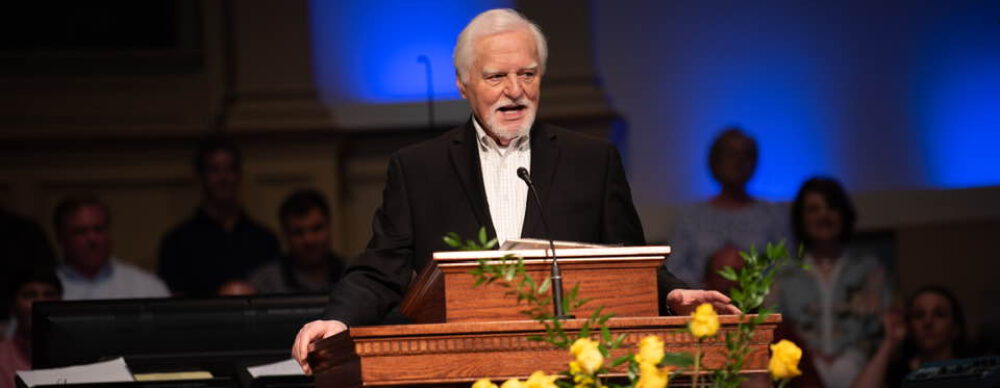
Passing of a Beloved Maverick

G. Avery Lee died on December 23 in Lake Charles. Readers with New Orleans backgrounds will remember this one-of-a-kind pastor who served St. Charles Avenue Baptist Church from 1961 to 1980. He was 92. A memorial service will be held at St. Charles Avenue Baptist Church (7100 St. Charles Ave) on January 30 at 2 pm.

The lengthy obituary in the Times-Picayune fills some of the gaps of my own knowledge of Dr. Lee. Prior to coming to New Orleans he served the FBC of Ruston from 1948 to 1961, and before that directed Baptist student work at LSU while serving as associate pastor of the FBC in Baton Rouge.

I was a student at our New Orleans Baptist Theological Seminary in the mid-60s, so had occasion to learn of Dr. Lee first-hand. After I became director of missions for BAGNO in 2004, he and I swapped a few notes and kept promising to get together. I regret that we didn’t.

Would it be too harsh to say that Dr. Lee took a special pleasure in being a burr-under-the-saddle to defenders of the status quo in our denomination? (The newspaper’s headline calls him a “pioneering pastor.” That’s one way of putting it, I suppose.)

Some quotes….

Continue reading

A Motorist’s Prayer

There’s a line where the Apostle Paul says in the last days men will be “ever learning and never coming to the knowledge of the truth” (II Timothy 3:7).

I don’t want to be too hard on such folks, because that describes me in more than one area. Last evening, for instance….

On the way home from the office, I ran by the neighborhood grocery store. I approach that parking lot with fear and trepidation because it has to be the most dangerous spot in town. Cars enter from all directions, people are walking everywhere, baskets stand where shoppers abandoned them, kids speed through on bikes as though they were in their backyards, and foolish drivers impatient to get home rush down the lanes as though they were on the highway.

One would think I would enter that parking lot on full alert and watching for trouble. Instead, after a long day filled with multiple meetings and conferences, my brain was operating on three cells and my eyelids were having trouble staying open. I spotted a parking space close to the front and veered in that direction. As I begin turning into the space, a panel truck roars into the lane. I’m already turning, but throw on my brakes and come to a halt just as he would have crashed into me. I turned the wheel to the right, giving up on that parking space, and as I drove past him, did something I would never do when my mind was working.

I rolled down my window and spoke to him.

Continue reading

Jimmy Stewart Deals With Fear

Not long after Pearl Harbor, the actor Jimmy Stewart joined the Army and became a pilot. Through two long years of training, he suffered stateside, wanting to join the action but being used, overused, and abused, he felt, by his military superiors who wanted him as a spokesman for the war effort and bond drives and who thought him too valuable a resource to send into harm’s way. Stewart chafed and complained and pulled every string he could, and finally arrived in England, ready to pilot the Liberator bombers in their runs over Germany.

He got what he had been hoping for. And for the first time in his life, he found himself dealing with fear on a massive scale. He was fine flying his plane into battle. What unnerved him was watching friends get shot down and thoughts of what could happen to him.

In “Jimmy Stewart: a Biography,” Marc Eliot tells of the young pilot developing a “fear he could not easily shake.” During the night before an especially risky assignment, “he lapsed into a fit of panic. Unable to sleep, he broke out in cold sweats, believing he would not survive that attack.”

Later, as he reflected on the fear gripping him at that time, he said, “I was really afraid… our group had suffered several casualties even before I knew I was going to have to lead the squadron deep into Germany… I feared the worst. Fear is an insidious and deadly thing. It can warp judgment, freeze reflexes, breed mistakes. And worse, it’s contagious. I felt my own fear and knew that if it wasn’t checked, it could infect my crew members.”

In subsequent flights, Stewart felt increasingly that he was not going to survive the war, that his plane would be shot down and he would be killed. Yet he knew that many a person with such fear does indeed survive and outlive the threat, and that his fear was both normal and deadly unless it was dealt with.

Continue reading

Still Hating Death

The e-mail Saturday said the young adult son of some longtime friends had been in a serious automobile accident and was in intensive care. The Sunday night phone call and the Monday morning e-mail said he had died. We are devastated for these precious friends.

No one who has ever raised a family thinks the time may come when they hold a funeral for their child. It’s unnatural, it’s not in the correct order of things.

The 1996 Christianity Today Book of the Year was “Not the Way It’s Supposed to be: A Breviary of Sin” by Professor Cornelius Plantinga, Jr. The title alone was worth the price of the book. It gives me a certain amount of comfort when looking at the world around us with its strife between nations, war between religions, and ugliness between families and friends to be reminded that this is not the order of things as the Creator set them up.

Plantinga says sin distorts our character, perverts human excellences, and both causes and results from misery. Sin produces death, and by that we mean both kinds: spiritual and physical.

The front page of the Times-Picayune in my city this morning tells of a fellow who murdered his 72-year-old mother over the weekend. Neighbors told the story of this hard-working, devoted mother who knocked herself out raising two boys by herself. She kept the cleanest house and neatest yard in the Carrollton section of New Orleans and, they say, she doted on her sons. She sang in the choir of her Missionary Baptist Church and was the centerpiece of her community. And now one of her sons has killed her. Police say he stabbed her and choked her. He admits it, saying he did it for drug money.

There’s something bad wrong with this world when this sort of thing happens.

In 1993, Woody Allen was asked to explain his incestuous affair (and later marriage!) with the Asian daughter he and Mia Farrow had adopted. “The heart wants what it wants.”

Continue reading

Sense and Nonsense

This cries to be made into a cartoon….

Grandpa was visiting his daughter’s family. After lunch, he told the family he’d be back in 15 minutes, that he was going to take a walk around the block. Two hours later, he returned. “Sorry I’m late,” he said, “but I ran into an old friend and he just wouldn’t quit listening.”

The other day, reading a biography of Franklin D. Roosevelt, I ran across a new term. The writer spoke of FDR’s accommodating himself to the polio that hit him as a young adult. When people would come to visit him or to assist him, he would talk them to death. The writer said, “Polio victims call this ‘walking on their tongues.'” The idea is that they feel guilty when people come to assist them and so feel they must try to amuse them by a constant stream of chatter.

I’ve not had polio, but I think I’ve found the phrase that describes my condition!

Some things that just do not make sense….

Why does Hamas feel it can use the Palestinians in the Gaza Strip anyway it pleases — even as shields and suicide bombers — to provoke Israel into retaliating, then when they do retaliate, accuse the Jews of cruelty and barbarity? At a pro-Israel rally I attended Thursday night with one of our pastors who had been asked to speak, another speaker quoted former leader Golda Meir with the best bit of wisdom I’ve heard in years on that situation: “There will not be peace in the Middle East until the Palestinian political leaders decide they love their children more than they hate the Jews.”

Continue reading

Life Lessons from FDR

You’ve seen Jonathan Alter on television news talk shows. He is a senior editor at Newsweek, a contributing correspondent (whatever that means) for NBC, and knows everyone on the political scene. His most recent book is “The Defining Moment: FDR’s Hundred Days and the Triumph of Hope.”

In this book Alter covers the beginnings of Roosevelt’s first term in the White House in 1933. Those “one hundred days” have long been chronicled and analyzed as a turn-around for our nation stuck in the depths of the Great Depression.

The reason I call attention to the book here — other than the fact that as a history student I find it fascinating reading and as an American citizen, I’m aware of the parallels between FDR’s situation and Barack Obama’s as he takes the leadership next week — is that Alter is a great story-teller and loves those little tidbits from history which make great reading and terrific gossip. They also work well in lessons you teach and sermons you preach when you’re searching for a fresh illustration.

Here are a few stories and quotes and insights from Alter’s book. (Incidentally, run down to Border’s or Barnes & Noble and you can buy it on the “bargain table” for 5 bucks instead of the $16 printed on the cover.)

–You know how during the Iraqi War people in this country hollered to high heaven about the Patriot Act which gave the government extraordinary powers to pursue terrorists. Well, here’s what Alfred E. Smith, the Democrats’ candidate for president in 1928, said about this same issue when this country was fighting Germany in the First World War: “During the World War we wrapped the Constitution in a piece of paper, put it on the shelf and left it there until the war was over.” (p.5) Lincoln did much the same thing during the Civil War and FDR ditto in the 1940s.

Continue reading

Owning the Church

I was driving down York Road in Charlotte, North Carolina, one day and was stopped in my tracks by a little sign in front of a small church: “For Sale. By Owner.”

Who owns the church, I wondered then, and I wonder now.

In national news, a court in California has determined that the national office of the Episcopal denomination owns the church buildings and grounds of several congregations which are pulling out in order to protest the gay agenda of national religious leaders. No matter that the members of those congregations are the ones whose offerings paid for the buildings; what counts is that each congregation had covenanted with all the others of their denomination that the national office would hold the title to every church. The idea was — and is — to keep renegade pastors from stealing entire congregations.

In our own city, after the Catholic diocese of New Orleans made the tough decision to shutter some of its church buildings following the devastation of Katrina, a lot of long-time parishioners have been unhappy. Two churches in particular have received the brunt of their frustrations.

Continue reading

King’s Day 2009

January 6 each year is “King’s Day,” a tradition originally established to honor Baby Jesus. Someone centuries ago estimated that the Magi arrived in Bethlehem on this day and since they worshiped Him as “the King of the Jews,” ta-da—King’s Day.

Bakeries all over New Orleans are turning out King cakes. If you have ever lived in this area, you need no explanation. These pastries are calorie-rich and more expensive than they should be. Think of taking enough dough to make a cake, spreading it out flat, cutting it in strips, and then braiding the strips together and forming it all into a huge ring (of various sizes, but most are large enough for you to poke your head inside!). Inside or on top of the cake, you’ll find cinnamon and colored sugar and various kinds of fillings. And one more thing.

There’s a baby inside.

Supposedly representing Baby Jesus who was hid from King Herod by Joseph and Mary, the “doll” is plastic and an inch or two long. Just the ideal size for you to choke on it or break a tooth if you happen to bite down on it. That’s why some bakeries have discontinued hiding the baby inside the ring and including it inside a cellophane baggie.

The custom originated sometime in the past that when friends share a king cake, whoever ends up with the baby has to buy the next cake. And that has been the cause of friends falling out with one another! As I said, they’re not cheap.

Continue reading

Cultural Differences

Years ago, an African-American friend showed me the worship bulletin his church had prepared for the memorial service of a mutual acquaintance. At the top of the page, I was surprised to read: “The Funeralization of John Doaks.”

Until that moment, it had never occurred to me that a funeral for my people was a funeralization for his. It was the first of an unending line of reminders I’ve received over the years in the ways blacks and whites in this country do things differently. Some readers of this blog reside in other countries — in recent days, we’ve heard from South Africa, New Zealand, Australia, and this morning from Scotland — and they may be surprised to learn while we’re all fellow citizens of the USA, our cultures are vastly different in many ways.

Saturday’s memorial service — they called it a celebration; I like that — for Pastor Marshall Truehill was unlike anything you will encounter in an Anglo service in this town. I counted the names of 17 ministers in the printed program. At one point, host pastor Dr. Dwight Webster (we were at neighboring Christian Unity Baptist Church) asked all ordained men and women in the audience to stand and introduce themselves; there must have been fifty.

I’ve paid tribute to Marshall in previous articles on this website, so I’m confining this to a few things readers will find interesting.

Continue reading

When to Retire and What to Do Then

With all the bowl games coming at us over this long Christmas-New Year’s holiday week, I have found myself wondering something. Why don’t coaches like Joe Paterno and Bobby Bowden retire? JoePa is in his 80s and Bobby is pushing 80. Yet, they hang on.

Brett Farve hangs on as a football player, as does Barry Bonds in baseball. You can think of others.

My question, incidentally, has nothing whatever to do with the win-loss record of the coaches. Paterno took his Penn State Nittany Lions to the Rose Bowl this year, so there may be a tendency to say, “Well, he can still do the job.” Bowden’s Florida State Seminoles went to a lesser bowl, but still had a fair year.

The question, “Why don’t they retire?” has more to do with what is the essence of living for these men.

In his World War II memoirs, “Flights of Passage,” aviator Samuel Hynes tells of a sergeant-major he knew in the war. The man was approaching mandatory retirement and everyone who knew him was concerned. He had no family anyone knew of and he spent all his time — all of it! — on the base doing military stuff. One day, they found his body in the office of his commanding officer. He had ended his life with a pistol.

He was afraid of life after the military.

And that, I offer to you as a proposal just to get the discussion started, is the reason people hang on to their jobs long after they should be handing them off to the younger generation: fear.

Fear of coming home to the family. Fear of having to face who they are when they’re not the coach or quarterback or pastor (or director of missions). Fear of what to do with their time and their lives. Fear of being considered old. Fear of fear.

Fear of life is a real problem.

Continue reading