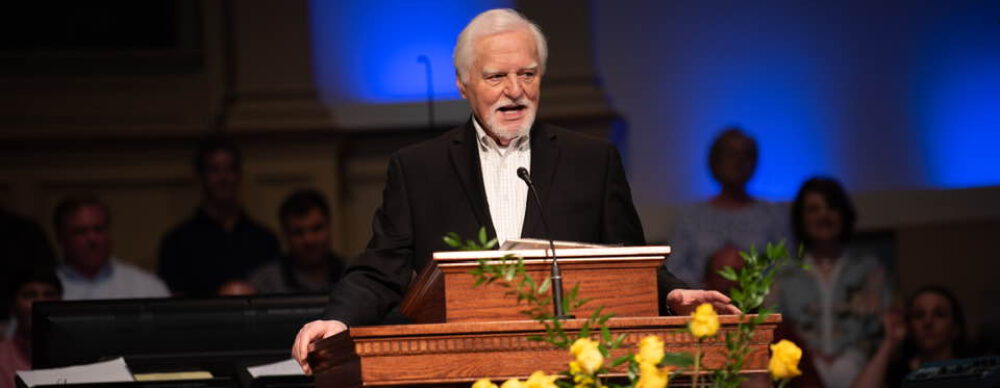
LEADERSHIP LESSON NO. 36–“Speak Well But Don’t Overtalk”

The number one tool in the leadership kit is words.

Opening our mouth, we utter sounds which others recognize as meaningful words and which we hope to have arranged in such a way as to inspire, instruct, and encourage, and once in a while rebuke. That’s a pretty hefty order for something as simple as words, but we’ve all seen people do it. We remember Churchill’s words in 1940 and Martin Luther King’s words in 1963 and we thrill at the power of speech well-chosen and powerfully delivered.

I’d like to do that, we all think to ourselves. We imagine the effect of speaking just the right words and watching lives change before our eyes.

If the number one tool in the leader’s kit is words, I daresay the number one failing of leaders, and especially the preacher-kind-of-leaders, is overtalking. It’s not that we did not use some great words in our talks, our sermons or our prayers; it’s that we surrounded those wonderful words with so many other words that we ended up devaluing their worth and weakening their impact.

Ask one of us preachers a question and 15 minutes later, we pause for breath and ask, “What was the question again?”

Shame on us.

Continue reading

This Christmas Season

As Rosanna Rosannadanna said, “It’s always something.”

My niece Deanna’s house burned down Friday night. She lives a city block from my Mom, but Mom slept through the fire trucks that finally extinguished the blaze. She lost everything.

Fires are not unknown in our family. Until the death of my brother Charlie in 2006 and our father’s death on November 3, 2007, the most defining event in our family was the burning of our house in February of 1954. It came when all 6 children were still living at home and a month after Dad had lost his job. Twenty or more years later, Charlie’s house burned.

We know all too well the pain caused by such things. Deanna has health problems too and frankly, this was the last thing she needed. We will appreciate our friends praying for her.

I’m about to do something here I never do: tell you what we’ve been doing, where we went, and such.

Continue reading

Homes for the Holidays

The big controversy raging in our city these days has to do with the planned demolition of five shuttered housing projects to make room for planned multi-level-income housing. No one is neutral on the subject and everyone has “the truth”.

We need housing for the poor. The test of any society is how it takes care of its poor. We have to get the homeless out of the parks and off the streets. Demolish those projects and you will multiply the number of homeless in New Orleans. Save those buildings.

Those projects were breeding grounds for crime and violence. They provided sanctuary for drug pushers and a haven for gangs. We do no favor to the poor of our city when we relegate them into the saddest accommodations on the planet where they will be victimized by the ruthless and terrorized by the ungodly. Tear down those buildings.

The New Orleans City Council is on the spot and has to make the ultimate call. Citizens on both sides of this issue are bombarding council members with emails, phone calls, letters, and visits.

One council member shared some of the emails she is receiving with the Times-Picayune, and they were printed in Sunday’s edition.

Beth Pesses is a nurse at Charity Hospital. “For 32 years I have served the poor in our community. I have wiped their tears, bandaged their wounds and prepared their bodies for the morgue. Very few people have more empathy for the poor in our society than Charity nurses. But the housing projects are not the answer… The combination of asbestos, lead paint and violence are three community health issues that nurses are interested in on an international level. But nurses need their leaders to back them up. We need our leaders to stand up to those who are demanding, some through violent means, to reopen these unhealthy environments. We look to our leaders to use their knowledge and expertise to make the RIGHT decision and not just the most popular one.”

Erin O. Stopak is with Talbot Realty Group. “My wife and I are very politically active New Orleanians, and understand y’all are in a ‘no-win’ situation in regard to the tear down of public housing units. Whatever or however you choose to vote will anger somebody. Please know that myself, family, and friends all want what is best for the future of this city, and most importantly fair to former public housing residents displaced by Katrina. PLEASE DO NOT BLOCK THE TEARDOWN OF ANY PUBLIC HOUSING UNITS!!!!!!!! Katrina was a horrific event, but has given us the chance to rebuild our city correctly, and break the cycles of poverty (which) trapped so many of our residents for generations.”

Then, two on the opposite side of the issue.

Continue reading

Christians Should Choose Their Fights Carefully

“A dog can whip a skunk,” the old-timer said, “but it just ain’t worth it.”

Some fights ought to be called off; they’re not worth the trouble and if you win them, you haven’t got much.

Just north of New Orleans lies the bedroom community of Slidell. Earlier this year, the courthouse there became ground zero for a contest between the ACLU and the political establishment as well as the religious right, all because of a picture of Jesus hanging on the wall. Defenders of the picture spoke of the Lord’s being our Lawgiver, of the debt our society owes to Him, as well as the worthiness of the painting from the standpoint of art and antiquity. The ACLU, to no one’s surprise, wanted it down, period. They said the picture was violating the well-known rule against blending religion and public life in a pluralistic society like ours.

The courts got involved and were equally divided. Then, as the ACLU folks fumed and threatened, the Slidell people did something rather brilliant. They left the picture up, but added some more. I’m not sure who’s images are now adorning the wall in addition to the first one, but presumably they were founders of other religions and other noted lawgivers.

Just like that, the furor died down and the controversy went away.

This Christmas season, like the last several, we’ve been treated to the spectre of Christians speaking out against greetings which omit “Merry Christmas” in favor of “Happy Holidays” or the like. Now, I’m a conservative, almost-but-not-quite-right-winger–the type who would love to have Mike Huckabee as president, for example–but I am really amazed at this controversy.

It’s probably not necessary to remind my brothers and sisters in Christ that this season of the year is not just for Christians. Everyone has the same calendar and every sect in the world has its own celebrations. In America at this time, the Jews have Hanukkah and our African-American friends have Kwanzaa.

Frankly, that’s fine with me, although…

Continue reading

My Favorite Christmas Verse

“Unto you is born this day in the city of David, a Savior, who is Christ the Lord.” (Luke 2:11)

It should go without saying that the angels from Heaven know a lot more than you or I do. And when Jesus was born in Bethlehem and they brought the announcement to the shepherds on a dark hillside nearby, they identified Jesus as “a Savior.” Check any dictionary and you’ll find the obvious: the word means “one who saves.”

I once pastored a church which used to have a blue neon sign out front which beamed out the message JESUS SAVES. They took it down in the 1950s, I think, but have never asked anyone the reason. I think I know. People are embarrassed by that message. Erect it on the front of a church building, and immediately people think you are a bunch of holy rollers or religious nuts. And since we all want to appear dignified and respectful, they took it off the building and probably sent it to the trash heap.

Read a thousand Christmas messages–cards, advertisements, songs, sermons–and you’ll find very few dealing with the salvation aspect of Jesus’ coming to earth. And yet, according to the angels, that was the whole point of His coming! He came to save us.

In fact, that’s what His very name means. “You shall call his name Jesus for He shall save His people from their sins,” the angel Gabriel had told Joseph (Matthew 1:21). The literal meaning of ‘Jesus’ is something like ‘The Lord saves.’

All of which begs the question: SAVED FROM WHAT? And to what? The New Testament is filled with answers to both questions, and I’ll let you do your own spadework on that. But in essence, it tells us we are saved from ourselves, from our sins, from the penalty for our sins, from this perverse generation, and such. We are saved to new purpose in this life, to Heaven in the life to come, and to all the plans and promises of God.

I hate to argue with Christmas cards–they can be so beautiful and inspiring–but Jesus did not come to bring peace on earth according to His own words (Matthew 10:34). He did not come to make everyone feel good about themselves or the human situation. He did not come to bless religion or to tell everyone they are loved and beautiful in God’s sight. He came to save us.

That’s what His death on the cross was all about. It was the culmination of the very purpose for His appearance in the first place. A gospel song about His death puts it like this: ‘Don’t feel sorry for my Jesus; He did exactly what He came to do.’

Continue reading

Wondering About Christmas

“And there were in the same country shepherds abiding in the fields, keeping watch over their flocks by night.”

Have you ever wondered what those shepherds and their flocks were doing outside in the open in the dead of night? How many sermons have we heard over the years describing how shepherds put their sheep inside the shelter at night, and then lay down across the door opening, giving illustration to our Lord’s teaching that “I am the door of the sheep.” (John 10)

Some writers say shepherds in that part of the world kept their sheep outside from March through November. Maybe that’s the reason. I wonder.

Have you ever wondered if there were other shepherds in nearby fields at the same time? And why only these shepherds were chosen as the earthly audience for the very first Christmas pageant ever, and this one the standard by which to judge all the succeeding ones?

Is it because only these shepherds were available? We do know that God puts a high prize on availability, more than on ability itself.

Were these shepherds the only people available?

“And lo, the angel of the Lord came upon them, and the glory of the Lord shone round about them, and they were sore afraid.”

I guess they were afraid. I would have been frightened out of my wits.

Have you ever wondered what that scene looked like? And if other people in other fields could see this heavenly vision? Would they have seen a bright light in the sky coming from the acreage these particular shepherds had staked out? Or would they have seen nothing at all, even had they been nearby?

“And the angel said unto them, ‘Fear not. For behold, I bring you good tidings of great joy, which shall be to all people.’

Fear not. Oh yeah. Easy for you to say, angel.

Continue reading

LEADERSHIP LESSON NO. 35–“Humor is Good; Don’t Overdo It.”

I was 27 years old with a new seminary degree and ready to take on the world. We had driven up from the bayou country of Louisiana to Greenville, Mississippi, to visit Emmanuel Baptist Church for a trial weekend. If we liked them and they liked us and if we all agreed God was “in this,” then I would become their new pastor.

I had pastored two small churches before, but this was my first “trial weekend.” Those are well named, incidentally, for they are trials for everyone concerned. That’s why I did what I did that Sunday morning.

I told three jokes at the sermon time.

During the worship service, someone introduced Margaret and our small boys and presented me. I walked to the pulpit, smiled at the expectant congregation, and opened my mouth to speak. Up until then, I had done fine.

First. “This is my first time to preach in Mississippi. I’m delighted to be here, and particularly glad to see you’re all wearing shoes.”

Okay, not a joke, but I meant it as one. They actually laughed, which was all I wanted. They knew I was teasing them about the reputation for backwardness Mississippi has.

Second. “Preaching here today–and you and I looking each other over–reminds me of the country preacher who was in the same situation I’m in today. He looked out at the congregation and said, ‘There is a powerful lot of wonderin’ goin’ on here today. You are wonderin’ if I can preach, and I am wonderin’ if you know good preachin’ when you hear it!'”

Again, it got some laughter. It’s not a knee-slapper, but a pleasant bit of humor. Up until now, I was okay. This was the time to move into the sermon. But I didn’t. I had another joke, the best one yet.

Third. “Flip Wilson (African-American comedian everyone was familiar with in 1967) was portraying a Black preacher in this same situation on his television program. You know how the congregation answers the preacher in their churches. He looked out at the people and said, ‘If I’s called to be pastor of this church, this church is going to WALK!’ The people called back, ‘Let ‘er walk, boy, let ‘er walk!'”

“The preacher said, ‘If I’s called to be pastor of this church, this church is going to RUN!’ They said, ‘Let ‘er run, boy, let ‘er run!'”

“The preacher said, ‘If I’s called to be pastor of this church, this church is going to FLY!’ They said, ‘Let ‘er fly, boy, let ‘er fly.'”

“The preacher said, ‘If this church is going to fly, it’s going to take money!’ They said, ‘Let ‘er walk, boy, let ‘er walk.'”

(Hope I don’t offend anyone by printing the joke in dialect, but that’s how he said it and it’s the only way to tell it. The teller has to raise his voice in the appropriate places to make it work, too.)

It is a funny story. They laughed, and finally I went into my sermon. Oddly, I have long ago forgotten what the sermon was about, but will never forget those three little jokes. The reason I remember is what happened afterward.

Continue reading

Special to Pastors: “What Your People Want to Hear at Christmas”

Many of the people in our churches have one thing in common with the Athenians whom Paul encountered on his second missionary trek: they love to hear new things. If a sermon does not present some new idea, enabling them to walk out with a ‘I never thought of that before,’ the message just doesn’t work. To many, the harshest criticism of a sermon is “I’ve heard that before.”

Now, being a preacher with a strong desire to please–to have people walk out of church feeling they’ve received something really special that day–I’ve sometimes fallen into that trap. I have found myself reading Scripture in search of exotic texts, those that surprise me with stories I’d never noticed, insights I’d never found, principles which I knew would excite my members. But, as I say, it’s a trap.

There is a reason ‘Amazing Grace’ is the most popular hymn in America. And reason aplenty why subjects like ‘Salvation by Grace’ (Ephesians 2:8-9), ‘The Inspiration of the Scriptures’ (II Timothy 3:14-17), and ‘Heaven’ (John 14:1-6) are such familiar subjects most of us could preach at a moment’s notice with no preparation at all. They connect with the deepest needs and hungers of people.

I cannot speak for other pastors–I know only my own situation–but I cannot count the times when in my study I have come across these and other well-known (i.e., much-loved and oft-preached) texts and considered adding them to the preaching schedule, only to back away. They just weren’t exciting enough.

My reaction might not have been so obvious but it feels like the worshipers in Malachi’s day who turned up their noses at the Lord’s offerings, saying, ‘What a weariness.’ In the old days, the Lord took that as an insult.

The grand themes of Scripture are grand for a reason: they have ministered best to God’s people over the centuries. As someone has said, ‘Cliches came to be cliches for good reason–they carry great truth.’

I sat across the table at a fast food restaurant chatting with a young pastor who was struggling to find his way. I had seen enough of his work to feel he was getting off course, that his preaching was too negative, and his people were becoming restless and discouraged. I said to him, “My friend, preach the great old truths. The love of God. Grace and mercy. Forgiveness. The joy of the Lord is your strength. The incarnation of Jesus.”

I said, “Now, I can just hear the enemy whispering in your ear that these are boring subjects. But he’s lying. These are the diamonds in the field. These are the sermons that will minister best and accomplish most for your hurting people.”

It took years, but I finally came to take my own advice.

Continue reading

About New Orleans and the Bowl Games

The city is excited that in the post-season arrangement of college football games, New Orleans gets the two biggest contests. On January 1, the Sugar Bowl features Georgia versus Hawaii, the only unbeaten team in the “big” division of the NCAA. Georgia has lost two games but many people call them the toughest team going right now. They want to prove that, while Hawaii wants to show they can play with the big boys.

Because of their unblemished record, Hawaii claims it should be in the BCS championship game which will be held in the same arena, the Louisiana Superdome, on January 7. That game features LSU against Ohio State.

The two biggest games of the season, and we’ve got them. On Tuesday after the Sugar Bowl, the Georgia/Hawaii guests will be leaving town the same day the LSU/Ohio State people are arriving. Look for gridlock.

I said to my dentist, “So, who are you pulling for on January 7?” The framed certificates all over his walls bely his Ohio State roots.

“Not even close,” he said.

I pointed out that I’m from the state of Alabama, but pulled for LSU against the Crimson Tide this year.

He said, “But you didn’t attend Alabama.” Nope. Birmingham-Southern. But we didn’t have a football team, and Bear Bryant had just arrived as the Alabama coach, so we all adopted the Tide and quickly became ardent supporters. I’ve gone to many of the Alabama games and have my own Bear Bryant stories.

“Not the same thing,” he said. “When you live on campus and the Saturday football game is the biggest thing going and you sit in the freezing stands with your sweetheart and your fraternity brothers–you are forever bonded.”

I guess so.

Continue reading