The Glamour Wears Off
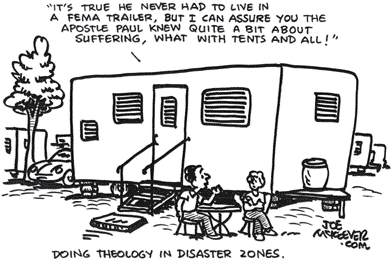
Keisha Moran was living in Waveland, Mississippi, with her small children when Katrina destroyed their home along with the town. Oprah Winfrey found them living in a tent on a parking lot and featured their story on national television. Leaders from St. Paul United Church of Christ in Palatine, Illinois, a half hour northwest of Chicago, took pity and invited her family to move into the church parsonage rent-free. The idea was to give her enough time and opportunity to start afresh.
It’s a nice home–two story, three bedroom, located next to the church. Members fixed up the house and moved Keisha and her children in last September. What the two parties did not do was have a clear understanding on how long she would be allowed to stay in the home. Now, almost a year later, the relationship between the Katrina evacuee and the compassionate church is wearing thin.
Keisha Moran says she has until December 31 to get out. The church wants her out now, this month. “They told me I could stay until December 31 rent-free,” she told a reporter for the Associated Press. “Then we’d work out the rent.”
That is not how church leaders remember the agreement. Terry Ryan, speaking for the congregation, told the reporter they had a verbal agreement that Moran could stay until June 2006, at which time everyone would meet to “revisit” the matter. In a statement released last Friday, leaders say they have tried numerous times to meet with Moran to create a lease. “She never responded to our numerous requests for that meeting,” the statement said.
Keisha said, “I feel like it’s coming across that maybe I’m ungrateful, but that’s not it. I’m not asking them to give me money. I just don’t have a roof to put over my children’s head.”
I wonder how many times this same scenario is playing out all across this land. Churches and communities opened their hearts, their homes, and their wallets to take care of our people who lost everything in the hurricane and subsequent flooding. Initially, warm feelings abounded on both sides. The victims thought their hosts were the best people on the planet. The hosts rejoiced at this opportunity to show hospitality to “the least of these my brethren.” But that was then; this is now.
Not Neglect the House of God
Saturday the First Baptist Church of Waggaman held a block party, culminating the work of a fine group of adults and youth from Dallasburg Baptist Church in Wheatley, Kentucky. Matt Dye is their pastor.
“We held a Vacation Bible School all week,” Matt said in answer to my question. “And a revival at night. In the daytime, the adults landscaped the yards. We put in that fence over there. And a new baptistry in the church.” And that’s not all. “Yesterday, we handed out bottles of water to people at intersections and invited them to the block party. Plus, we’ve visited several hundred homes in this area.”
Waggaman is a long, skinny village lining the west bank of the Mississippi, just upriver from Northrop-Grumman’s Avondale Shipyards where my son Neil works as a corporate trainer. Many of the several thousand employees live in Waggaman. Bobby Malbrough has been bi-vocational pastor of the FBC here for a number of years. Before Katrina, he worked for Nunez Community College in St. Bernard Parish, a position that vanished along with most everything else in that parish last August 29. Bobby had invited me to the party, to sit under a tent and sketch people to my heart’s content as part of the festivities.
“We’re leaving early tomorrow morning,” Matt Dye told me. A long Sunday drive back to Wheatley, halfway between Louisville and Cincinnati. I could see what a fine job they had done on the campus. The church yards were lovely and everyone was having a great time at the block party. These Kentuckians have strengthened the Lord’s church in this area, and for that, we are in their debt.
The men of the FBC of Kenner held their monthly breakfast Sunday at 7:30. Johnny Barlow and these fellows have figured out how to have a Baptist Men’s ministry. They have no program as such, no speakers, just various ones of their group reporting on the work they are involved in and promoting the work they are planning. Bob Huffman gave an account on the progress of the new port ministry center at Global Maritime Center on Tchoupitoulas Street. “We need six new bookcases,” he said, “to display Bibles in all the various languages for the seamen coming into the center. We expect to give away hundreds and hundreds of copies of God’s Word.” Then he said, “We’ve received enough money to buy the materials. Now, we need men who know how to build bookcases. Maybe someone with a table saw. Let me know. We want to get this done this month.”
Danny Moore took early retirement from Dow Chemical and has joined the Kenner staff as administrator. He promoted an upcoming work day in which teams will restripe parking lots, making more room for seniors and visitors, and will paint the inside of the sanctuary in preparation for the new carpets, plus playground and fence alterations. New deacon chairman Tom Howell shared his vision on this church becoming a beacon for metro New Orleans.
As I headed home to get ready for church, it occurred to me the main reason I attend this breakfast. Not just to spend time with my son and grandson, although that is very special, and not for that great cholesterol-laden breakfast of huge biscuits, thick bacon, and sausage gravy. It’s the laughter, the fellowship. After an hour with these men, I feel uplifted. There’s a camaraderie and a joy in the Lord, a “glad to see you” which all men need.
I found myself wishing every man in the church was in on this. It may be the best hour of the month for many, as well as the best-kept secret in the congregation.
An Extra: “Finding a Cure for Road Rage”
Two weeks ago, an older gentleman did something nice for a fellow motorist–something I have done on several occasions–and it cost the life of his grandson.
The two cars pulled into the parking lot of a convenience store at the same time. The grandfather and his grandson got out and started into the store, just as the other driver was walking in. “You ought to use your turn signal,” Grandpa said. “What? You talking to me?” the other man said. He was obviously on edge and perhaps spoiling for a fight. That should have signaled Grandpa to back off and let it go. But he didn’t.
“I was following you just now and almost hit you. You made that turn without giving a signal. I was just saying you ought to use your turn signal. It’s just common courtesy.” Simple enough, the older man thought. Just trying to be a good neighbor, doing his little part to make the streets safe.
What he did not count on with that the other driver was crazy. Or at least, afflicted with poor mental health, maybe having a bad day, and completely unwilling to suffer a rebuke from anyone. He retaliated with a verbal assault on the grandfather who, being human and reacting normally, he thought, responded in kind.
Three times now, the grandfather had miscalculated. First, in trying to correct the bad driver. Secondly, in not dropping it when the other fellow reacted poorly. And now, in not getting away before this thing escalated out of hand.
As their altercation intensified in energy and emotion, the stranger walked to his car and pulled a pistol out of the glove compartment. He pointed it at the older man and fired. The bullet grazed his head, but killed the grandson who had been standing nearby, the innocent bystander in all this. A tragedy of great proportions that did not need to occur.
As I see it, the blame for the child’s death goes squarely to the grandfather. He was the only responsible adult in this story and he surrendered control of the moment to the bad guy. He will spend the rest of his life grieving over the death of this beloved child and over his inability to control the impulse that was burning within him to correct the poor driving of another motorist.
“Come Apart and Rest Awhile.”
How quickly things change. In Thursday morning’s headlines, the mayor’s people are announcing how they plan to enforce the August 29 deadline for owners of distressed homes to begin renovation or rebuilding or demolishing of their structures. Later, Thursday, the New Orleans City Council–most of whom are newly elected and did not vote for this deadline–is softening its stance. They are announcing plans to distribute lists of agencies that will do gutting out and rebuilding and if a homeowner is even on the list, that will meet the requirement needed to prevent a house from being torn down.
On the other hand, task forces will be formed to survey communities, looking for severely damaged homes that obviously need to be demolished, and to send that recommendation to the city leaders.
Jim introduced himself in our associational offices today. “We’re from Paducah, Kentucky,” he said. His church group is staying at Highland Baptist Church in Metairie, and they are wiring homes that have been gutted out, so rebuilding can begin. The youngest member of their team is a 27-year-old licensed electrician and he’s instructing the others. The oldest team member is 91. “His only infirmity is macular degeneration,” Jim said. “Other than that, he has more energy and stamina than anyone in our group.” I asked how they were holding up in the heat. “We’re doing fine. It’s not too bad.” After visiting in the office for a few minutes, he said, “I’ve got to get out of here. I’m drying out.”
Since receiving tons of criticism for his plans to celebrate the one-year anniversary of Katrina with fireworks, a masquerade party, and a night of comedy, Mayor Nagin is backing off. Perhaps they were sensitive to the charges of callousness about the 1600 who died in this city from the hurricane and the flooding, but the mayor’s newly appointed spokeswoman Ceeon Quiett–that’s her name–said they canceled these events due to a lack of time to get them planned adequately.
After the recent criticism of St. Tammany Sheriff Jack Strain over his comments that anyone wearing African-American hairstyles could expect to be stopped by his deputies, two civil rights groups are now reviewing Strain’s office records for signs of discrimination. Following a rash of murders on the Northshore, Sheriff Strain said this was obviously overflow from New Orleans and he was instructing his people to look for the “types” who carry out these kinds of drug wars. Since the Northshore communities of Slidell, Covington-Mandeville, and Hammond-Ponchatoula have for the last decade drawn off a large segment of the Anglo population of New Orleans, ethnic minorities tend to stand out over there. I have no idea what the civil rights groups will find in their searches.
An interesting sidelight on this issue is the mayor of Jackson, Mississippi, an African-American himself in a city that is perhaps 70% Black, who is fighting the high crime in his area by instructing police to go for “certain types” of his own people. Profiling, it’s called, and the ACLU doesn’t like it one bit. I’d tell you what the mayor said about the ACLU but this is a family website.
With the exception of homes in certain historical districts, all new or drastically renovated homes in New Orleans must be elevated at least 3 feet above street level, if the city council approves the recommendation from the mayor’s office of safety and permits. After weeks of discussion and negotiation, city leaders have agreed with FEMA and the Louisiana Recovery Authority that this level should be the minimum required of new homes and those being rebuilt.
On the editorial page of Thursday’s paper, everyone is concerned over the plans announced by Allstate to drop wind and hail coverage from 30,000 homeowner policies. John K. Dufour of Mandeville has received his bill, calling for a “40 percent increase in premium. I blew my top at a surcharge I have to pay.” He says, “This is wrong; it is taxation without representation and was carefully hidden from us by the Insurance Commission. Now it’s too late to do anything. Bye, Louisiana.”
Mike Scorsone of Belle Chasse calls for the insurance commissioner to start playing hardball with Allstate and “levy a $500 surcharge per auto policy that Allstate writes in our state.” I wonder if Mike thinks an insurance company would not pass that on to the policyholder.
The editor comments, “The company (Allstate) is skilled in sounding pitiful.” However, they cannot claim poverty, because “Allstate racked up $1 billion in profits in the second quarter, so that one is out.”
Here We Go Again
Tropical Storm Chris is just east of Puerto Rico on this Wednesday morning. Forecasters draw a large cone to show possible directions. A major part of that has it heading straight into the Gulf. Not what we wanted to see. We’re all a little antsy around here, and figure to be for several hurricane seasons to come.
One of our pastors called Monday night asking for prayer, which I am now passing on to you. His college student son has been charged with several counts of robbery. As I got it, the son tells his father he signed a confession for whatever it was he did, then later the cops added other offences, including the use of a pistol which changes the nature of this drastically. One of our Baptist lawyers is representing them. This is a massive blow for any family, but particularly one that has lost their home and their church and congregation. We will appreciate the prayers.
In Tuesday’s news, Mayor Nagin announced that 2000 blighted properties will be given or sold cheaply to a number of companies and organizations that will be able to restore them and put on the market. Wednesday’s paper lists the organizations, most or all of them non-profits. Habitat is down for 250 of the homes. The mayor says most should bring prices in the $100,000 range. First, final notices must be sent to the owners of these properties which had lain abandoned for several years before Katrina, without the taxes being paid. Owners have 60 days to respond.
Regular readers of this blog will remember the name of Kimberly Williamson-Butler, our most recent Clerk of Criminal Court, who while going through some kind of emotional meltdown, was jailed for contempt of court for refusing to turn over her office’s records to a judge appointed to oversee the cleanup of the flooded evidence room, then ran for mayor under the “martyrdom” banner, garnering fewer than a thousand votes. She’s back in the news. It has come to light that soon after the hurricane, she sought bids to clean up the flooded Orleans Parish criminal courthouse and awarded the contract to something called Biodefense America of St. Petersburg, Florida. The company did not have the lowest bid, not by far. Worse, the Times-Picayune reveals that the company may not even exist. The address they show is a home in St. Petersburg and they own a truck parked behind a strip mall in Largo, Florida. Butler isn’t talking. Authorities admit that $200,000 has been paid to the Florida company which never did the first day’s work and which abandoned the job. Stay tuned.
Lawsuits are popping up like weeds in a Lakeview yard, all directed at Memorial Hospital and LifeCare of New Orleans after the deaths of a number of critically ill patients. LifeCare says their patients were the responsibility of the feds.
A Burger King in old Metairie advertises: “Now Hiring 15 Year Olds.” On the one hand, the unemployment rate is as high now as it was pre-Katrina, just over 7 percent. On the other hand, businesses are hurting for employees. With fast food places paying 9 and 10 dollars an hour, one hopes teenagers don’t drop out of school for this.
The Eleven Month Perspective
Saturday, July 29, 2006, is exactly eleven months after Katrina. As various groups in the city plan their one-year commemoration of the Hurricane-that-changed-life-forever-in-New-Orleans, some are complaining that these events reek of celebrating, and why have a party to honor the storm that destroyed our city. In most cases, however, plans call for prayer meetings and worship services and for tributes to those who died.
This is wedding anniversary time in our family. Son Marty and wonderful daughter-in-law Misha in Charlotte celebrate number 17 today. Tuesday, August 1, son Neil and terrific daughter-in-law Julie in Metairie celebrate number 14. (Margaret and I are working on number 45 next April, and my parents go for number 73 next March. Just for perspective.)
Headline on Saturday’s front page: “Experts excoriate recovery leaders.” I looked up the word. “Excoriate: to denounce scathingly.” Leaders of the Urban Land Institute are coming down hard on the absence of real leadership from our mayor and city council. Scroll back to late last year on this website and you will read of the work of the ULI, a group of professional urban planners across America who were invited to study New Orleans and make recommendations for the rebuilding. As far as I can tell, not a single insight or suggestion from their report has been followed, and now the group is taking off the kid gloves.
“It’s virtually a city without a city administration and it’s worse than ever,” said John McIlwain of the ULI. “New Orleans needs Huey Long. You need a politician, a leader that is willing to make tough decisions and articulate to the people why these decisions are made, which means everyone is not going to be happy.”
ULI’s Tom Murphy, former mayor of Pittsburgh, said this city does not have a citywide plan and a single, powerful authority handling the rebuilding of homes and neighborhoods. “Given the extraordinary circumstances of what happened to your city, you cannot solve this incrementally.” Which is precisely how the city is coming back at this very moment–a street here, a house there, a store across the way. Piecemeal.
Murphy said, “You need to create an agency or an authority that has people who wake up every day and their job is simply to make development happen. You need to build on a scale that in the best of times most cities wouldn’t be able to do. You don’t need 200 houses a year. You need to do 10,000 houses a year.”
For perspective: First Baptist-New Orleans is nearing the 1,000th house gutted out. Disaster pastor Travis Scruggs who oversees church groups coming to assist has a list of every one helped and a long waiting list of those wanting houses cleaned out for rebuilding. Meanwhile, NAMB’s Operation NOAH Rebuild is shooting for 1,000 houses to be redone in the next two years. Since they will be mobilizing volunteers all across the country, I expect they’ll end up doing far more than that number.
What Faithfulness Looks Like
The headline in Thursday morning’s Times-Picayune read: “Mayor finally breaks post-election silence.” Most of what he said in a two-hour press conference was variations of: “The city is moving forward. We’re on track.” In other cities, he has proudly proclaimed that we are ahead of schedule in rebuilding the city. Locals want to ask, “Who says we are? By what measurement? Ahead of what schedule?”
Sorry. I’m not as objective on this subject as I wish I were. Mayor Nagin is predicting the population of the city proper will be 300,000 by the end of the year. On what basis? Because he wants that to be the case.
The mayor explained his optimism: “We as New Orleanians are resilient people. We are proving it. We are creative people. We will not take no for an answer. And I don’t care what anybody says, on the limited resources that we have, we’re going to figure out a way to bring this city back bigger, better and stronger.”
Pardon my skepticism, but he reminds me of a Baptist Student Union president at a state university I once knew. He was a good-looking kid and in the times I spoke at the BSU center, I came to like him. One day, I bumped into his BSU director in an airport on the other side of the country. “We’re going to have to replace him,” he said, referring to the young president. “He’s all talk. He keeps saying, ‘We’re going to get right on that’ and ‘Yes sir, we’ll do that,’ but he never does anything.” It sounds so familiar.
A sign of the continued unsettled state of things in New Orleans is that every day of the year, the newspaper runs a full page of fine-print announcements on how to get in touch with important offices and departments. Fair housing, environmental concerns, FEMA, general resources, law enforcement, legal assistance, Louisiana Recovery Authority, missing people, missing records, municipal and parish governments, nonprofit groups, people with disabilities, post office, schools, SBA, social security, social services, tax assistance, transportation, and veterans affairs–these are some of the headings, with each one having half a dozen numbers and email addresses under it. Under FEMA, you can find numbers on how to get a trailer, how to get maintenance for your trailer, where to call to return a trailer, and a dozen other bits of information.
My wife is halfway through Doug Brinkley’s book on the New Orleans catastrophe, “The Great Deluge.” To her utter surprise, she is fascinated by the narrative and totally engrossed in it. “He has nothing good to say about Mayor Nagin,” she told me Thursday morning. “He faults Governor Blanco sometimes, then he’ll turn around and give her credit when she gets it right.”
In Thursday’s paper, the editor has this in tiny print at the bottom of the editorial page: “Douglas Brinkley took a couple of potshots at Louisiana in a USA Today story about Mississippi’s recovery efforts. The Tulane history professor said that morale about the future is higher in Mississippi. He praised that state’s ‘can-do spirit’ and said that it ‘transcends what you’ll find in New Orleans.’ He could improve morale here by canning the trash talk.”
Thursday night, the board of Global Maritime Ministries met at the new port ministry center on Tchoupitoulas Street in the warehouse district of New Orleans. We’ve spoken of this world-outreach ministry before on these pages, but I need to tell you about tonight’s meeting. They started with supper at 6:30, with perhaps 25 or 30 in attendance. Scott Smith of Highland Baptist Church chairs the board and Freddie Arnold chairs the building committee which is erecting this impressive structure. I’m not a board member, but am invited to the meetings in my role as director of missions for the local Baptist churches. I love these folks, believe in the work they are doing, and support them financially and other ways.
Why Things Take So Long Around Here
(NOTE: I’m preaching this Sunday night, July 30 at 6 pm, at Calvary Baptist Church in Alexandria, LA. If you’re nearby, we’d love to have you worship with us. Pastor David Brooks asked me to update everyone on the New Orleans situation.)
We’re finding two groups of church volunteer teams coming to our city. The vast majority are dedicated, hard-working, and here to serve the Lord. But there’s another kind showing up in some of our churches.
“We had the church group from hell,” one of the pastors said. Everyone laughed at the obvious exaggeration, but he said, “I’m serious. They let the teenagers run wild, they knocked holes in the walls of the church, they were completely unrestrained.” He added, “I think someone told them it was all right to destroy things.” The 45 pastors and guests in Wednesday’s final meeting at Oak Park Baptist Church sat there stunned, until another pastor agreed with him.
“We did, too,” he said. He told how he walked into the sanctuary one night and found that the visiting youth group had taken over the sanctuary–a large one, too– and had turned on every light and opened up the sound board and were having a party. Teenagers were running wild throughout the building.
I had not heard any reports of this kind of behavior. Then, to my utter surprise, a third pastor admitted to having the same experience with undisciplined, uncontrolled youth groups.
“I think we need to have training for our people on how to host church groups,” a preacher said, “and possibly there ought to be training for groups coming here.” When several nodded in agreement, Jim Burton who heads volunteer mobilization for the North American Mission Board said, “We have that training available and can do it for you anytime you’re ready.” Not many people ask for it, he said, and mentioned that the NAMB website has a 65 page booklet available to be downloaded and printed and handed out any time we choose.
Jim said, “Can you ‘fire’ a church group? Absolutely, you can. In fact, I’ve terminated a couple of church groups in World Changers this summer. They knew what the rules were, they violated them, and we sent them home.” He looked out at the pastors and said, “You can, too.”
Why We’re Staying
Suzy and Gary Lazarus are committed to New Orleans. He works in his family’s construction business and she’s earning a master’s in social work at Tulane University. During the hurricane-enforced evacuation of last fall, they spent two months in Baton Rouge. “Never once did (we) entertain the thought of not returning to New Orleans,” she says in Sunday’s paper.
Dr. Chris Hasney was elated when he received word in March that his residency will be at Tulane Medical Center. “I can get my education and contribute to the rebuilding of New Orleans.” He says, “New Orleans is home for me, and I felt that after Katrina, if (the local) people didn’t come back, no one else would.”
Triplets Sasha, Amonie, and Frederick Johnson moved from here five years ago when their parents were looking for work. They settled in Fall River, Massachusetts, where the three have just graduated from high school. They had their choices of colleges throughout the country, yet this fall they will all begin pre-med classes at UNO. Why are they returning? They missed many things, they said, especially, the “big three”–family, food, and the fun atmosphere of this city.
Miles Granderson is a 26-year-old who had just received his law degree at American University in Washington, D.C. and was planning to see the world when Katrina hit. He returned home to New Orleans to help his grandparents whose home was located near the ill-fated London Avenue Canal in Gentilly. He’s been here ever since. “I wanted to be a part of preserving the soul of New Orleans.” He adds, “I want to be a part of this new beginning.”
Sunday morning, in spite of the deluge which went on for hours, turning the parking lot into a wading pool, Riverside Church in River Ridge was packed. The day camp children had worked up a musical program called “American Ideal,” and were given the 10:30 worship hour. I pulled the huge black umbrella from the trunk of my car and spent 20 minutes doing my best deacon imitation, helping people out of their cars and into the buildings. Lightning was popping all around, and with my umbrella the highest object around, I felt vulnerable.