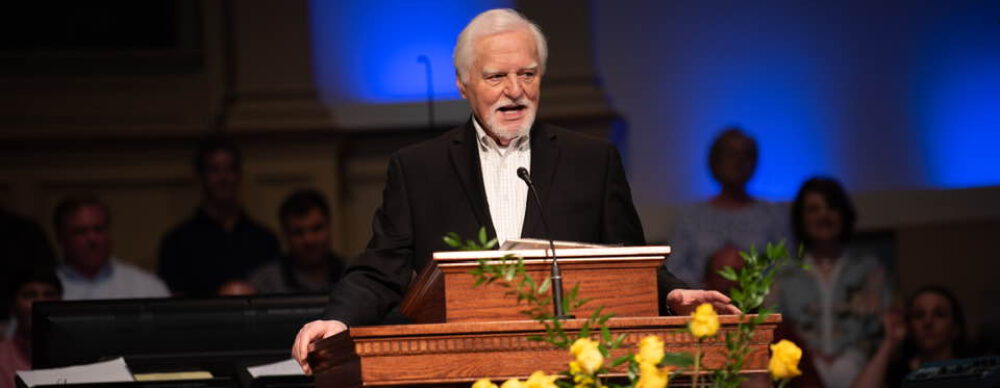
About Dr. Joe McKeever

Dr. Joe McKeever

joedrawing2009x225.jpg

Phone: 504/615-2190

How to Know Jesus Christ and Live Forever

Cartoons by Joe McKeever

Where is Joe from? It depends on who he’s talking to. He was born and raised in rural Alabama (near Nauvoo), but lived in the coal fields of West Virginia (near Beckley) from ages 7 to 11. He lived in Birmingham, Alabama from ages 19 to 24, New Orleans from ages 24-27, Mississippi from 27 to 46, North Carolina from 46 to 50, and New Orleans ever since! So, when he runs into someone from one of these places, he acts like a native!

What do we need to know about Joe? Not much. Try this: born to Carl and Lois McKeever in 1940, the fourth of their six children; born again in 1951 at New Oak Grove Free Will Baptist Church; called into the ministry in 1961 at West End Baptist Church in Birmingham; earned master of theology and doctor of ministry degrees from New Orleans Baptist Theological Seminary (1967 and 1973). Married to Margaret Henderson, father of Neil, Marty, and Carla, father-in-law to Julie and Misha, and grandfather to Leah, Jessica, Grant, Abigail, Erin, Darilyn, JoAnne, and Jack. That enough?

Where did he pastor? Before seminary, Unity Baptist Church, Kimberly, Alabama. During seminary, Paradis Baptist Church, west of New Orleans. Thereafter: Emmanuel BC, Greenville, MS for 3 years; FBC of Jackson, MS as minister of evangelism 3 years; FBC of Columbus, MS for 12 years; FBC Charlotte, NC for 3 years; and FBC of Kenner, LA for 14 years, ending in the Spring of 2004.

What’s he doing now? After five years as Director of Missions for the 100 Southern Baptist churches of metro New Orleans, Joe retired on June 1, 2009. These days, he has an office at the First Baptist Church of Kenner where he’s working on three books, and he’s trying to accept every speaking/preaching invitation that comes his way. He loves to do revivals, prayer conferences, deacon training, leadership banquets, and such. Usually, he’s working on some cartooning project for the denomination or some agency. (If you’re on Facebook, visit him there!)

Some quotes:

“I was pushing 6 year old Abby on the swing in her front yard. We were making up dumb songs and having a big time. She said, ‘We’re being silly, aren’t we, Grandpa.’ I said, ‘Yes we are. Why do we like to be so silly?’ She said, ‘It’s a family tradition.'”

“When I was five years old, Mom gave me and my little sister Carolyn pencil and paper and put us at the kitchen table and told us to draw. I discovered I loved to draw. The next year in the first grade, the rest of the class would gather around and watch me draw. To this day, I can outdraw any group of first-graders you’ve ever met!”

“When I do a revival in a church, I bring a sketchpad and draw people before and after the services. The pastor puts a volunteer with me to run to the church office and make copies. They post the copies on the wall somewhere and give the original back to the victim. By the end of the week, we might have a couple hundred drawings filling the walls. One night, the pastor stood off to one side and watched me work. As we broke for the evening service and headed down to his office for prayer, he leaned over and whispered, ‘McKeever, have you ever noticed that when a pastor can’t preach, he always has a gimmick?’ I said, ‘Friend, I’ve heard you preach and I’ll be glad to give you drawing lessons.'”

“This little delegation went to see the preacher. ‘Pastor,’ the chairman said, ‘You need to know the congregation is not very happy with you.’ The pastor said, ‘I’m sorry. But why are you telling me this?’ The chairman said, ‘I would think it would matter to you.’ The pastor said, ‘It does. But not much.’ The delegation was dumbfounded. A woman on the committee said, ‘Well, if you ask me, when the congregation is unhappy, the pastor is failing.’ The pastor said, ‘No ma’am. That’s based on a false assumption that a lot of churches have. You see, the Lord does not send the pastor to make the church happy. God sends the pastor to make the church healthy–and to make HIM happy. Big, big difference.”

“My life-verse is Job 4:4, ‘You have strengthened tottering knees; your words have stood men on their feet.’ For a preacher or a writer—and I try to be both–the power to use words and make a lasting difference in someone’s life is the best gift in the world. Occasionally, someone who reads this blog will send a note, ‘That was precisely what I needed to hear today.’ And that makes my day!”

“I love the line in Genesis 21:6 where, after Sarah gives birth to Isaac, she exclaims, ‘God has made laughter for me.’ I believe with all my heart that God has made laughter for each of us. But some of you aren’t getting your minimum daily requirement! And you’re suffering from it. You know the verse in Proverbs that says ‘A merry heart doeth good like a medicine’? We now know that it’s not just ‘like’ a medicine, but laughter IS medicine. Scientists tell us that hearty laughing releases endorphins–called ‘nature’s healers’–into your bloodstream. That’s why after a good time with a friend when you laugh and relax, you feel so elated. It’s not just psychological–it’s physical; it’s real. God is so smart.”

When Practical Jokes Have Their Place, And When They Are Out Of Place.

When Wayne Hunt served on our church staff, he was forever looking for opportunities to pull a practical joke. One day he phoned Deena Boyd, the preschool children’s director, and faking a middle-eastern accent, told her he was an Arabian prince or something in the process of moving to New Orleans. With his three wives and eight children, he would be needing the facilities of our church’s children’s program and she had been highly recommended. About the time Deena got all swimmy-headed thinking of eight new children in the program and a parent who could pay cash, Wayne burst into laughter. Deena took it well, but said, “I’ll get you.”

A few weeks later, Wayne had found a special golf club on the internet, at e-bay or somewhere, and with his wife Anita’s acquiescence, had ordered it. “It’s my birthday present,” he assured us. After a couple of weeks, he began calling the church office from the seminary where he was enrolled to see if the club had come in. “Not yet,” the secretaries would assure him. And then one day, it arrived.

I think he cut class that day to drive across the city just to get that new golf club. He rushed into the office, grabbed up the box, and tore into it. He gently pulled the wrapping paper from around the club and fell back into his chair, unable to believe his eyes. The club was absolutely the sorriest thing he had ever seen–old, battered, dirty, rusty, and bent.

“I’ve been cheated!” You could hear him all over the office area. “Wait til I report this guy to e-bay. I’ll sue him!”

Continue reading

Don’t Like How Life Treated You? Make A Movie.

I haven’t actually seen “Cinderella Man” yet, the movie some are calling the best of the year. This is the saga of prizefighter James Braddock and his struggle to provide for his family during the Great Depression using his fists and a courage that refused to quit. Anyone who sits through the previews several times, as I have now done, pretty much knows the story. And interestingly, it’s all history. Almost all.

Braddock was born in New York City’s Hell’s Kitchen. He fought his way out of poverty and and eventually challenged for the light heavyweight championship of the world, a fight he lost. Apparently an average boxer–he lost 20 times–he finally took a job on the New Jersey docks to support his wife and three children. Then he got a lucky break.

One night, on a boxing card that featured heavyweight champion Primo Carnera fighting challenger Max Baer, Braddock went against someone named Corn Griffin and knocked him out. Just a year later, after upsetting two more contenders, Braddock was fighting Max Baer, the reigning heavyweight champion of the world.

Peter Finney, New Orleans’ own champion sports columnist for nearly half a century, writes, “Here he was, a hopeless underdog who had lost 20 times on the roller-coaster journey, fighting a guy whose fists had been responsible for the death of two opponents.” Then he adds: “No Hollywood hokum. It was all true.”

“And there they were,” he continues, “on June 13, 1935, Braddock and Baer fighting for the title, as some of Braddock’s faithful, listening to the broadcast, prayed for the Irishman’s safety inside a Jersey church.”

According to the movie, the two boxers went at it tooth and nail for 15 hard rounds. Directed by Ron Howard–how far he has come from Mayberry–the men pummeled each other with so many devastating blows and knockout punches, one wonders how anyone could endure such pain and live to tell it. That’s what columnist Finney wondered. And he wondered how sportswriters of the time had covered such a monumental bout.

So, Finney did something I admire mightily. He dug up the newspapers records of the original fight to see how ringside writers described this vicious pounding that surely must have left both men as invalids.

Ah, what he found out.

Continue reading

Fun-Loving Boys And Absentee Parents

What started this was something I heard on “All Things Considered” the other evening. One of their reporters had attended the funeral of a U.S. soldier killed in Iraq and buried in Colorado Springs. His was quite a story–raised by his mother along with several younger siblings, a high school dropout who went back and graduated later, a prankster who just wanted to have fun, a kid who loved hunting wild animals in the mountains. In high school, he got in trouble in shop class when a buddy went to the bathroom and he welded the door shut. And there was that time he stole a car and rode around town for a couple of hours. Just having fun. He got his act together, they said, and joined the military where he used his sharpshooting skills to become a sniper with our forces in Iraq. A roadside bomb ended his life a few days ago.

Memorial Day morning some boys were having fun in my neighborhood, and it cost them dearly. The newspaper says at 3:30 am, three sixteen-year-old friends abandoned a car they had stolen in order to take a beautiful new pickup truck from a fellow’s driveway. The owner heard a noise, looked out the window and saw the truck pulling out, and called the police. Within minutes, a cop spotted the bright red expensive pickup and a chase ensued. Up and down Causeway Boulevard they went, jumping medians and doubling back. The boys bursted through a blockade and almost hit an officer. Finally, they ended up two blocks from my house in the New Orleans suburb of River Ridge where they made the worst mistake of a morning filled with them. As a police officer approached the truck, the young driver tried to run him over. Bad decision. Later, the investigators picked up over 100 spent shells from the grass surrounding that bullet-ridden truck. The driver was dead and his two passengers were headed to the hospital and later to jail. “Self-defense,” said the sheriff, and who can argue. A three ton truck qualifies as a deadly weapon by any standard.

What is it about adolescents and their fun?

Continue reading

Can You Say No To God, And Live To Tell About It?

My grandchildren still do not understand why I left their church. Since Grant is 10 and the twins, Abby and Erin, are 8, I am the only pastor they have ever known. Yet, a year ago, at the age of 64, I resigned the pastorate of the First Baptist Church of Kenner, Louisiana, to become Director of Missions for all the Southern Baptist churches of metro New Orleans. I still live in the same house and have even retained my church membership at Kenner. But these days I’m preaching all over, in all kinds of churches–big and small, formal and informal, in the city and on the bayou. And that’s what puzzles my grandchildren.

Yesterday Erin asked my wife, “If Grandpa can still preach, why did he leave our church?”

Margaret went for the simple answer: “Because God told him to.”

Erin countered, “Couldn’t he have said ‘no’?”

Good question. Could I have turned God down? Was this one of those “okay if you do, but all right if you don’t” issues?

Continue reading

What I Did For Love

Thursday, May 5, the National Day of Prayer, I drove across town to attend the noon gathering near the Kenner, Louisiana, City Hall. The lovely little park sports a pavilion large enough for a hundred people and we fairly filled it up. The temperature hovered in the low 70s, the humidity was low, and a breeze stirred the lovely trees just beyond the memorial flag display. I could have stayed a week.

An interfaith women’s group has been assigned responsibility for the annual prayer observance, and they did an excellent job. Only two or three of us knew that the little white-haired lady on the second row, Josie Lanzetta, actually started these prayer observances nearly 15 years ago. She took it upon herself to call the mayor’s office and ask if we could use the park and the pavilion for the prayer service. Sometimes a dozen of us would meet, and once or twice a school-bus load of children. In time, the idea caught on and now others have taken the leadership. Miss Josie is so kind and unassuming, she simply shows up as a participant and would never in a hundred years tell that she originated these observances in Kenner.

Even though the program exceeded the noon hour, each speaker/pray-er was outstanding and brought a special contribution to the proceedings. These included the mayor, a judge, several ministers, a medical doctor, a local television personality, and a deacon from the Hispanic Apostolate Church. I wanted you to know about this last one, the deacon.

Deacon Luis Campuzano is perhaps sixty years old. He said, “I am from Honduras. Had you told me 20 years ago I would someday be addressing this group of community leaders, I would not have believed it.” Then he told us about his mother.

Continue reading

Praying Over Those Two Roads

Funny how those little decisions you make with hardly a thought have a way of redirecting the rest of your life.

Best friend J. L. Rice and I were coming up on our junior year at Winston County High School in Double Springs, Alabama, and thought of something that might be fun. We had come through the science fair together and loved to kid around, imitating Don Knotts on the old Steve Allen program (with a wide-eyed, “Nooo!”–okay, you had to have been there), when one of us had a bright idea. We would take short-hand the following year.

Gregg Shorthand was taught in almost every high school in the land back then, always by the “business” teacher, the lady who instructed in typing and office skills. Shorthand class was intended to prepare future secretaries to earn a living, and thus no one but girls enrolled. J. L. and I became the only boys in the school’s history–before or since–to sign up. We took the class for two solid years, made excellent grades, and loved every day of it.

Had you asked, we would have told you we were preparing for college. Neither of us knew anything about college, but we had always imagined there would be lots of lectures which necessitated note-taking. J. L. went to work up north after high school and never used his shorthand, whereas I found out pretty quickly that you don’t need shorthand for college classes.

Continue reading

Even Jesus Had His Disciples

Jonas Salk was in the news a few weeks ago, fifty years to the day after announcing his vaccine which halted the epidemic of polio in its tracks. How well I can recall the dreadful plague known officially as infantile paralysis. Every time you turned around, you heard of another precious child being afflicted. “Don’t swim in that pond,” we would hear. Our parents were certain that the disease was caught or spread through infected swimming pools. As a child in the 1940s, I joined with others from our school as we filled the little March of Dimes cards with coins to help fight polio. And we breathed a great sigh of relief when Salk’s announcement was made.

Now it comes to light that Dr. Salk was only the point man of a vast team of researchers and scientists. While that is not particularly surprising, what is unusual is that none of them got any credit for their part in the discovery and perfecting of this vaccine. A half century later, those researchers and their families are still hurting over the slight. Dr. Salk is long dead, but his son now apologizes for the glaring oversight.

Continue reading

A Baptist Living In Catholic Land

On the plane returning to New Orleans from Atlanta, I found myself seated beside a Catholic priest making an overnight trip to my city to speak at a local church. We fell into a conversation about our respective ministries in a brief attempt to understand each other better. At one point the priest said, “What’s it like being a Baptist in New Orleans?”

While I was formulating an answer, the lady in front of us–we had no idea she was listening–turned around and said loudly, “I’ll tell you what it’s like. It’s like being a Catholic in Atlanta!” A dozen passengers around us, also tuning in, erupted in laughter.

Outnumbered is the point. Maybe overwhelmed sometimes. And, if we’re not careful, overlooked.

Continue reading

Why I Remember The Alamo

Five years into our marriage, Margaret and I had a honeymoon. That’s what happens when you are a) poor and b) in seminary all the time, trying to earn your credentials as a pastor.

Anyway, I was just graduating from seminary and pastoring a little church on a bayou some 25 miles west of New Orleans and we decided the time had come for a real vacation. We did something that was so unlike us that it seems a little foolhardy now and I wonder that we did it at all. We hired a lady to come in and stay with our two small boys for the week. (Okay, it wasn’t quite that scary. Leola was a lovely Black lady who helped Margaret with the housekeeping one day a week and our boys adored her.)

We were driving a 1964 red Ford Falcon with no air conditioning, but hey, it was 1967 and that’s how most people lived. And so we went to Texas.

Continue reading