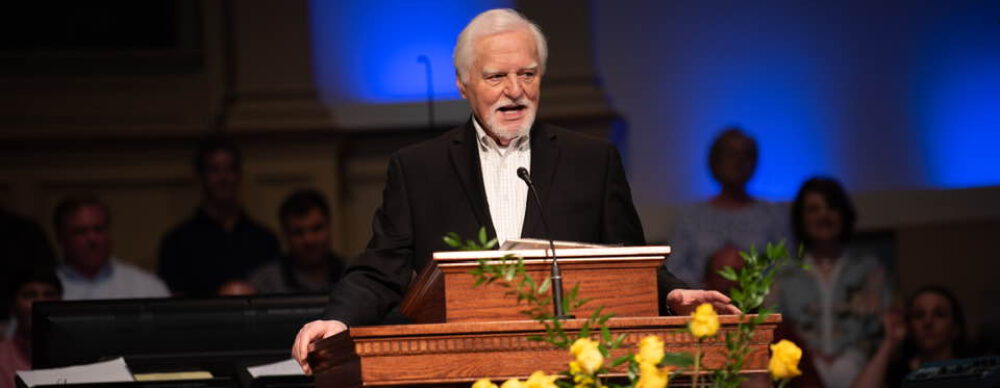
I prayed for my preaching–and got answers I did not expect

(This is a reprint of an article I wrote for Leadership magazine several years ago, maybe 2001. It was later picked up and included in “The Art and Craft of Biblical Preaching,” a textbook edited by Haddon Robinson and Craig Larson, published by Zondervan, 2005.)

I had been preaching for more than two decades, and I should have been at the top of my game. The church I served ran up to 1,500 on Sunday mornings, and the live telecast of our services covered a fair portion of several states. Most of my colleagues thought I had it made, and if invitations to speak in other churches were any sign, they thought I could preach.

But I didn’t think that.

My confidence was taking a beating as some of the leaders let me know repeatedly that my pulpit work was not up to their standards. Previous pastors carried the reputation of pulpit masters, something I never claimed for myself. To make matters worse, we had numerous vacancies on staff and my sermon preparation was suffering because of a heavy load of pastoral ministry. But you do what you have to do. Most days, my goal was to keep my head above water. Every day without drowning became a good day.

That’s when I got serious about praying for my preaching. Each night I walked a four-mile route through my neighborhood and talked to the Father. My petitions dealt with the usual stuff–family needs, people I was concerned about, and the church. Gradually, one prayer began to recur in my nightly pleadings.

“Lord,” I prayed, “make me a preacher.” Asking this felt so right I never paused to analyze it. I prayed it again and again, over and over, for weeks.

I was in my fifth pastorate. I owned a couple of seminary degrees. I had read the classics on preaching and attended my share of sermon workshops. I was a veteran. But here I was in my mid-forties, crying out to heaven for help: “Lord, make me a preacher.”

I knew if my preaching improved, if the congregation felt better about the sermons, everything else would benefit. I knew that the sermon is a pastor’s most effective contribution to the spiritual lives of his members. To do well there would ease the pressure in other areas. So I prayed.

Then one night, God answered. Continue reading

The two sides of death and why we don’t fear it any longer

God’s faithful no longer fear death as much as we used to.

Ever since our Lord Jesus went to the cross and pulled its fangs, descended into grave and recovered the keys, then rose from the tomb as the first fruits of eternal life, the poor ogre has lost his threat.

He still growls but all his rantings are just so much bumping his gums.

Maybe we ought to pity death.

Like a honeybee that has lost its stinger but is still flying around scaring people, death can no longer do any kind of significant damage to all who are in Jesus Christ.

No more fear, Christian. It’s all gone.

O death, where is thy sting? O grave, where is thy victory? (I Cor. 15:55)

Hebrews 2:14 puts this in an unforgettable way: He Himself partook of (flesh and blood) that through death He might render powerless him who had the power of death, that is, the devil, and might deliver those who through fear of death were subject to bondage all their lives.

Defeat the devil, deliver the hostages.

Big task. Great victory. Huge celebration–one that’s still going on.

Continue reading

Why change is hard for some of God’s people

I sometimes tease our young pastors that “in all the world, there are only three people who enjoy change, and none are members of your church.”

It’s a common perception in our churches that the Lord’s people seem to be resistant to change. And there is certainly plenty of anecdotal evidence, as flockless shepherds step up to tell how they lost their pulpits when they tried to change a schedule or a program.

But, look around at the people attending our churches. They seem to handle change fairly well in other areas of their lives. They’re on computers, own X-boxes, play farm games on Facebook, send emails, and stay in touch with the world by their smart phones. No one at church drives a 1948 Packard because he doesn’t like change. No woman still wears the hair styles of the 1930s (as they did when I was a kid in the 1940s and ’50s). Their clothing is fairly up-to-date.

And yet, I can take you to an even dozen pastors right now who carry the scars of battles they fought trying to get the Lord’s people to make even the simplest of changes.

What’s going on?

Here is my take on why change is hard for God’s people. And the news, I have to say, is not good. The Lord who said, “Behold, I make all things new” (Revelation 21:5) is probably not very pleased with those who hold onto what He did in the past and refuse to accept the new thing He is doing today.

The Lord who repeatedly commanded that we “sing unto the Lord a new song” (Psalm 33:3; 96:1; etc.) is probably not impressed when we refuse to sing anything but the songs we grew up under.

Why Change is So Hard for the Lord’s Frozen Chosen.

By the way, these are in no particular order, other than as they occur to me.

1. Change feels like loss.

–“If we add choruses to our worship service, we will have to cut out some of the hymns. But I love the hymns. Why should I give up my wonderful hymns for some cutesy little tunes someone wrote in his garage?”

–“If we add an additional worship service, we will divide the congregation. I’ll not see my friends unless we attend the same service. I am ag’in it.”

–“When I go on a diet, I lose weight and get healthier, which are all good. But I also have to quit wearing some things in the closet I love. And give up chocolate ice cream. So, no diet for me, thanks.”

2. Change challenges our belief system.

–“It was good for Paul and Silas; it’s good enough for me.” Yes, sir–give me that old time religion.

Continue reading

Worship: Going about it in the wrong way

Give unto the Lord the glory due to His name. (Psalm 29:2)

It’s Sunday around noonish. As the congregation files out of the sanctuary heading toward the parking lot, listen closely and you will hear it.

It’s a common refrain voiced near the exit doors of churches all across this land.

“I didn’t get anything out of that today.” “I didn’t get anything out of the sermon.” “I didn’t get anything out of that service.” “I guess her song was all right, but I didn’t get anything out of it.”

Sound familiar? Not only have I heard it countless times over these six decades in the ministry, I probably have said it a few times myself.

This is like dry rot in a congregation. Like a termite infestation in the building. Like an epidemic afflicting the people of the Lord, one which we seem helpless to stop.

But let’s try. Let’s see if we can make a little difference where you and I live, in the churches where we serve and worship. We might not be able to help all of them, but if we bless one or two, it will have been time well spent.

1. You are not supposed to ‘get anything out of the service.’

Worship is not about you and me. Not about “getting our needs met.” Not about a performance from the pastor and singer and choir and musicians. Not in the least.

2. Worship is about the Lord.

Give unto the Lord the glory due to His name. That Psalm 29:2 verse is found also in I Chronicles 16:29 and Psalm 96:8. It deserves being looked at closely.

a) We are in church to give. Not to get.

Now, if I am going somewhere to “get,” but find out on arriving, I am expected to “give,” I am one frustrated fellow. And that is what is happening in the typical church service. People walk out the door frustrated because they didn’t “get.” The reason they didn’t is that they were not there to “get,” but to “give.”

Someone should have told them.

Continue reading

7 things to keep in mind when discussing religion

If anyone advocates a different doctrine, and does not agree with sound words, those of our Lord Jesus Christ, and with the doctrine conforming to godliness, he is conceited and understands nothing; but he has a morbid interest in controversial questions and disputes about words, out of which arise envy, strife, abusive language, evil suspicions, and constant friction between men of depraved mind and deprived of the truth…. (I Timothy 6:3ff).

Some people debating religion are this way, Paul.  Conceited and ignorant, rabble-rousers and mean-spirited.  I’ve sat across the table from them more than once.  It’s no fun, as you know.

But some are sincere and faithful brethren trying to get this right.

Help us, Lord.

If you are a Southern Baptist, as I am, you may find yourself having a problem with the theology of some people whom you happen to like and respect as brothers and sisters in Christ.  You respect them and would like to be closer friends, but this “thing” they believe and teach stands between you. So…

You ask if the two of you can discuss those differences.  Not a debate, you insist, and certainly not an argument.

Some would say you’re being naïve for thinking you can have such a discussion without emotions entering into it, and the rhetoric heating up.  But you decide to see if you can.  The prize is worth the effort.

Understand going in that…

One.  People don’t just believe doctrines; they have a whole belief system.  And that system usually results in them flocking with others of similar beliefs, so that ends up becoming their culture, their entire world.  And when you question their beliefs, in their mind you are undermining their entire set up. So, they quickly become defensive, as though you had attacked their mother.

A Mormon–someone belonging to the LDS faith (or system)–doesn’t just believe some things about Joseph Smith and some other things about the Scripture, which, if you can refute you have dislodged them from their errant beliefs (as you believe).  They are part of an entire set-up.  All their friends are in that system.  So, for them to consider dropping their religion because they learned it was in error is also asking them to drop their friends and change their entire lives.  So, helping someone transition out of that system becomes a huge process.

Lord, help us to be patient with each other. 

Continue reading

Reasons not to fear zombies and such

I was grading tests for a seminary course I was teaching.  In his essay one student wrote, “The only thing I fear is zombies.”  I wrote back, “Zombies? You fear zombies?  There is no such thing. They are the figment of someone’s imagination!”

I’ve laughed about that ever since.  This guy is going to be a minister of the gospel and he fears zombies.

“No fear allowed.”  That should be the sign across every believer’s doorway.  Anyone doing even a cursory reading of Scripture has encountered text after text informing God’s children–reminding them, teaching them, again and again–that we are not to fear.

God is insulted when His children fear.  It’s as though we believe the enemy and not Him.

Here are some of our favorite texts on “No Fear Allowed” that come to mind…

“Do not fear, for those who are with us are more than those who are with them” (2 Kings 6:16).  Elisha’s words to his panicky servant who had just seen the enemy encircling the city are good for us today.  Don’t be afraid: We outnumber them. 

“Do not be afraid of (those to whom I send you), for I am with you to deliver you,’ declares the Lord” (Jeremiah 1:8).  Later, same chapter, God said, “Do not be dismayed before them, lest I dismay you before them.  For behold, I have made you today as a fortified city, as a pillar of iron, as walls of bronze against the whole land….” (1:17-18).  Don’t be afraid: The Lord is with you.  And, do not fear because you are invincible.

“Do not fear, for I am with you; do not look anxiously about you, for I am your God.  I will strengthen you, surely I will help you; surely I will uphold you by my righteous right hand” (Isaiah 41:10).  Don’t be afraid: Your Heavenly Father is on the job!

Continue reading

Some people we have to work at loving

If you love those who love you, what credit is that to you?  The unsaved do that…. But love your enemies and do good and lend, expecting nothing in return, and your reward will be great…. –Luke 6:32-35

I was a freshman in college, with everything that implies:  I was green, scared, eager, excited, learning, stupid, silly, self-centered, and a hundred other things.

Among the employees on our campus was Mrs. Grigsby.  I can see her to this day: stern, tight-lipped, unfriendly, and unloving. We thought she looked more like a man than a woman. She was all business, never a ‘good morning,’ and generally unpleasant, we all thought.

Among her other duties, Mrs. Grigsby cleaned the hallways and bathrooms of our dormitory.  (Students were expected to keep our own rooms clean. What a joke.)

The guys in our dorm would make nasty jokes about Mrs. Grigsby behind her back.  She was a convenient target and no one spoke up in her defense.  Boys being boys.

One day my girlfriend back home in Alabama told me something unsettling.  “I have a relative who works at the college where you go.”  She had never met her, but was told this by her mother.  A day or two later, she broke the news to me.

“Her name is Grigsby.”

Yikes.  My girlfriend was related to the campus nightmare.

Continue reading

Preaching courageously in a climate of fear

God has not given us the spirit of fear, but of power and love and a sound mind.  –2 Timothy 1:7

You therefore, my son, be strong in the grace that is in Christ Jesus.  –2 Timothy 2:1

I solemnly charge you in the presence of God and of Christ Jesus…preach the word! Be ready in season and out of season; reprove, rebuke, exhort, with great patience and instruction. –2 Timothy 4:1-2

“They’re almost to the point of giving me my walking papers.  The animosity from some of our leaders is so thick you could cut it with a butter knife.  What do I do now?  How do I stand in the pulpit and preach? And what should I preach?”

If you’ve never preached the gospel while sitting throughout the congregation were people who hated you, arms folded and brows furrowed, you’ve missed out on one of the great experiences of the Christian life.

If you’ve never feared for your job for nothing more than preaching the whole counsel of God, you’re in a minority, pastor.

Sometimes the ill-will is for nothing you have done or failed to do.  The plotters and schemers have their own reason and their own private agenda.  Sometimes, the problem is you have stepped across an invisible line and intruded into forbidden territory.

You preached against guns when every man and half the women in the congregation were bonafide members of the NRA.  They were aghast.  “How dare you!”

You preached God’s love for all races when the KKK (or their modern successors) were looking around for their next victim. “You crazy, boy?”

You preached tithing to people who had made idols of their money, preached sexual purity to a gang of partyers, preached God’s definition of marriage to a liberal crowd. “Do you know where you are?”

Continue reading

12 reminders about prayer

“Pray without ceasing.”  — I Thessalonians 5:17.

I do not imply that I know more about prayer than others.  I hate to hear anyone celebrated as “an expert in prayer,” for the simple reason that no child should be called an expert in talking to his/her parent.  What’s so hard about that?

Granted, we often make it harder than it should be, with our rules, our religions, our legalism, our opinions, our blindness, and our sinfulness.  But in its essence, prayer is talking to the Father through the work of the Lord Jesus Christ.  Period.

What I do imply however (for this article) is that there are insights in Scripture on the subject of prayer many of us may have missed.  Here are a few……

One. Scripture says you do not know how to pray as you should.  That’s Romans 8:26. So, let’s not let that stop us.  God’s not looking for eloquence but faith.

Two.  Scripture says both the Holy Spirit and the Lord Jesus are interceding for us.  That is Romans 8:26 and 8:34.  Now, personally, I have no idea how this works, particularly when Romans 8:31 says “God is for us!”  So, it appears the Triune God is on our side!

Three. Scripture indicates the best pray-ers God knew were Moses and Samuel.  That’s Jeremiah 15:1.

Four.  Unconfessed sin in our lives stops our prayers dead in their tracks.  That’s Isaiah 59:1-3.

Five.  When we fail to intercede for those who count on us, we sin against the Lord. That’s I Samuel 12:23.  See Ephesians 6:18-19.

Six. As a rule, short to-the-point prayers are best.  That’s Matthew 6:5-7.

The inimitable John R. Rice used to say, “Prayer is not a touring sedan in which to see the sights of the city, but a truck which you drive to the warehouse, pick up the goods, and come home.”

Continue reading

The blind beggar of Jericho: Responding to the critics of the Bible

Critics of the Scriptures want to have it both ways.

If they find an inconsistency in Scriptures–the numbers seem not to agree, or a story is told in two different ways, that sort of thing–to them it proves the Bible is man-made, filled with errors, and not to be trusted.  However, when they find no inconsistencies, this proves the church removed all the troublesome aspects of the Bible in order to claim it to be inspired of God.

Either it is or it is not.

When one is determined not to believe a thing, nothing gets in his way. He can always find a reason not to believe.

Take the matter of Bartimaeus, the blind beggar of Jericho.  His account is told in three of the gospels, but he is named in only one (Mark 10:46).  My favorite account is the one in Luke 18.

I call this my favorite story in the Bible.

I like to think of Bartimaeus as “the smartest man in town,” even though he is a blind beggar wearing rags, a fellow who needed a bath badly and a haircut seriously.

What makes him so smart, in my thinking, is that while sitting on the roadside outside the city gates of Jericho, he did the wisest thing any of us can do: he kept his mouth shut, kept his ears open, listened to what was going on around him, thought about what he heard, and reasoned it out.  He kept hearing stories about Jesus of Nazareth.  For three years now, the news of Jesus had flowed in from every direction.  You and I might say that “Jesus had gone viral.”  Over and over, people arriving from various communities reported what they had heard Jesus teach, what they saw Him do–healing the sick and raising the dead!–and what they heard others saying about Him. No one had not heard of Jesus of Nazareth. Even the blind beggars.

The most disturbing thing Bartimaeus had heard about Jesus was that He had been through Jericho several times before, on His travels to and from Jerusalem. And each time for some reason, Bart had missed seeing Him.

And that is how the blind beggar of Jericho came to three critical decisions about Jesus: 1) He is the Son of David, the Messiah, the Christ, the Son of God sent by the Father to save the world from sin; 2) The next time Jesus comes to Jericho, I’m going to meet Him and give Him the opportunity to change my life; and 3) Whatever I have to do to get to Him, I’m willing to do it; nothing is more important than this.

That’s why, when the beggar heard all those trampling feet going by him heading into Jericho, he spoke up. “Who is this? Who’s coming this way?”

Something big was afoot.

Continue reading