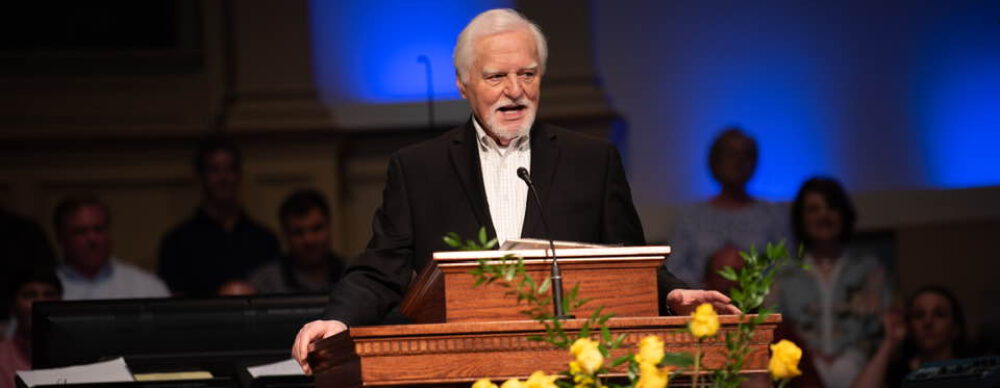
What laypeople need to know about speaking in church

By laypeople, we mean non-preachers.

Speaking in church refers to addressing large groups of the Lord’s people.

Many non-preacher types are outstanding on their feet in front of large groups. Schoolteachers come to mind. They are experienced and at ease. But the typical church member, even one who teaches a Sunday School class, may feel out of his element when asked to deliver a talk in front of the congregation.

Marlene said to me, “I’m sorry I took the entire service, Pastor. But the Lord was leading me.” Translation: She was unprepared, really got into her talk and couldn’t control it.  As a young pastor, I was inviting church members to share testimonies in the morning worship service, something along the lines of 5-7 minutes.  (Later, I learned to interview the individual and keep hold of the microphone the entire time!)

Once Marlene got going, she could not find a convenient stopping place. She kept on for a full 40 minutes. (I could have pointed out a half-dozen great places to stop!)

Now personally, I would not blame my failure to prepare for a speech on the Lord.

I see it happen all the time.  It can be almost embarrassing.

Continue reading

Grandparenting by faith

The just shall live by faith. —Habakkuk 2:4, and quoted in the New Testament in Romans 1:17;  Colossians 3:11; Hebrews 10:38.  That truth formed the basis of the Apostle Paul’s theology, and his Epistle to the Romans (on that subject) fueled the theology of Martin Luther and the Reformation, and two centuries later of John Wesley.  

I tell friends who are about to become grandparents for the first time, “You are about to be more in love than you have ever been in your life!”  I tell them, “Right now, you don’t even know that child.  But pretty soon, you will not want to live without them.”

It’s a marvelous thing the hold that the child of my child can have on my heart.  In many respects, my eight grands have given me more joy than my three did.  Perhaps it’s because we had our children when we were young–in our twenties–and our grands when we were in late middle-aged and were far different, even better, people.

We want to cherish these little ones and to do all we can to make a lasting difference in their lives, for now and for eternity.  So, let’s talk about that.  Let’s talk about grandparenting by faith.

Continue reading

What the pastor should say in the wedding

“…the  two shall become one….” (Matthew 19:5)

The wedding ceremony is a great time–once in a lifetime for most people–for the pastor to get something across to two people in particular while hundreds are eavesdropping.

Not that they will remember a thing you say.

Friday, April 13, 1962, when Margaret and I stood at the altar, our pastor said some wonderful things that I found fascinating and inspiring.  Alas, my mind retained his insightful words for exactly half an hour, so whatever he said is gone forever.

These days, someone is recording your wedding service. So, you’ll be able to listen later when life returns to normal.

Presumably, that’s when the minister’s words are finally heard and begin to sink in.

So, what do you tell them, pastor? What words of lasting value and incredible help can you utter during the ceremony which will make a huge difference down the road a year or two or ten?  Now, you have only so much time, and this is not the time nor place for a full sermon. Still, choose a few great points you wish to lodge in their hearts forever and give it a shot.

Here are my suggestions on what you want to tell the couple….

Continue reading

The subtle sin of judgmentalism and how it works

“Do not judge, lest you be judged…. Why  do you look at the speck that is in your brother’s eye, but do not notice the log in your own eye?” (Matthew 7:1ff.)

If you are prone to criticism and judging others, chances are you will be the last to know it.

It’s that kind of sin. I see it in you; but it’s just part of who I am.

I find it fascinating that after issuing the warning about not judging others, our Lord followed with the caution about specks and logs in people’s eyes.

This is precisely how it works.

My judgmentalism of you appears so normal and natural that it never occurs to me that I am actually condemning you.  So, while your rush to judgment is a log in your eye–one you really should do something about!–my human tendency to speak out on (ahem) convictions is merely a speck in mine and nothing to be concerned about.

One thing about me, I’m no hypocrite, right?  I call it like I see it, right?  You know what you’re getting with me, right?  (yuck!)

Consider this conversation….

You: “What did I have for lunch? Well, I was in a hurry, so I ate a banana, a handful of nuts, and a soft drink.”

Your co-worker: “The banana and the nuts are okay, but the soft drink is fattening and poisonous.  It is suicidal.”

You say nothing in response, but sit there wondering, “Who asked you? You wanted to know what I had for lunch and I told you. Does that give you a right to sit in judgment on my actions?”

It happens all the time, and just that subtly.

Continue reading

Seven things the pastor cannot do from the pulpit

“…so that you may know how you ought to conduct yourself in the house of God, which is the church of the living God….” (I Timothy 3:15).

You can’t chew gum in the pulpit, smoke a cigarette, or bring your coffee in with you. You can’t preach in your pajamas or lead a worship service in your swimsuit.

But you knew that.

However, sometimes we pastors do things every bit as silly as this, and as counter-productive.

True, a pastor can do anything from the pulpit.  Once.

But we’re talking about things no right-thinking godly pastor should attempt to do from the Lord’s sacred place of leadership in His church.

1. He cannot recommend a book which has questionable material in it nor condemn a book he has not read.

Okay. He can, but he shouldn’t.

Continue reading

When reading Scripture, slow down and savor it.

So, you’re reading the Bible through in a year?  Or, like a few people I’ve known, you read it through every year for the umpteenth time.

Fine. But after you have done it two or three times, that’s probably enough. I have a suggestion for what you will want to do next.

Reading the entire Bible in a year is like seeing Europe in a week: You will notice a lot of things you don’t see from ground level, but it’s no way to get to know a country.

After a few flyovers–two days in Genesis and one day in Romans, for instance–you will want to land the plane and get out and make yourself at home in Ephesians or Second Timothy.  Move in with the locals and live with them a few weeks.

Continue reading

Trouble in the pulpit: The angry pastor

“Now, in the last days, difficult times will come. For men will be lovers of self…boastful, arrogant, revilers…ungrateful, unholy, unloving, irreconcilable, malicious gossips, without self-control, brutal, haters of good, treacherous, reckless, conceited…. Avoid such men as these.” (II Timothy 3:1-5)

Veteran Christian workers get this a lot. People tell you of a conversation with you from years ago in which you spoke words that changed their lives.  You were God’s gift to them that day, or, just as likely you infuriated them and they have not been able to get past it.

The problem is you don’t remember any of it.

My daily e-mail brought two such messages, one of each kind. A young minister was thanking me and an older pastor was venting. The conversations had occurred some ten years earlier.  I remembered neither.

The older pastor told of the time he sat in my office, seeking guidance for entering the ministry. According to him, I had asked what kind of church position he was interested in.  That was the harmless little question that had ticked him off and fueled his anger for a full decade.

“I was morally outraged by the question,” he said.

Continue reading

Ten insights about the fellowship in your church

And they continued steadfastly in the apostles’ doctrine and fellowship, in the breaking of bread and in prayers…. So continuing daily with one accord in the temple and breaking bread from house to house, they ate their food with gladness and simplicity of heart, praising God and having favor with all the people (Acts 2:42-47).

When a church of 120 members set out to assimilate 3,000 new additions into the life of the congregation, they ranked “fellowship” toward the top of the list as a critical step in accomplishing the task.

Fellowship is a nebulous term in our churches.  No one seems to know exactly what it is.

Koinonia is the Greek word. It refers to a sharing of life, or a partnership. Of course, that doesn’t tell us what it meant in the follow-up program in the early church. So, in the absence of anything definitive from Scripture on the precise meaning of the term, I submit for your consideration my own definition: Hanging out.

Continue reading

Lose the naivete, Christian!

On a state or secular college campus, the atheistic professor has complete freedom to spout religious views and opinions without protest from the students or interference from the dean. However, let a Christian instructor relate his personal story to inform the students of his worldview so they can better understand where he’s coming from, and he’s harassed and soon out of a job.

At a convocation of students on the average secular campus, freedom of speech and the First Amendment are championed. However, let a student stand and own up to being a follower of Jesus Christ who attempts to live by the Bible, and he/she is hooted down.

Ironic, isn’t it, the hostility those of a secular bent have toward belief in Jesus Christ. And they call themselves open-minded champions of free speech.

It’s more than just a prejudice, however. It’s a full-blown hatred.

That hatred is born of a fear of Jesus.

If in reading the gospels you have wondered how in the world things in that remote day came to the point where reasonably-minded people moved to arrest and crucify the Lord Jesus Christ, He who never lifted a finger against a human on the planet, the Prince of Peace, then take a look around you.

Human nature has not changed in the last 2,000 years.

Continue reading

Some people are so refreshing to us

I urge you, brethren–you know the household of Stephanas, that it is the firstfruits of Achaia, and that they have devoted themselves to the ministry of the saints–that you also submit to such and to everyone who works and labors with us.  I am glad about the coming of Stephanas, Fortunatus, and Achaicus, for what was lacking on your part they supplied.  For they refreshed my spirit and yours.  Therefore, acknowledge such men.  (I Corinthians 16:15-18).

Refreshing others.  What a wonderful ministry.  As opposed to wearing them out and using them up.  Leaving them stronger than how we found them.

I’m struck by Paul’s tribute to Stephanas at the end of his epistle to the Corinthians. Along with his family and friends, this brother in the Lord did three things which earned him an “honorable mention” in Holy Scripture—

1.  They were addicted to ministry. That’s quite a tribute. In our day, when people see needs, they frequently imitate the Lord’s disciples in the early part of John 9 and get into debates over who is to blame. But there are among us a few who have no time for such pointless dilly-dallying. They jump in to see what they can do to alleviate the situation.

There are so many kinds of addictions, but surely this is the best.

Continue reading