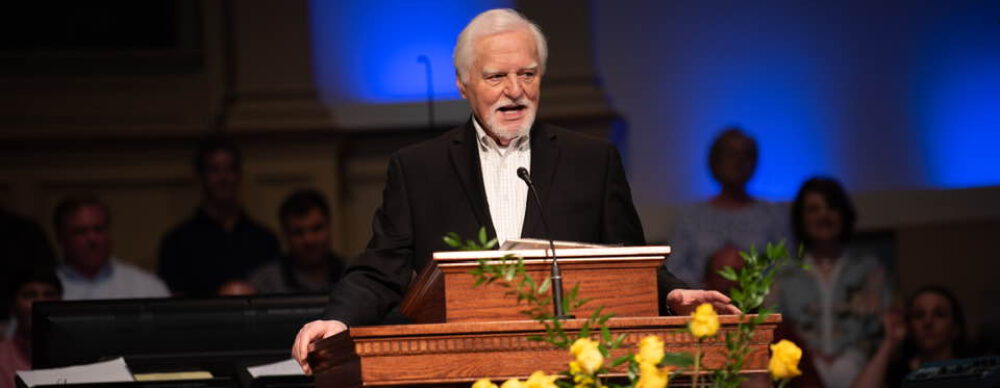
How to preach on guns to your congregation.

You probably can’t.

If you pastor a church that is far to the left (liberal) and you know everyone is for gun control, you can do it and live to tell about it.

If your church is far to the right (conservative) to the point that everyone owns guns and has stickers lauding the Second Amendment adorning their bumpers, you can do it, so long as you take the accepted position.

If however, your congregation is like the other 70 percent of Christian churches across this land and made up of believers of all stripes and varieties, once you introduce a hot-button issue like gun control and bring a full-blown sermon on it, you are going to stir up more strife than you are prepared to deal with.

The grief you cause will not be worth the benefit you derive.

Case in point.

Continue reading

Stories one wonders whether to tell from the pulpit

(When I first posted what follows, I was in something of a rush and told only one of Bruce McIver’s wonderful stories. But now, later, I want to add a few things at the bottom.)

Recently, I was asked to speak before a “writers guild”–a fancy term for a dozen writers of every imaginable varietyand skill meeting in the Mandeville, LA, city hall around tables–on the subject of “writing humor.” The problem with that is instead of leaving the invitation open-ended (“as soon as you figure out how to do it”) they gave me a date and a time. So, I showed up and shared what material I had managed to pull together and filled the alloted time, although it was quickly clear to everyone that I had no idea what I was talking about.

The Q&A time which followed indicated that they didn’t know anything about the subject either, so no one left upset or disappointed as far as I could tell.

I did one truly smart thing, though. I took along Bruce McIver’s book “Stories I Couldn’t Tell While I Was a Pastor” and read from it. Published by Word in 1991, the book can be bought for a dollar plus postage at the usual online places.  I recommend it as the perfect gift for one’s pastor (perfect because the recipient will enjoy it heartily and the donor can get it cheap).

Continue reading

The master gardener arrives. Uh oh.

“I am the true vine and My Father is the vinedresser. Every branch in Me that does not bear fruit, He takes away; and every branch that bears fruit, He prunes it, that it may bear more fruit” (I John 15:1-2).

When the Master Gardener arrives at His vineyard, everyone sits up and takes notice. What follows might be painful. The branches which accomplish nothing are about to be lopped off, and the branches which bear good fruit can expect to be pruned.

None of this is without pain.

Yesterday, I went through the cuties–those little mandarin oranges we buy in a pack of two dozen or so at the grocery–and threw out several.  We had gotten behind in eating them and one had gone bad, then was affecting (and infecting) those around it. To preserve ten, I threw out five.

In urging friends and family to eat more fruit, I remind them they should go into it knowing that sometimes they will have to throw out good fruit they allowed to spoil. It’s part of the price of keeping apples and pears, oranges and strawberries, bananas and blueberries in the house.

When I was a teenager, my dad set out several grape vines and pear trees in the small field behind our farmhouse. Even though he was a lifelong coal miner–who came from a long line of coal miners–Dad  had married into a farm family and took to the life of a farmer with zest. Dad loved the farm, enjoyed working in the field and growing things, and was dead-set on making sure his six children grew up with an appreciation for the farm life. We did.

It was puzzling the first few times Dad took his shears and cut back the vines after the grape season had ended. It looked to this kid as though he had killed them. Sure enough, next year, there they would be–green and lush and loaded with delicious grapes.

Continue reading

Seven cautions before you preach on money, Pastor.

“Prove yourselves to be blameless and innocent, children of God above reproach in the midst of a crooked and perverse generation; among whom you appear as lights in the world.” (Philippians 2:15)

The worst time to preach on money is when you need some, pastor. The second worst time is when the church needs some.

The best time to preach on money is all the other times.

That said, here are a number of cautions for you to consider before walking into that lions’ den to tame the monster called greed.

1) Get your own house in order. Now, it’s possible to preach on prayer while knowing you have a long way to go in that respect. You can preach on good works and witnessing even if your record is spotty. You can do so because everyone has room for improvement in these areas. But when it comes to giving/stewardship, you can know when you are doing well.

The Christian is to be a giver. That means a hefty portion of his/her income will go into the church offering (whether you call it a tithe or something else), and believers will also be generous to the poor, to the needy around them, even to their enemies (Luke 6:30-35).

So, unless you are faithful in giving to your church, kind to the beggars you meet on the street, and generous in your tips to waiters and waitresses, hold off about preaching on stewardship. You have a bit of catching up to do.

Continue reading

How I learned to love preaching on money. Well, almost.

“Beware of preaching on money.”

That’s not in the Bible, but it ought to be.

And somewhere in the Proverbs we could insert this one:

“He who preaches on money to a new congregation should expect the honeymoon to end abruptly.”

Few subjects are as fraught with danger for the unsuspecting pastor than preaching on stewardship (money, giving, tithing, contributions to the Lord’s work, greed, materialism, however you want to put it).

As a new pastor of a church that had broken ground for a $5 million sanctuary just before I arrived, I found we were running behind the budget and were facing some hard financial decisions quickly. So, I did what I had always done in previous churches with a fair amount of success: I preached on giving.

It seemed the logical thing to do.

In fairness to myself, I wasn’t harsh or demanding, legalistic or judgmental. I thought my approach was balanced and scriptural.

Almost immediately, I began receiving anonymous notes from longtime members, all saying pretty much the same: “We are not used to our pastor preaching on money all the time. Please stop.”

I got the message.

There is no use in doing something the congregation is rejecting.

Continue reading

Help! I’m a Pastor!

“In a multitude of counselors there is victory.” (Proverbs 11:14 and 24:6)

I said to Pastor Marion, “I’m glad to exchange notes with you like this. But you need a couple of mentors–older guys with long histories in the ministry–whom you can sit across the table from and talk about these things.”

He named two such, a seminary professor and someone else.

Good.

It’s tough knowing what to do in certain situations pastors find themselves in.  Right now, Pastor Marion is leading his church in a massive building campaign, and working night and day to minister to his growing flock.  In the five years he has been at his church, they have doubled or more in attendance. And then, this happens….

A deacon who is used to getting his way in the church calls a meeting of the key leadership. He is upset about some of the sermons Marion has been preaching, he says. Furthermore–it will not surprise you if you have ever been the target of this kind of abuse–“many others in the church feel the same way.”

He threatened Pastor Marion that steps may be taken to remove him from the pulpit.

What is a pastor to do?

Continue reading

What to say when your church members ask about those hard Scriptures

“This is a difficult statement; who can listen to it?” (John 6:60)

Young pastors struggle with questions that arise from the congregation in the middle of their teachings. You’re holding forth on some rich teaching and someone blurts out, “But pastor, doesn’t Paul say such-and-so?”

Sure enough, Paul did say such and so, and said it in two or three places so strongly and clearly no one but the most resistant can deny. However, what he said does not fit with the point you were trying to make. Now, you have no choice but to deal with it.

Until that moment, you always liked the Apostle Paul and considered him one of your favorites.

You find yourself remembering–treasuring even–something the Apostle Peter said about Paul: “In all (Paul’s) letters, speaking in them of these things, in which are some things hard to understand, which the untaught and unstable distort, as they do also the rest of the Scriptures, to their own destruction.” (II Peter 3:16)

That’s a good verse to remember, young pastor. The time will come when you will need to refer an insistent questioner to it. After reading it–never quote it; the heckler  (smiley-face goes here) needs to see it in black and white in his own Bible–you will then say, “If Peter had difficulty getting a handle on some of Paul’s writings, it’s no stretch to think you and I might.”

Continue reading

Welcome to the human race, pastor!

“For He Himself knows our frame; He is mindful that we are but dust.” (Psalm 103:14)

So, pastor, you have been feeling inadequate for the work given you by the Lord? You feel unable to measure up to the expectations of the Lord’s people toward you? You wonder what the Lord was thinking when He called you into such a strategic ministry?

Good. Welcome to the human race.

You were not chosen by HIm and called into this sacred work because you were good enough, smart enough, mature enough, or godly enough.

You are not patient enough, focused enough, or sufficiently spiritual.

It’s not about you.

Unless you can get that through your skull and imbedded in your soul, you will be forever frustrated in this work.

Continue reading

The sermon pastors shy away from preaching

Will a man rob God?” (Malachi 3:8)

Some people are going to be mighty upset with their pastors one day.

When, standing before the Lord, it becomes obvious that Jesus was not speaking metaphorically when He said that in giving to Him we are “laying up treasure in Heaven” (Matthew 6:20), many who were never taught to do that on earth are going to be pointing the finger of accusation at the preachers who failed them.

Why would a pastor shy away from preaching a message on giving? The answers are many and complex, but most boil down to one: He’s afraid.

He is a coward.

Pastors do not like criticism and nothing will get him criticized quicker than a rousing sermon on turning loose of the almighty dollar and rerouting it into the offering plate.

Pastors do not like anonymous letters and nothing will fill his mailbox sooner with these orphan missives than declaring the whole counsel of God against materialism and greed.

The cowardly in any congregation enjoy anonymous carping at their spiritual leaders. If the preacher is silenced before he even begins, they have won.

Continue reading

Some people are trying to break into your church, pastor. Help them.

“And so, we built the walls.” –Nehemiah.

“Something there is that doesn’t love a wall.” — Robert Frost

A family I know has been having a difficult time getting into church. It’s not their name, but let’s call them the Carlson family.

Now, early on Mr. and Mrs. Carlson established themselves as not at all interested in spiritual things (for reasons that will become apparent). However, a favorite relative–we’ll call him Uncle Ted–who lived several states away, saw them as they were: two parents in critical need of the Lord and three precious children who would so enjoy the nurturing of a healthy church family.

One day, while visiting in their city, Uncle Ted walked down the street with the three Carlson children to a nearby Baptist church. Inside, they met the pastor and his associate. Uncle Ted told them about this young family living three blocks away who needed to be in church. The children were excited.

Later, from home, Uncle Ted wrote letters and emails to the ministers with more information on the Carlson family. He encouraged the church to reach out to these precious people living down the street.

Ted’s letters went unanswered and no one ever called at the Carlson home.

When the parents divorced and it came out that Mr. Carlson had been abusing the children in the worst way imaginable, he went to prison. Meanwhile, no church family was there to minister to them.

Continue reading