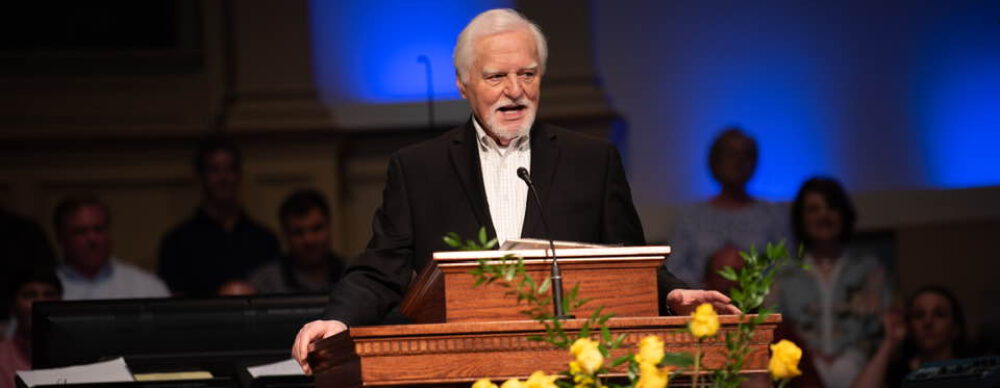
A Veteran Minister’s Regrets (About His Sermons)

I’m a veteran.

A veteran minister. I received the call to preach in April of 1961, which means we have recently passed the half-century mark for that anniversary. I began pastoring in November of 1962, and was ordained on December 2. I served 6 churches as pastor for 39 years and one as a staff minister for 3. Does this qualify me as a veteran?

“Veteran,” at least to me, is a better term than what originally came to mind: “old.”

I’m not nearly through preaching, although, best as I can tell, I’ve pastored my last church. And that’s just fine. I do not miss the day-to-day grind of the pastoral ministry at all. If I never attend another deacons meeting, never preside over a monthly church business meeting, and never sit in on a finance committee meeting, it will suit me just fine. The preaching part, I love.

So, as the Lord wills and host pastors continue to issue invitations, I’ll keep preaching wherever He sends me.

The other thing we retired veterans do–in addition to trying to stay active and useful–is to look back and rethink what we did. We reflect on what we wish we had done. Not, hopefully, in a morbid sense. No one wants to do an autopsy on himself, to second-guess every decision he ever made. To do so would fill today with all of yesterday’s pains.

But there is value to thinking of the ministry behind. And wondering what we could have done better.

For the purposes of this article, let’s not make this a Joe-confessional. Let’s raise the question and confine ourselves to: what sermons most of us veterans wish we had done differently “way back when.”

Continue reading

The 5 Most Frustrating Things Pastors Do

I’m pro-pastor, but I’m not blind.

These men (in our denomination, pastors are men) are called of God and assigned some of the most difficult work in the universe, and for the most part they labor well and long and you never hear a complaint out of them. They are my heroes.

Most of them.

The typical pastor in our denomination serves a church running 100 or fewer in attendance, which tells you the offerings are insufficient to provide much of a living for him. In some cases he holds down a second job or his wife works. Or both. Or, most amazing of all, he manages to live on what they pay him.

I believe in these guys. They are my brothers and my admiration of them knows no bounds.

Most of them.

But there are times when some of these ministers do the most self-defeating things. Not all of them, thankfully. But enough to warrant our addressing the issue as a caution to the rest of the Lord’s stable of shepherds.

Here is my personal list of the 5 most frustrating things pastors do.

Continue reading

Please Send Us a Pastor With Enthusiasm

My friend Gene Brock and I have been reminiscing.

We were classmates in New Orleans Baptist Theological Seminary in the 1960s, graduating the same year, ’67, and both went forth to pastor churches, he to SW Georgia and me to the MS Delta. These days, he’s serving sweet Little Ochlocknee Baptist Church outside Thomasville, Georgia, and this week I’m his revival preacherl.

We’re catching up on old times.

Gene and I agree that a revival we did for his church in Edison, Georgia, in the late 1960s is one of the best we’ve ever experienced. The funny part is how Gene invited me in the first place.

The mail that morning in Greenville, MS, brought a letter from Gene. His inviting me to preach a revival for him was most unusual, since we’d never been especially close during seminary, just classmates. But it was how he began the letter that we still joke about.

Dear Joe: If you are still as enthusiastic as you were in seminary, I’d like to invite you to preach a revival for my church.

I wrote back and said, “Sorry. Not as enthusiastic. Try someone else.”

Not.

I did not do that. No way was I going to admit to having dampened my enthusiasm for the Lord, for life, or for the Lord’s work.

I am enthusiastic about life, the Lord, and ministry to this day. I hope you are. But if not, it needs to be addressed.

That’s what this is about.

Continue reading

Should I Tell That Joke at the Start of My Sermon?

I must have forty or fifty books on preaching. Some of them deal with humor–a little, not much–but as far as I’ve been able to tell, none answer the great question of the hour that is bugging the h–k out of a large number of preachers on this Friday morning, two days before the moment of truth:

Should I or should I not tell that joke when I get up to preach?

It’s a great joke. It’s had me in stitches all week, ever since I heard it at the pastors’ conference last Monday. And furthermore, I’ve figured out how to use it as the introduction to my sermon. Okay, it’s a stretch, but I think I can make it work. But it’s such a great joke, everyone will enjoy it.

Groan. (That’s the reaction of 99.9% of the non-preachers who are reading this. To them, it’s a no-brainer. “No! Do not start a sermon with a joke! The very idea!”)

Only the preacher deals with such temptation. He’s about to do the most serious thing in the world–speak for the living God to people who desperately need a word from Him–and he wants to begin with a funny story!

The first week of August, Greg Woodward and I led a seminary workshop for 45 masters level students on “Worship Leadership.” The actual classes took place that week–morning, afternoon, and an evening or two. Then, there were book reviews to turn in during the rest of this fall semester, and something else you might find interesting.

Each student was charged with visiting three worship services in various types of churches/synagogues and writing a report on each. This week, I’ve been reading those reports and grading them. One thing in particular keeps recurring.

Several of the students made a point of stressing that the preacher/priest/rabbi did not begin his message with a joke. (I think one of the texts had said something about that.)

Finally, after reading for the umpteenth time that the pastor of Buttercup Church did NOT begin his sermon by telling a joke–as though this earns the man accolades–I decided I’d about had enough.

There is a lot to be said for telling a joke at the beginning of a worship service or the start of a sermon.

And–just so you’ll know I haven’t gone completely looney here–there’s more to be said for NOT telling one. Still, there are two sides to this issue.

Continue reading

The Top 12 Things for a Pastor to Remember Just Before Sunday Morning Worship

This is the moment the preacher has had on his mind and heart all week long. Now, he has done this for years, and by now you would think he’s got it down to a science and he can do this blindfolded–lead worship, read scripture, offer prayers, preach the Word, inspire the congregation–but not so.

This is not like anything else anyone on the planet does.

This man is attempting to speak for God. Not because of egomania. Not from an inflated sense of self. Not even because he wants to.

He was chosen. Hand-picked. Called.

Chosen and called and sent.

Sometimes the preacher tries to bolster his confidence as he enters the sanctuary by remembering the caution God gave Jeremiah at his call: Do not be dismayed before their faces, lest I dismay you before them (Jer. 1:17).

God will have no weakling speaking for Him. No coward afraid to be bold, no milquetoast fearing to be strong, no sycophant who cowers before the rich and powerful among the congregation.

Again and again, the Lord told Joshua, Be strong and courageous. That admonition is found in Deuteronomy 31:6-8,23 and Joshua 1:6,9,18. Evidently, Joshua was a lot like us in that some things he had to be told again and again.

All right. Pastor, you’re about to walk into the sanctuary and do what God has told you in the quiet of your study (as well as in the car as you drove, in the neighborhood as you walked, and in bed as you tried but were unable to sleep).

This is the most important hour of your week.

Knowing it could be the most important hour of someone’s life is what intimidates you. God has big plans for this moment. You don’t want to fail Him.

Here are my 12 suggestions for you at this moment, preacher.

Continue reading

How to give your audience something they will always remember

I’ve thought about that conversation ever since.

A friend whom I know only from our internet exchanges wanted to know if in all the articles on my website, there was anything on a text he was researching.

I responded that I could not recall dealing with those verses, but suggested where he might find help. Then, I said, “Are you preaching on that text?”

I had no idea whether he was a pastor or not.

It turned out he was a layman and had been asked to bring a message that Wednesday night to his church. The Lord had laid on his heart a text, and he was trying to find out all he could on it.  Good for him.

Then he said something which has lingered with me ever since: I want to give the people truths from this passage which they will remember the rest of their lives.

Wow. Big assignment he has given himself.

My first thought–which I would not dared have stated, lest it seem I was trying to discourage him–was: “Yeah, me too. Every time I stand to preach, that’s one of my goals.” I suspect his pastor would say the same.

Every preacher loves it when our sermons convey truths which people never forget.

However–and this was my second thought: That’s hard to do.

Church people hear hundreds of messages, lessons, and sermons. They are fed such a relentless stream of revelations, insights, truths, principles, and biblical information in sermons that I suspect very few walk into the sanctuary, take their seats, and look toward the pulpit expecting to hear something life-changing. Most will be satisfied to receive something interesting or thought-provoking.

That said, I come before you this morning to declare that it is indeed possible to deliver a message to your people that will never be forgotten. I might add, with as much humility and gratitude as I can muster on this Wednesday morning, I have done it a few times in nearly a half century of preaching.

Here’s how.

Continue reading

To Influence Your Generation, Be a Writer

I’m a sucker for a great beginning of a book.

Here is how Kelly Gallagher kicked off his outstanding work Teaching Adolescent Writers:

You’re standing in a large field minding your own business when you hear rumbling sounds in the distance. The sounds begin to intensify, and at first you wonder if it is thunder you hear approaching. Because it’s a beautiful, cloudless day you dismiss this notion. As the rumbling sound grows louder, you begin to see a cloud of dust rising just over the ridge a few yards in front of you. Instantly, you become panicked because at that exact moment it dawns on you that the rumbling you’re hearing is the sound of hundreds of wild bulls stampeding over the ridge. There are hordes of them and they are bearing down right on top of you. They are clearly faster than you and there is no time to escape. What should you do? Survival experts recommend only one of the following actions:

A) Lying down and curling up, covering your head with your arms.

B) Running directly at the bulls, screaming wildly and flailing your arms in an attempt to scare them in another direction

C) Turning and running like heck in the same direction the bulls are running (even though you know you can’t outrun them)

D) Standing completely still; they’ll see you and run around you

E) Screaming bad words at your parents for insisting on a back-to-nature vacation in Wyoming

Gallagher, who teaches high school in Anaheim, California, says experts recommend C. “Your only option is to run alongside the stampede to avoid being trampled.”

Then, being the consummate teacher, he applies the great attention-grabbing beginning: “My students are threatened by a stampede–a literacy stampede.”

He adds, “If students are going to have a fighting chance of running with the bulls, it is obvious that their ability to read and write effectively will play a pivotal role.”

Illinois high school teacher Judy Allen, wife of Pastor Jim Allen of Palmyra, gave me her copy of Gallagher’s book when she saw how fascinated I was with it. I’m grateful.

As the grandfather of eight intelligent, wonderful young people, I am most definitely interested in their being able to “run with the bulls.” But my concern on this blog, as readers have figured out by now, is for pastors and other church leaders who are trying to find their greatest effectiveness.

I hear veteran pastors say, “When I retire, I’m going to go to the mountains (or the beach) and write my memoirs.”

I think, “No, you’re not. If you’re not writing now, you will not suddenly become a writer when you retire.”

Sometime around 1996, our church’s minister of education, Jim Lancaster, installed a computer in my office. He did it without being asked. As he plugged it in, he simply said, “Pastor, you’re going to be needing this.”

He was so right. That small act from a friend changed my life and, if I’m allowed to say, has influenced a lot of the Lord’s people toward greater service. Thank you, Jim. (I am eternally in the debt of this good man who now pastors the First Baptist Church of Hammond, Louisiana.)

Writing is a remarkable thing. Almost magical even.

In a 1994 article in Christianity Today, Philip Yancey notes just how remarkable it is. In a scene from the movie “Black Robe,” a Jesuit missionary tries to persuade a Huron chief to let him teach the tribe to read and write. The chief sees no benefit to this practice of scratching marks on paper until the Jesuit gives him a demonstration. “Tell me something I don’t know,” he says. The chief thinks for a moment and replies, “My woman’s mother died in snow last winter.”

The Jesuit writes a sentence and walks a few yards over to his colleague, who glances at it and then says to the chief, “Your mother-in-law died in a snowstorm?” The chief jumps back in alarm. He has just encountered the magical power of writing, which allows knowledge to be transferred in silence through symbols.

Pastor, let us transfer some knowledge in symbols. And let us get on with it. The stampede is bearing down on both of us.

Continue reading

What Burdens the Pastor Most

When the prophets Nahum, Habakkuk, and Malachi stood up to preach, they began with the words, “The burden of the Lord.”

That was a dead giveaway this was not going to be a sweet little devotional filled with funny stories and touching vignettes. The men of God were about to drop a heavy load from their hearts into the laps and onto the shoulders of their audiences.

It took me a long time laboring in the Lord’s vineyard to figure something out. The burden God gives His preacher for some problem, some people, or some cause is every bit as much a gift from Him as the blessings of salvation. And it becomes my starting place.

Starting place for what? I’m glad you asked.

The burden God gives you, pastor, is your beginning point for three things….

Continue reading

When Preachers Need Correcting

Anyone who reads my stuff on this website knows I am a preacher and am pro-preacher. I’ve seen so much mistreatment of God’s servants over nearly a half-century in the ministry that it weighs heavily on my heart. I want to do anything I can to encourage these beloved friends and anything I can to help churches and church leaders know how to relate to them.

However.

Periodically, someone will write, “Yes, but what if the preacher is in the wrong? What if he is—” and you fill in the blank. What if he’s a bully? a dictator? a flirt? a heretic? a liberal? a nut? an abuser? a molester? a criminal? a thief? a liar?

Let me emphasize that I am under no illusions about human nature. We are all sinners and daily in need of God’s mercy, Christ’s forgiveness, and compassionate understanding from one another. I know also that some men in the pulpit have no business there.

There are times when godly lay leaders in a church absolutely must rise up and deal with an out-of-control preacher.

Those times and occasions are rare, thankfully.

More often, the problems are smaller, subtler, safer (if you will), and less of a threat. Even so, every church needs a system for speaking to the pastor who needs a rebuke, even if it’s only a gentle one.

If you thought I was leading up to a story, you’re right. Several, in fact.

Continue reading

The Kind of Friend Every Pastor Needs

Question: Pastor, is there anyone you can go to with a serious doubt about the Christian faith?

Let’s say you are struck by contradictions in the Bible. But if you preached these from the pulpit, you would have caused great harm. Psalm 73:15 comes to mind.If I had said, “I will speak thus,” behold, I would have been untrue to the children of your generation.

But you need answers. Where do you turn?

You are burdened by the suffering in the world. “How,” you wonder, “could a powerful and loving God allow such?” Perhaps you say, as some have, if God is almighty and allows this suffering, He is not all-loving. If He is loving and does nothing to stop it, it must be because He is not able. But, you reason, since suffering exists, we cannot have it both ways.

Who can you talk to about your questions?

If you have no friend to whom you can turn, there is a serious gap in your life. You are in need of another friend or two or three.

We do not mean just any kind of friend. We may have hundreds of “friends” on Facebook. But most are only acquaintances at best. Few if any are “friends” in the deepest sense.

A friend, they say, is someone you can call in the middle of the night to help you bury the body. He shows up and never asks for the details, but helps you carry out your unpleasant little task.

Maybe so. Maybe not. I prefer to think a real friend would confront you and force you to come to terms with what you have done. Faithful are the wounds of a friend; but deceitful are the kisses of an enemy. (Proverbs 27:6)

This is about two friends: a young Billy Graham and a young Charles Templeton. The story of that friendship and the doubt that drove them into separate life-paths is told in “Billy,” a book by William Paul McKay and Ken Abraham.

Billy Graham you know. What you may not know is that when he began his ministry of city-wide crusades, Charles Templeton was “the” evangelist drawing the big crowds, seeing great results, getting all the press. Templeton was tall, movie-star handsome, articulate, dynamic, and popular. He was a star, if we may use that word, when Billy Graham was just stepping onto the stage.

Instead of becoming rivals or competitors as we might have expected, these young men developed a great friendship. Each appreciated what he saw in the other. Both helped to organize Youth For Christ, the post-World War II evangelistic ministry which brought the gospel to a new generation. Billy Graham was its first full-time evangelist.

As young and dynamic evangelists, both Graham and Templeton went through a valley of doubts and questions regarding the Bible, God, and the Christian faith. Graham emerged stronger than ever; Templeton’s faith did not survive the test.

Billy Graham had friends to help him through his crisis; Charles Templeton did not. That, I believe to be the primary reason for what happened to each evangelist.

Continue reading