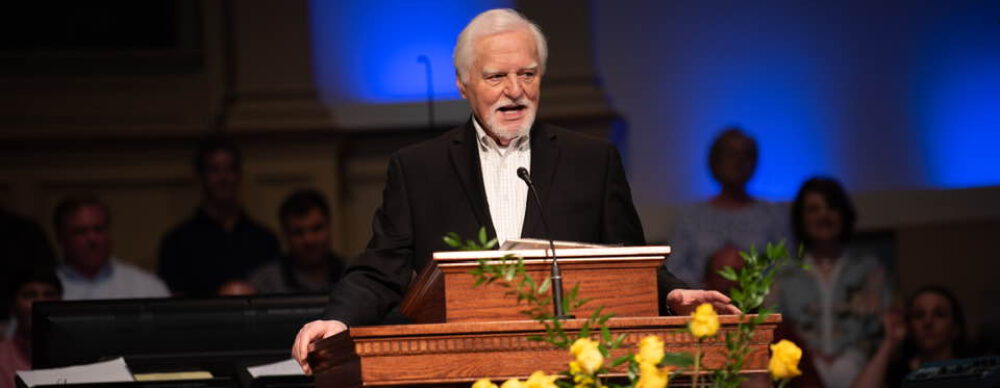
Let’s Reform the Deacon Body

The most confused group of people in the average Southern Baptist church is the deacons.

They have no idea what they are to be and do. Depending on the whims of the deacon chairman for that year, they become servants or managers, program heads or administrators. Helpers or bosses. Activists or inactive.

The church’s constitution and bylaws are usually vague on who they are, what they are to do, how they should function.

And, let us admit up front, Scripture does not give us a lot of guidance on this matter either. At every deacon ordination I’ve ever attended–and in a half century of ministry, that’s quite a few–Acts 6:1-7 has been read. But there’s not a word in that passage about those seven men being called deacons.

In fact, let’s quit calling them deacons and start calling them what the name means: servants.

Continue reading

What My Mother Did For Me No One Else Tried

The list would be long. Mom gave birth to me, the fifth of seven children, on March 28, 1940. The boy born on March 25 of the previous year had not lived, so they referred to me as the fourth child. I owe her my life.

Did she take some teasing or even ridicule because of the rapid-fire way she was bringing children into the world? All 7 of us were born in a 9-year-span.

Lois Jane Kilgore was 17 when she agreed to marry Carl J. McKeever, a 21-year-old she had been seeing for three years. She was a farmer’s daughter with a 9th grade education; he came from a long line of coal miners and dropped out of school in the 7th grade to go to work. He was the oldest of 12, she was the middle child of 9.

They surprised the preacher and got him out of bed that Saturday night, March 3, 1934, and asked him to perform the ceremony. There was no premarital counsel, no fancy surroundings, and for a time, no honorarium for the preacher. The next Monday, the coal miners went out on strike. An inauspicious beginning for marriage.

Lois had no idea what she had gotten herself into. Nothing from her sheltered, happy upbringing in the church-going farm family had prepared her for married life with that Irishman with the temper, a love for the sauce, and an unruly mob of siblings of all ages.

In time, Carl got his life straightened out, their marriage stabilized, and life was good. But for a couple or three decades, Lois paid a severe price for her determination to save her marriage and raise her brood of young’uns well.

As he aged, Carl became a wonderful patriarch in this family, revered and loved. He filled a room when he entered. He loved to talk, to tell a story, to read and learn and tell you what he had learned, and to work on problem-solving for the miners union of which he in time became a 70+ year member.

I grew up thinking he was the dominant force in my upbringing.

It took my wife to make me see otherwise.

I’m 95 percent about Lois McKeever. I owe her far more than I can ever know or say or repay. Here’s what I mean.

Continue reading

Why We No Longer Fear

(A sequel to the previous article on Why Fear of Death is Not Allowed for Jesus’ Disciples)

And lo, I am with you always, even to the end of the world. (Matthew 28:20)

The overriding, most awesome, absolutely most compelling reality of the life of a disciple of the Lord Jesus Christ is His continuing presence with us throughout this life and on into the life-beyond-this-life.

How can we say this stronger?

The greatest factor in the believer’s fearlessness is that “Jesus is with me.” The reality that tips the scales for all time in favor of bold living and confident dying is the eternal presence of Jesus. Nothing else is so determinative.

I will never leave thee nor forsake thee. (Hebrews 13:5)

As a result of this promise from our Lord, found in both the Old and New Testaments, we “may boldly say, the Lord is my Helper and I will not be afraid” (Hebrews 13:6).

Bold living, confident proclaiming, sweet testimony, and assured dying. That is the plan. That is what Jesus Christ feels He has a right to expect of every disciple.

Throughout Scripture, the Lord had the same answer–almost like a broken record if you remember what that was–to every excuse from those whom He called into His service: I will be with you. This was His panacea, His answer for everything.

It’s all through the Word….

Continue reading

Fear of Dying? Not Allowed!

I’m sorry, followers of Jesus Christ. The one thing you are not allowed in this life–and certainly not the next–is fear of death. It’s verboten, off limits, taboo.

Fearing death ranks first as the ultimate insult to the Lord Jesus Christ.

It is unbelief of the first order.

Death was the biggest gun in Satan’s arsenal when the enemy’s forces trotted it out on that Passover Eve on a hill outside Jerusalem’s walls. This Jesus Person would be dispensed with once and for all.

For a few awful hours, it appeared the diabolical plan had succeeded.

Jesus was dead. Really dead.

Then, on that never-to-be-forgotten Lord’s Day morning, the tomb was found to be empty and reports began popping up that Jesus was appearing to His followers. The disciples, who had been ready to give up and go home and deal with their dashed hopes and the Galilean’s embarrassing claims, suddenly were energized and “shot from cannons” as they blanketed the world with the news: Jesus is alive!

If He was alive, everything else had changed for all time.

That was the point.

Opponents and critics, eager to find holes and loopholes and potholes in the Christian message, rush to inform us that one man’s death and even His resurrection, if indeed there was one, changes little.

They miss the point.

Continue reading

The Pastor Who Needs a Friend Most

I’m on this “the preacher needs a buddy” kick in this week’s articles. Obviously, not everyone agrees. Some are offended by the thought, as though we’re suggesting that Jesus is not enough.

I’m not suggesting it. I’m saying it.

Well, to be precise, what I’m saying is: One of the primary ways the Lord works in your (and my) life is through other people. And He has chosen not to alter that system even for the most spiritual, most mature, and most godly.

How’s that? Clear enough.

The pastor (an all-encompassing term in my lexicon which refers to ministers, missionaries, shepherds, church staffers) who tries to go it alone in ministry is choosing to walk with a limp, to work with one hand behind him, to limit his effectiveness, and to let a large part of his personality atrophy.

On the other hand….

When a minister climbs out of his shell and reaches out to befriend two or three colleagues in the Lord’s work, when he makes friends of others called into this service, at least 12 things happen, all of them good.

Continue reading

The Number One Failure of 90 Percent of Pastors

The four-year-old who says, “I can do it by myself” has a lot in common with the typical pastor.

Pastors are notorious for their lone ranger approach to ministry. It’s what I call the number one failure of 90 percent of pastors. They prefer to go it alone.

Even Jesus needed a buddy. “He came to the disciples and found them sleeping, and said to Peter, ‘So, you men could not keep watch with me for one hour?'” (Matthew 26:40)

Sometimes it helps to have someone nearby, praying, loving, caring, even hurting with you.

The word paracletos from John 16:7 is translated “Comforter” and “Helper” in most Bible versions. The literal meaning is “one called alongside,” the usual idea being that the Holy Spirit is our Comforting Companion, a true Friend in need. And each time that word is found in the New Testament–John 14:16,20; 15:26; 16:7; and I John 2:1–it always refers to the Lord.

However, here’s something important.

Continue reading

Seeking Approval

Thursday of last week was the National Day of Prayer throughout America. The towns I drove through seemed to be making quite a deal of it.

Several pastors whose stuff I read, however, seemed worried that this might be the last such day. They fear President Obama might not authorize such an official observance in the future. They worry about that.

And that stuns me into silence. Well, almost. But not quite.

It ranks alongside the uppance of my dander when I read that Nashville’s Vanderbilt University is requiring campus religious organizations to allow anyone of any beliefs or no beliefs to hold leadership positions. (Note: all I know on this issue is what I read in www.bpnews.net. This is the Baptist Press’s website.)

What in the world is going on here, I wonder. Have we (they) lost our sanity?

Continue reading

10 Insights About Your Church’s Fellowship

And they continued steadfastly in the apostles’ doctrine and fellowship, in the breaking of bread and in prayers…. So continuing daily with one accord in the temple and breaking bread from house to house, they ate their food with gladness and simplicity of heart, praising God and having favor with all the people (Acts 2:42-47).

When a church of 120 members set out to assimilate 3,000 new additions into the life of the congregation, they ranked “fellowship” toward the top of the list as a critical step in accomplishing the task.

Koinonia is the Greek word. Literally, it refers to a sharing of life, or a partnership, which doesn’t tell us a lot about what it meant in the followup program in the early church. So, in the absence of anything definitive from Scripture on the precise meaning of the term, I submit for your consideration my own definition: Hanging out.

The “fellowship” quotient of a church–whether the members love the Lord and one another–is one of the most telling features of a congregation, one of the most dependable indicators of the health of the church, and one of the best predictors of its future usefulness in the Kingdom.

Here are 10 aspects of the fellowship of your church worth carving in stone, or better, engraving on the hearts of your leadership and membership.

Continue reading

Justice vs. Mercy: “Take Mercy Every Time!”

“All I want is what’s coming to me!”

Henry was being obnoxiously persistent in the church business meeting. Finally, in exasperation he blurted out that statement.

An elderly sister in the pew behind him said softly, “Sit down, Henry. If you got what was coming to you, you’d be in hell.”

Henry was demanding justice; Henry needed mercy.

This week driving down Interstate 55 below Jackson, Mississippi, I kept noticing bits and pieces of pink insulation batting everywhere.

After a few miles, we came upon two 18-wheelers pulling halves of a large mobile home. One of the units was shedding, littering the highway. Bits and pieces of the trailer were flying from the open top and being strewn across the countryside.

I dialed “*HP” for the Mississippi Highway Patrol and reported the offender. The dispatcher assured me they would jump right on the matter.

They never showed up.

I was wanting justice. I wanted the cops to pull these drivers over, read them the riot act for the careless way they had secured the mobile home and for littering the countryside, and if they didn’t issue tickets, at least force them to tie everything down.

I suspect this is a the way it is with most of us. I want justice to be done when it involves other people. But for myself, mercy is a better choice.

Continue reading

What Churches Could Learn From Restaurants

Recently, my wife and I have found ourselves in discussions about restaurants where we’ve dined. We enjoyed the food in each place and found the staff sufficiently friendly. But several aspects loomed large in our conversation, provoking me–ever the preacher–to thinking about how churches could benefit from studying what these eating establishments are doing, and what they’re not doing.

1. I wish churches put as much emphasis on friendly greeters at the front door as great restaurants do.

Often they are teenagers, or perhaps college students. The kids are fresh-faced, sweet-spirited, well-dressed, and friendly. The graciousness appears genuine.

Have you ever walked up to an unfamiliar church and saw no one at the doors, no greeters or welcoming team anywhere on the premises? It happens to me frequently.

Are restaurants more interested in welcoming paying customers than churches are interested in showing hospitality to people coming to worship the living Christ?

Even so, sometime in the service the preacher or a staff member will give a verbal welcome. They will tell how much this church loves visitors and guests. But it doesn’t wash. It rings hollow.

Take the business of having a handshaking, fellowshiping time in the middle of the worship service. If the members do not care enough to greet newcomers before and/or after the service, any attempt to do so within the service itself doesn’t work. To a visitor, the only friendliness that counts is the spontaneous outpouring prior to and after the worship.

The most successful restaurants choose greeters carefully and train them. Managers monitor them occasionally and correct the greeters who are not getting it right. Furthermore, these young people are surrounded by a staff of their peers who will help them.

Churches can learn from this. A church interested in effectively welcoming newcomers will have continual greeter training going on.

Continue reading