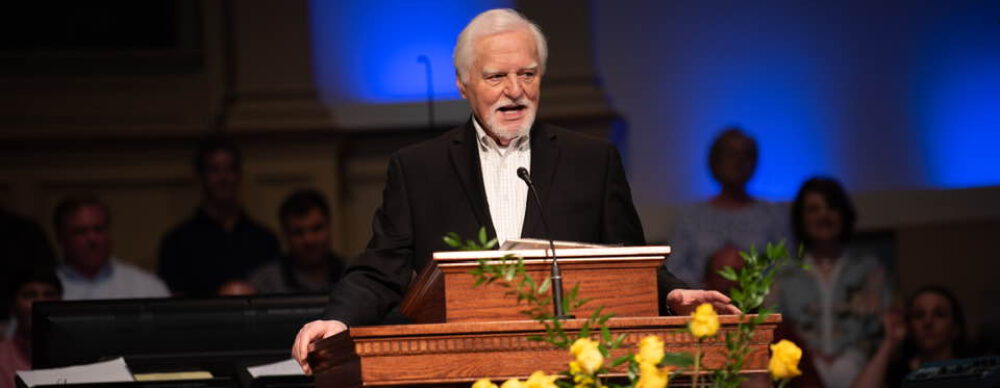
“We Want You as Our New Pastor. Just as Soon as We Get Rid of Our Old Preacher.”

My pastor friend told me this.

“From time to time, members of my old church–the one where I came to know the Lord and was baptized, was ordained as a deacon and later to the ministry–will tell me they want me to be their new pastor. That is, they do, just as soon as they get rid of the one they’ve got.”

He said, “I will confess that I’ve thought from time to time maybe the Lord might send me back there to pastor. It’s just a thought, you understand.”

“But when people say that to me, I tell them, ‘Okay, here is the only way I would want to become your pastor. Go see your present pastor. Tell him that you are going to support him 100 percent, that you are going to pray for him every day and be his biggest encourager. Then, if and when the Lord leads him away, if God tells me to become your pastor, I would be honored.'”

“Invariably, though, they say to me, ‘But he’s not giving good leadership. The church is suffering under him. He needs to go.'”

“I tell them, ‘Maybe he would if you would love him and encourage him and pray for him. If you would go out of your way to assure him you are supporting him and that he can count on you a hundred percent. You’d be amazed what that does to a pastor.'”

“Frankly,” my friend admitted, “That is not what they want to hear.”

Maybe not. But it’s the wisest counsel possible to God’s people in that circumstance.

Here’s why.

Continue reading

When the Preacher is a Joke–And How to Prevent That Syndrome

It sounded cruel, but he was not a believer and his assessment of the former pastor was an honest statement of how he felt.

After hanging in with a church of their denomination for too long–watching the pastor drive people away by his lack of ministry, his poor leadership, and a neglect of everything that makes a church a church–the entire family reluctantly moved to a church a few miles away. What they found there was striking in its contrast.

The congregation was warm and friendly, the church was thriving, and the pastoral team was outstanding. The minister’s sermons were powerful, biblical, and convicting. When a grandchild went into the hospital for surgery, the pastor left home before 5 am and met the family in the medical center. After praying with them, he stayed until the medical staff reported that the surgery had ended and the child was doing great.

After he left, the son-in-law, father of the child who had just come through the surgery, offered his assessment of the contrast between this new pastor and the old one who was still in the former church. “The other one was a joke,” he said.

A joke.

The family member who reported this to me observed, “We would not agree with Bobby that any minister is a joke. Remember, Bobby is unsaved and was not raised in the church. This is his honest reaction.” Then she said, “But no one in our family can help but be struck with the contrast in the sermons of the two men.”

How were they different? The former minister filled his sermon time with jokes and funny stories then ended with a short devotional thought. The new minister preaches a powerful message direct from God’s Word, the kind of sermon that cuts and convicts and inspires and blesses.

When a conversation (or story or scripture or quote) lodges itself in my heart and will not leave me alone, I know the Holy Spirit has sent me a message. That’s the case with this.

The contrast between those two preachers and those two types of sermons need closer investigation. Let’s attempt to do that here.

Continue reading

How to Tell You’re No Leader

Woe unto you when all men speak well of you, for so did their fathers to the false prophets. (Luke 6:26)

Let’s just come right out and say it up front:

Unless someone is not constantly on your case, mad at you, irritated, and upset with you all the time, you are no leader.

The would-be leader who fails to recognize this will be constantly bewildered by the reactions of the people he has been sent to serve.

He comes into a church with a divine mandate. (This is not pious talk. He has been called by God into the ministry and sent by Him to this church. If that’s not a divine mandate, nothing is.) He proceeds to take the reins and lead out. To his utter amazement, the very people he expected to welcome his ministry, to support his vision, to affirm his godliness, to volunteer their service–those very people–stand back and carp and criticize and find fault.

This was the last thing he expected.

Because he’s human, he begins to wonder many things: Did I make a mistake in coming here? Am I doing something wrong? Are these people not God’s children? Should I stay? Should I leave?

I answer: You’re doing just fine, preacher. Stay the course.

Salt is an irritant. We have been sent into this world as its salt (Matthew 5:13).

Light hurts the eyes. We were sent as the light of the world (Matthew 5:14). The brighter it shines, the more darkness resists it, resents it, runs from it.

This is as good a place as any to state the obvious: Many in places of leadership inside our churches are not leaders. I’m talking about pastors, staffers, deacons, and other so-called leaders.

They may qualify as counselors, program directors, consensus builders, negotiators, mediators, affirmers, or even teachers. But they are not leaders.

A leader by the very definition stands apart from the crowd, pointing and pushing and urging them onward to a destination that many cannot understand, do not see, and are not sure they want. The more forcibly he or she leads, the greater the reaction against his message and his methods by some.

Thankfully, not all. But there’s always some who will oppose any challenge to the status quo.

Perfectionism is one of the leader’s greatest enemies. If he waits until 100 percent of the team is on board, they will still be sitting there when Jesus returns.

When a leader insists on the enthusiastic support and complete approval of every last member of the team, the work grinds to a halt and all forward progress ends at that point.

Continue reading

The Person I Want Praying For Me

If you’re like me, you’re glad to have the prayers of anyone and everyone. And yet, when we have an urgent need, the kind we want kept in confidence, and for which we need immediate emergency prayer, the people we first think of calling are extremely few in number.

We were facing a family crisis, but the kind you don’t want to write about on your blog or announce in facebook or proclaim from the pulpit. It was more the type every family deals with sooner or later and wishes would go away.

We needed to pray and we needed prayer.

Margaret thought of one person to call and I thought of one. We made those two phone calls and enlisted those special friends to intercede for the situation. We have every confidence in them and in their prayers.

Do I think God hears one person’s prayers above all others? Do I think some people pray better than other people? Would a loving Father choose to answer one child’s requests and ignore the pleas from another?

I have no answer to these questions.

God is sovereign and can answer any request He pleases (Psalm 115:3). If there is a pattern to the way He grants one request and denies another, I haven’t found it yet.

It’s tempting to say it’s all a matter of faith, but we know better than that. People of great faith go through times when Heaven seems far off, when their prayers seem to rise no higher than the ceiling, when God seems deaf or preoccupied, the same as everyone else.

Even so, you and I have a few people whom we think of calling for prayer before everyone else.

Here are the four qualities of the person I call for prayer first.

Continue reading

“A Loving God Would Always Please Us.” Say What?

Some guy in Alabama ticked me off the other day.

I was driving back to New Orleans from two weeks of ministry in Tennessee and Kentucky when I bought a Birmingham (AL) News in Tuscaloosa. At a rest stop in Mississippi, I scanned it and was snagged by a letter to the editor written by an outspoken agnostic.

After reading it and steaming a little, I tossed the paper in the trash. Later, wished I’d kept it just for reference here. So I’m going by memory.

The writer wanted the world to know that the recent tornadoes in Alabama proves beyond doubt either that there is no God or if there is, He is a tyrant who delights in doing cruel things.

He was clearly proud of his great letter. Betcha he clipped it and is displaying it somewhere prominent in his house.

I’m wondering now if anyone responded to the editor and answered the letter. Probably not. The Bible cautions against answering fools, and this guy surely fits in that category.

Now, I am not saying all atheists or all agnostics are shallow, non-thinking, or even fools. When Scripture says the fool hath said in his heart, ‘There is no God’ (Psalm 14:1), it’s not saying everyone who says that is a fool. Only that fools do this. There is a difference.

Many an agnostic or atheist is an honest seeker, and if he/she perseveres will emerge into the light. They are not fools.

But this guy was. I feel safe in saying that.

Think of it. This fellow’s reasoning process goes like this: If there were a good God, He would only do those things that please us. Since there is much in this world that displeases us, there must not be a loving God.

(Hey, I took a course in logic in college. I don’t claim to remember everything about it, but I do know the syllogism.)

Imagine someone looking you in the eye and saying this: “There cannot possibly be a loving God because there are things that take place in the world we don’t like.”

That’s what that bird is saying.

But he’s not alone. He has his friends–birds of the same feather–in churches all across the land, and ensconced in seats of criticism where they sound forth on their ridiculous philosophy.

Remember the J. B. Phillips book from a generation ago? Your God is Too Small answered this foolishness back then. Trouble is, it keeps popping up with each new crop of critics, people too lazy to think matters through, people who want their theology to be easy and go down smooth, otherwise they reject all notions of God.

So, what is the correct answer? Why the tornadoes across the Deep South two weeks ago? Why the flooding in the Mississippi River Valley right now? Why do good people go through suffering while Heaven seems deaf to their pleas?

No one has all the answers. Here are some.

Continue reading

Signs the Pastor is Not Interested in Reaching People

I sat in your church and heard you preach. You did not know I was in the congregation because we never had the opportunity to meet.

Now, I was visiting in your part of the state, and the next day moved on to the next city where I’m ministering. So, had we met you would not have greeted a prospective member and probably would not have remembered it the next day. That’s fine.

What concerns me is that I had with me some friends who have moved to your city. I was hoping they would make some kind of connection with you and your church. That did not happen.

Watching what you did and failed to do concerns me. One reason it has persisted in my thoughts is that I’m certain at various times in my six pastorates, I made the same mistakes as you.

Since we do not know each other, I’m assuming you will not read this. So this is not for you. Rather, we post it on this website in the hope that other pastors will look at their own Sunday ministries in view of the newcomer sitting in the pews.

Here is what you did.

Continue reading

When We Cut Hell Out of the Equation

The best-selling religious books today are about heaven.

Write one about how you died for a few minutes and experienced a momentary jolt of nirvana beyond anything you ever imagined and publishers will line up outside your door ready to print it. They know the book-buying public is eager to get a glimpse through that scary curtain called death…so long as what’s on the other side meets with their preconceptions.

Ross Douthat is a columnist for the New York Times. In a recent column titled “Hell’s grip on religious imagination weakens,” he writes, Even in our supposedly disenchanted age, large majorities of Americans believe in God and heaven, miracles and prayer. But belief in hell lags well behind, and the fear of damnation seems to have evaporated.

He says near-death stores are quick to sell. “The Boy Who Came Back from Heaven” tells of a child’s return from paradise. However, “you’ll search in vain for ‘The Investment Banker Who Came Back From Hell.”

Douthat blames this disenchantment, this unbelief, regarding hell on “growing pluralism,” among other things.

What does that mean? Simply that people of all religion live on our block, go to our schools, shop in our stores, and are no longer abstractions to us. So, when we consider the question whether those-who-do-not-believe-in-Jesus go to hell, we are asking about some very real people we know personally and not the impersonal heathen of some dark continent.

I’m grateful for Rob Bell raising the question of hell for our generation. It’s an issue Bible-believers need to come to grips with, even though there is precious little about the subject that makes it fun to study or debate. No one wants there to be a hell.

Well, no one did until this week.

Continue reading

Somebody’s Praying For Me

People say it all the time, “I’m praying for you, pastor.”

I suppose they are.

My question to you, as a minister of the gospel, is: Can you tell?

I think I can. And I’m guessing you can also. Particularly if you have ever been the focus of genuine, heart-felt intercessions.

One president of the Southern Baptist Convention said the next day after he turned over the leadership of the denomination to the preacher who succeeded him he felt the difference–people were no longer praying for him. It was a sad day for him, he said.

My friend Bill Hardy tells of the farewelll reception Woodland Hills Baptist Church of Jackson, Mississippi, was giving him and his family as they prepared to move an hour up the state to the First Baptist Church of Kosciusko. An elderly lady went through the line to greet them and said, “Brother Bill, I have kept you at the top of my prayer list all these years.” Bill thanked her and said, “I hope you will keep me there.” “Oh no,” she said. “I’ll be praying for our new minister. Let the people in your new church pray for you.”

Little dose of reality there for my friend Bill.

Over the last few months, I have noticed the difference prayer makes in my own life.

Continue reading

How to Frighten a Preacher

“Pastor, some of our members are concerned.”

That gets his attention, believe me.

You can say all you want about how the minister is God-called and God-protected and that sort of thing, but he would not be human if he did not want the people he’s serving to be supportive and responsive. After all, since he’s sent to help them, he will want some kind of evidence he’s accomplishing his purpose, otherwise, he feels that he has either failed them or God. Or both.

He is vulnerable as a result.

What makes him more vulnerable to negative influences from the congregation is that he has a family to feed and look after the same way you do if you work at the post office, drive a delivery truck, teach school, or extract teeth. The fact that he needs this job means he opens himself up to pressure from his constituents.

As a result, he reacts–at least emotionally–when he hears some of these lines that have been used on preachers since the beginning of the church.

Continue reading

Three from Saturday’s Newspaper

I’m a little irked with the younger generation of preachers who get all their news from the internet…or from the Jon Stewart show! Buy a newspaper, friend! You’ll find a hundred things a week that will fascinate you, instruct you, inspire you, and mortify you.

Here are three from Saturday’s “Times-Picayune” which are great preaching values.

“Transocean failures called systemic”

This refers to the explosion a year ago of an offshore rig operation for British Petroleum by Transocean. “The rig was finishing up its work drilling the Macondo deep-sea well for BP when oil and natural gas blew out from the ocean floor a mile down and ignited in fireballs.”

A Coast Guard report has just been issued (Friday) that lowers the boom on Transocean. “Unlike previous reports on the catastrophe that killed 11 rig workers and polluted the Gulf of Mexico, the Coast Guard’s report says almost nothing about the raft of decisions and mistakes by BP personnel that led to the blowout.”

“Instead, it looks at actions and systemic failures after the Deepwater Horizon had already lost control of the well–all in the realm of Transocean and its crew.”

Notice the word “systemic.” It is the key.

The report faults that company, not for a few mistakes or errors in judgements, but for an entire culture of bungling, corner-cutting, safety-negligence. The problems were throughout the system, from top management down to the lowliest hand.

Pastors and teachers, take note of this please. That’s the problem with humans these days. That’s what original sin is all about. Sin is “systemic” within us.

Sin is not a misstatement. Not misspeaking. Not a lapse in good judgment. Sin is not a slipup, not an error, a failure to adhere to otherwise good principles.

Sin is throughout our hearts and lives. It is not a small segment of our lives that needs to be salvaged, healed, redeemed, helped, bandaged, treated. It’s all of us. Throughout.

“Why should you be stricken again? …The whole head is sick, and the whole heart faints. From the sole of the foot even to the head, there is no soundness in it, but wounds and bruises and putrefying sores; They have not been closed or bound up, or soothed with ointment.” (Isaiah 1:5-6)

Second thing from the newspaper.

Continue reading