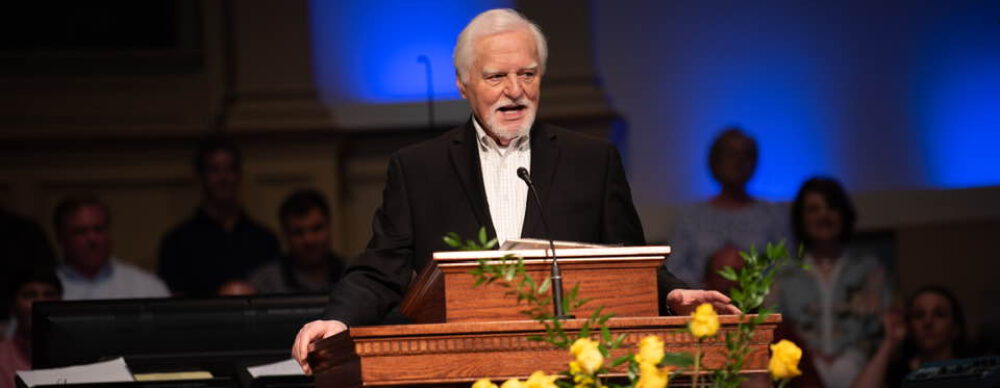
20 things a pastor can do to get past a rough time

Some power clique in the church is on your case.  Some church member is leading a movement to oust you.  The church has a history of ousting pastors every so often and it’s time, and some members are getting restless.

Or, perhaps, as the pastor, you did something wrong and it blew up in your face.  People are calling for your head.

Or, you failed to act and some cancer has gained a foothold within the congregation and your job is in jeopardy.

What to do now?

Continue reading

The special diet young believers need

“After they had preached the gospel in that city and had made many disciples, they returned to Lystra and to Iconium and to Antioch, strengthening the souls of the disciples, encouraging them to continue in the faith, and saying, ‘Through many tribulations we must enter the kingdom of God.’ (Acts 14:21-22).”

People who sell pet food say the young animals need a richer diet, one loaded with protein and certain vitamins.  Obstetricians make a similar observation about human babies.

It’s true of babies in Christ also. They need nurturing, tender instruction, and careful preparation for all that is ahead in this new life they have chosen and for which they were chosen.

At the apogee of what we refer to as their first missionary journey,* Paul and Barnabas decided that instead of blazing new trails into pioneer territory with the gospel of Jesus, they should retrace their steps and do followup with the people they had already led to the Lord. So, they turned around and went back, right into the towns and cities where they had been “tarred and feathered,” so to speak, and warned never to return.

In this case, however, they were no longer standing in public squares proclaiming the gospel to the disinterested and hostile, but meeting quietly with bands of believers to assist them in their spiritual growth and in becoming effective churches.

Continue reading

The day the Seventh-Day Adventist came to visit.

“Therefore, let no man act as your judge in regard to food or drink or in respect to a festival or a new moon or a Sabbath day–things which are a mere shadow of what is to come; but the substance belongs to Christ” (Colossians 2:16-17).

I’m not sure why some people want to fight over which day of the week to worship. Why not worship Him every day?

Let’s thank the Lord for every day of every week, praising Him that this one also is “the day He has made” and declare that “we will rejoice and be glad in it!”

But some people choose one day for special religious duties and insist that everyone else should too. Those who don’t are disobeying Scripture, disappointing God, and deserting their duty.  According to them, such backsliders are in big trouble.

People making an issue over the Sabbath need an answer.

Continue reading

The church membership in the last days

“But mark this: There will be terrible times in the last days. People will be lovers of themselves, lovers of money, boastful, proud, abusive, disobedient to their parents, ungrateful, unholy, without love, unforgiving, slanderous, without self-control, brutal, not lovers of the good, treacherous, rash, conceited, lovers of pleasure rather than lovers of God–having a form of godliness but denying its power.  And that’s just the Christians!” (II Timothy 3:1-5)

I added that last line. Forgive me.

I did it to make a point: Paul is not talking about the world’s crowd here.

The people of the world have always been self-centered, money-mad and pleasure-driven.

It’s God’s people–the redeemed, the members of His churches, those entrusted with the gospel–who will be this way.

Read that and weep.

Some observations on what this means for ministry in these last days…

1) This is not all bad.

Everyone is welcome at church, so we have always had a mixture of the good and evil in the pews, and that’s how it should be.  (See Matthew 22:10 where both evil and good people became guests at the banquet.)

Continue reading

Three huge mistakes church bullies make (and what to do about them)

Anyone interposing himself between the Lord Jesus and His church is asking for it.

Sometimes–as I keep getting reminded by readers–that would-be dictator is the pastor, a man sent by God to be the shepherd of the sheep but who has forgotten that he does not own the flock and cannot do with it as he pleases.

More likely, however, the man (it’s almost always a man) who takes it upon himself to run the church is a layperson with what he thinks are dynamic leadership skills.  My observation is that he is a bully in other ways and places too, particularly at home and in the office. (He usually owns his own company and thus calls the shots without interference from anyone.)

1) Bullies are wrong about themselves.

They don’t think of it as bullying: they’re just taking the leadership when no one else will. Filling the vacuum.

Continue reading

The brave and courageous leader of the Lord’s church

“Be strong and courageous” (Joshua 1:6,7,9,18).

The pastor of a church with which I’m familiar is something of a bully, according to some members I know. So, the other day, seeing him talking rudely to two women and watching them leaving in tears, a deacon in that church did a brave thing.

He went to see the pastor.

After hearing out the preacher on what had occurred, this courageous clayman told the pastor he was in the wrong, that he had been out of line, and asked him to apologize to the women.

The last I heard, the pastor has not apologized. From what I gather, no one expects that he will.  He built a reputation as one who will get his way above all, and to back down to anyone is not in his nature.

Such a bully has no business in the ministry.

Continue reading

Three things a pastor cannot do (and should not try)

The best thing about being a pastor is you’re able to make such a difference in people’s lives for eternity’s sake.

There are so many great aspects to the ministry, things you can do which were not available to you until the Lord thrust you into the ministry.  People trust you, they hand you the key to their lives (in a sense), they receive you  into their homes as an honored guest (almost a family member from the first), and they listen to you as though yours was the voice of the Father.

That’s a heavy load.

However, there are limitations. Just because people trust you and hand you a trainload of esteem and truckloads of trust does not mean you can do everything you would like. There are some lines you should not cross, some fences you need to respect.

The no-no’s everyone thinks of first might include prohibitions such as these:

…Not to preach longer than 45 minutes (25-30 is best). Who made that rule? No one. But unless your name is Spurgeon, it’s probably a good one to observe.

Continue reading

Word-wrangling: A new rodeo event for preachers?

“Remind them of these things, and solemnly charge them in the presence of God not to wrangle about words, which is useless and leads to the ruin of the hearers.” (II Timothy 2:14)

I’m not sure most of us preachers fully believe the scriptural command to avoid word-fights.

After all, aren’t some words worth wrangling over?

“Wrangling about words” conjures images of cowboys at the corral trying to tame a bucking theological term that won’t hold still.

It’s an interesting translation of the Greek logomacheo, with the logo meaning “word” and macheo referring to fighting.  “Wrangling” is as good a translation as any. Maybe “wrestling,” or simply “fighting over words.”  (Logomacheo is found only here in the New Testament, but the noun logomachia, found in I Timothy 6:4, is translated “disputes about words, out of which arise envy, strife, abusive language, evil suspicions, and constant friction between men of depraved mind and deprived of the truth….”  A little free information there. )

Be that as it may, many of us preachers do love to argue about words.

Wonder why that is.

Continue reading

That little outpost of 1950 inside your congregation

In Brazil, there is a community of Alabama and Mississippi rednecks.

Really.

Okay, that needs a little explaining.

These are descendants of Southerners who migrated to South America right after the end of the Civil War. They call themselves “Confederados,” and according to Americans who have traveled there to study them, they sound like they’re all from Georgia.

The September 2013 issue of “American Civil War” magazine says as many as 20,000 southerners left the devastated southern states beginning in 1866 and continuing over the next few years.  Most settled in Brazil, although  some returned home, but those who remained accommodated themselves to their new culture, new language, etc., while making sure that their descendants grew up bi-lingual and with an appreciation for their southern heritage.  The city of Americana in the Brazilian state of Sao Paolo is 200,000 strong (not all of them Confederados, of course).

One member of their group says, “We’re the most Southern and the only truly unreconstructed Confederates that there are on Earth.  We left right after the war, and we never pledged allegiance to the d–n Yankee flag.”

As a citizen of the wonderful United States of America, I respond, “That’s your privilege, but you ought to get down on your knees every night and give thanks to Almighty God that the USA came together and has stayed intact. Imagine what Hitler and Stalin would have done in this world had North America been made up of a bunch of tiny, independent, competitive, argumentative nations instead of the United States becoming the leader of the free world!”

Anyway, as I was saying.

These transplanted southerners call to mind the Amish people inside our own country who maintain traditions and customs of former times.

Many a pastor knows what this is like.

Continue reading

How to discriminate against “those other people”

“You shall do no injustice in judgment; you shall not be partial to the poor nor defer to the great, but you are to judge your neighbor fairly…. You shall love your neighbor as yourself. I am the Lord.” (Leviticus 19:15,18)

This is not a good story and I apologize in advance.

In between my sophomore and junior years in college, I worked the call-in desk for the Seaboard Railroad ticket office in Birmingham.  Located downtown on 20th Street South, this was an attractive office with pleasant people.  The year was 1960 and during the hey-day of Jim Crow laws. The police commissioner in the city was named Bull Connor, a man destined to make headlines a couple of years later when he turned the fire hoses on blacks (and maybe a few whites; I’m not sure) protesting the harsh laws and customs in our city..

My job was taking reservations over the phone.  My instructor, a pleasant fellow named Andy, said to me, “Now, we have a little system here.  It goes like this.”

Continue reading