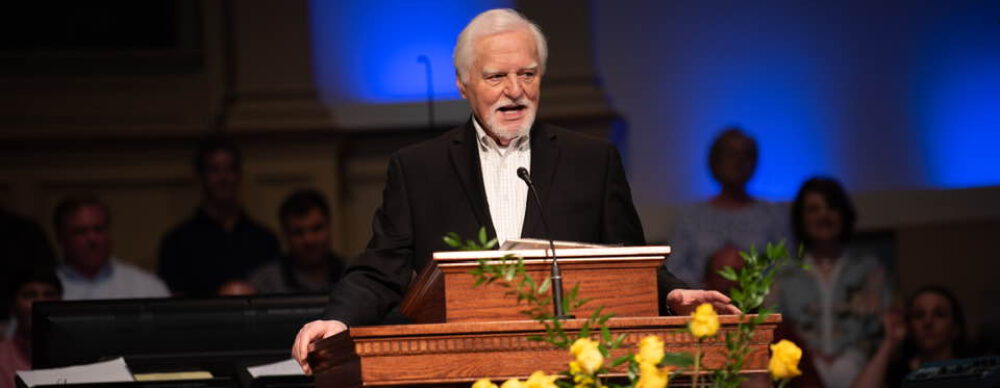
The One Qualification for a Leader No One Mentioned to You

I remember it like it was last week.

It was the mid-1970s and we were living in Columbus, Mississippi, where I’d gone to pastor First Baptist Church. A seminary professor who had taught some of us (“us” being myself and several area pastors) was in town for a few days, bringing a series of Bible studies in a local church. On Monday morning, we had gathered in my church and were sitting around drinking coffee and visiting.

The professor told us that Dr. Landrum Leavell had just been announced as the new president of New Orleans Baptist Theological Seminary. He was currently pastoring First Baptist Church of Wichita Falls, Texas. I knew him slightly, having met him a couple of times when in the company of his son Lan, whom I taught in Sunday School in Jackson, Mississippi, when Lan was in college.

It seemed like a good choice to me.

The professor had his reservations.

One comment he made about Dr. Leavell lingers to this day: “I was in seminary with Landrum. We go a long way back. With that great shock of white hair and that imposing presence of his, the rest of us have to put twice as much content into our preaching to get half the hearing he receives.”

Catty? Unkind? Maybe. But we’ll cut him a little slack and say it was an off-the-cuff remark the way most of us sometimes talk with friends and assume we will not be quoted.

So, why do I recall that comment to this day? Because it completely misses the mark.

What the professor failed to realize is that Landrum Leavell had one more quality that went a long way to account for his popularity as a preacher and his desirability as a seminary president: He was so cotton-picking likeable.

I can see him smiling down from Heaven at that.

Dr. Leavell met you and learned your name and remembered you. If he believed in you–and for reasons known only to the Heavenly Father, he seems to have believed in me–then you had an advocate of serious dimensions and influence.

He loved people and they adored him. He was a straight shooter who would tell you what he thought, and you still liked him, even if you disagreed. It’s a rare quality to be highly desired.

Elsewhere on this website, we have posted something like 71 articles on the subject of leadership. I’ve not checked it lately, and have not perused the shelves of books on leadership from the guru himself, John Maxwell, but I’m going to venture that this is the one quality no one mentions as making a whale of a difference for those who go forth to lead: “likeability.”

Jesus had it, in spades.

Continue reading

Sub-dividing the Gospel

I cannot vouch for the accuracy of this quote. I read it online as the report from a television station in a Southern city. A large, new, huge church in that city had made the news because the previous Sunday its leaders had asked a woman to leave the church and take her severely handicapped child with her.

The child, according to the article, had made noises during the service. The kind of noises one might expect a handicapped child to make.

“We’re not set up for handicapped people,” she was told.

The crowning statement came from–according to the article–a staff member who said, “Our church is not about ministry. We’re about worship.”

Pardon me while I throw up.

Where in the sam hill, I want to know, did someone come up with the idea that it’s possible for disciples of Jesus Christ to pick and choose the portions of the Gospel they will abide by?

Where did churches get the idea they may choose to emphasize evangelism or ministry or worship or Bible study or doctrine to the exclusion of all the others?

At what point did we decide it’s all right to subdivide the gospel?

Continue reading

6 Things We Have To Get Right in Church or It’s All Over

In the Lord’s work as in anything else in life, there are essentials and non-essentials. There are the loadbearing features and cosmetic for-appearance-only aspects.

If we don’t know which is which, we’re in big trouble.

In the late 16th century, the mayor of Windsor engaged architect Christopher Wren to design and oversee the building of a town hall. When it was completed, the mayor refused to pay the bill, insisting that it needed more than the few columns Wren had designed. No matter that it was pointed out to him that the columns were holding up the building just fine. He wanted more columns and would not pay until they were installed.

Christopher Wren had several more columns added to the building. Each was identical to the first ones he had installed, with one exception. Each lacked one inch going all the way to the ceiling.

Some of those columns were load-bearing and others were cosmetic.

It’s a wise church leader who knows which is which in the Lord’s work.

Here is my list of “six load-bearers,” six essentials which we must get right in the Lord’s work or it’s all over.

Please let me point out up front, these are not arranged in the order of priority. This is to ward off letters I sometimes get from debaters and arguers that B is more important than A, that C should be higher. I suggest, somewhat impishly, that he should have read the article more fully, because I said in the body that there was no particular order, that they are listed as they occurred to me. Anyone who writes learns quickly that some people prefer to skip the reading of the material in order to get on with criticizing it.

Continue reading

Dealing With The Preacher-Eaters in the Pews

Recently, in an article on this website, I cautioned young assistant pastors on a snare lying in their path (i.e., certain church members puffing them up into believing that they are superior to the pastor and ought to have his job). In telling my own story from several decades back, I expressed gratitude that I had not become the senior pastor for several reasons. Chief among them was the extremely strong laymen who exercised great influence in that church, and who would have “chewed me up and spat me out.”

A young pastor wrote asking me to elaborate on that. Who are those men? How do they operate? What is a pastor to do when he finds himself serving a church with such leadership in place?

Nothing that follows is meant to imply that I have all wisdom on this subject. Far from it. I carry scars from encounters with some of those men. Not men from that church in my previous article, but from their clones with whom I did battle in two subsequent churches.

The Apostle John wrote to a friend whom he called “beloved Gaius” in the little epistle we call III John. The key issue is a church boss who was exercising tyrannical control over the congregation. John says, “I wrote to the church, but Diotrephes, who loves to have the preeminence among them, does not receive us. Therefore, if I come, I will call to mind his deeds which he does, prating against us with malicious words. And not content with that, he himself does not receive the brethren, and forbids those who wish to, putting them out of the church.” (III John 9-10)

They’ve always been with us, these self-important self-appointed church rulers who reign as big frogs in small ponds and get their thrills from dominating God-sent ministers.

Who are they?

They are almost always men. I’ve never seen a woman try to control the church and the preachers the way some men do. Perhaps you have. Human nature being what it is, doubtless there are female Diotrephes out there. Thankfully, they are rare.

Where do they come from?

Ah, there is the rub.

Continue reading

The Trap That Snares Assistant Pastors

I was 30 years old and had left my first post-seminary pastorate to join the staff of the largest church in the state. My title was “Minister of Evangelism,” although some of my closest buddies kept pronouncing it as “Vandalism.”

Once in a while, the pastor let me preach in his absence. It was a heady experience.

The church I had just left ran slightly over 200 in attendance. The new congregation was over seven times that size, and was peopled with an entirely different kind of human beings. The governor was a deacon, a previous governor sat on the front pew, the state denominational leadership could be found throughout the sanctuary, and television cameras beamed the live broadcast across the state.

The first time I preached in the pastor’s absence he had come down with a cold and called me the night before. “Be ready to preach,” he said. “Just in case.” The next morning, his wife called. “You’ve got it.”

That day, a dozen people joined the church.

Leaders told the preacher, “From now on, when you see you’re going to be out of town, there’s no need to bring in guest preachers. Joe can handle it.”

And that’s when it began to happen. That snare that traps all assistant pastors at one time or the other began to be set for me.

One day, I found myself sitting in the office of the editor of our state denominational weekly. He was encouraging me. He liked my kind of preaching. My sermons, he assured me, were more biblical than the pastor’s. More meatier, more edifying.

I floated out of his office thinking I must be one of the best preachers in the state if that veteran leader thought so.

Not good. Not good at all.

Continue reading

Is the USA in Bible Prophecy?

I’m trying hard to answer this question with a straight face.

Short answer: No.

Longer answer: No sirree!

Last night, driving the interstate from Jackson, Mississippi, to New Orleans, I passed a billboard advertising some ministry that is focusing on biblical prophecy. Big letters: “THE USA IN BIBLE PROPHECY!” And a website.

My opinion–and that’s all this is; this is my website and I can freely post it; thank you very much–is that the people involved in this kind of “find the USA in the Bible ministry” are of two types: 1) well-intentioned unthinking believers who love Jesus but were never grounded in the essentials of the Christian life, and are now being led seriously off-track; and 2) clones of Harold Camping (the guy who gets his kicks out of his own off-brand interpretations of Scripture and loves to predict the end of the world) who spend all their time trying to unlock the Rubik’s cube of the Bible so they can know more than anyone else as to what the Lord is up to.

Both groups are in bad trouble.

Continue reading

(Father’s Day) “Preparing Sermons for Special Days–Tough Job for Many Preachers”

For some of us in the ministry, sermons for Mother’s Day, Memorial Day, Father’s Day, July 4, and the like come easily. But other pastors have a difficult time planning such sermons. Some ignore those days altogether.

Here is my approach. It might possibly help a pastor somewhere find how to pull this off without feeling that he was caving in to the culture and turning his back on his call to preach the Word.

Right now, I’m thinking about my sermon for Father’s Day. That Sunday, I’ll be filling in for Pastor Craig Beeman at the First Baptist Church of Winnsboro, Lousiana. It’s nearly 3 weeks away and a good time to get to work.

Typically, we pastors close the door to our study and sink into our chair and say out loud, “What do I want to say about Father’s Day? Lord, what do you want me to say?” And, if I may say so, typically no answer comes. We’re stuck. That’s why this sort of thing is no fun.

I suggest those are the wrong questions. A better question is: “Lord, what lesson have you taught me about fatherhood?”

Sit there for a few minutes and consider your own role as a father, your dad’s role, the men you have known who were fathers and granddads, and sermons you have preached on this subject before. What key points, what definitive stories, what lesson looms large in your mind?

In my case, as I consider that question, two things occupy center stage in my mind.

Continue reading

Special Word to Older Ministers

Sometimes when I’m speaking in churches for what is variously called “senior adult Sunday” or such, I’ll say to the congregation as a whole….

It’s great being a senior adult! If you knew what fun we have, you’d be chomping at the bit wanting to be one.

One of the best things about it–I don’t know if this is common knowledge, so you might want to keep this to yourself–is that every month, the government sends you money! I’m not kidding.

It’s really kind of amazing. Toward the end of the month, you’ll call the bank to check on your balance and find that your account is almost bare. Then, the next day, boom! There’s more money in the account. The government did that just for you.

Is that nice or what?

And if that’s not enough, being a retired pastor (that’s what I am, ever since my 69th birthday two years ago) brings a special kind of reward most other people don’t have: We get to preach all over the place! Really. People call and invite us to their church for a revival or banquet or prayer conference, to speak to the deacons–boy, do I ever get a kick out of that!–or do a senior adult emphasis. All these churches we used to drive by and think, “Hey, wonder what it would be like to pastor there,” well, they invite us in and we get to preach there. It’s more fun than anything.

Honestly, if I’d known retirement would be this much fun, I think I’d have gone straight from ordination into retirement.

There is one downside to all this getting older business, however. And that’s what brought me to my soapbox this morning. Something I need to say to my brethren in the ministry who are moving into those senior years.

Continue reading

The Hardest, Best Thing for a Preacher to Do

(Please don’t miss my story at the end of this article on how the principles in this article work together.)

Malcolm Gladwell is speaking at a forum in New York City soon. The promotion describes him thusly:

The Canadian-born ‘New Yorker’ staff writer Malcolm Gladwell is the author of such best-selling books as “The Tipping Point,” “Blink,” “Outliers,” and “What the Dog Saw.” Gladwell is known for taking a unique perspective on seemingly well understood topics and generating new patterns of thought about them. This provocative thinker joins Luminato to share his latest brainstorm.

Do you ever read a sentence and a day later, it’s still with you, hounding your steps, disturbing your sleep, probing your spirit? That’s what that description of what Gladwell does did to me.

He takes seemingly well understood topics and generates new patterns of thought about them.

Anyone who can do that–who can show us a different perspective on something we thought we knew well and then can draw fascinating conclusions from it–that is someone I want to know.

You probably already know this writer. Many of my friends cannot wait for Gladwell’s latest books and eagerly snap them up as they hit the bookstores. There’s something about his unique way of looking at things that produces “aha!” moments and leaves readers gasping, “Why didn’t I think of that?”

In “The Tipping Point,” Gladwell wrote about how little things can make a big difference. What turns an unusual clothing item into a hot new fashion trend? What are the forces at work to cause strange shoes to go from being oddities worn only by oddballs one day to (ahem) Birkenstocks the next?

Gladwell tries to find the precise act when that change occurs. He calls that moment the tipping point.

In “Blink: The Power of Thinking Without Thinking,” Gladwell focuses on intuition. Far from being a glorified hunch, he says intuition is the result of long hours of work and searching and concentration. His examples are worth the price of the book.

“Outliers” is his latest hot book. Subtitle: “The Story of Success.” Gladwell examines achievers for what they have in common. He says we should not ask “what are these achievers like?” but “where are they from?” That is, what went into making them different from the rest of us? He finds commonalities for them.

Okay, pastor. Malcolm Gladwell is your new role model from now on. Go forth and do with your ministry what he does with the mundane things of everyday life.

Continue reading

Deceiving and Bewitching as Careers

O foolish Galatians! Who has bewitched you that you should not obey the truth, before whose eyes Jesus Christ was clearly portrayed among you as crucified? (Gal. 3:1)

The bewitchers are among us, hard at work.

I see it all the time.

Beautiful people sit (reluctantly) before me for me to do a quick sketch. I say, “Look at me please. Could I see a smile?” But getting a smile from them–or even eye contact–is next to impossible.

They say variations of, “I don’t smile” or “I don’t like my smile.” Sometimes, it’s “I’m shy” or “This is really difficult for me.”

And I wonder who has done a number on this person to warp their psyche that severely.

A man told me a few days ago, “I had a teacher in high school who said to me, ‘You do not have a nice smile.'” That was all it took, he said. Thereafter he went out of his way to avoid smiling.

Aarrgghh! That’s a good comic book expression that means, “This is awful! I cannot believe this!”

I see intelligent people–men and women and young people who are really brilliant with great gifts and talents–who seem to think they are stupid. Ask them to do something that requires reading or writing or thinking and you will hear a variation of “I’m not good at that” or “You’ve got the wrong person for that.”

Who bewitched them into believing they were dumb? Take your pick: a teacher, a parent, a friend. But someone did it to them. No one comes into the world automatically believing they are morons.

I see godly people oppressed by needless guilt over forgiven sins.

Continue reading