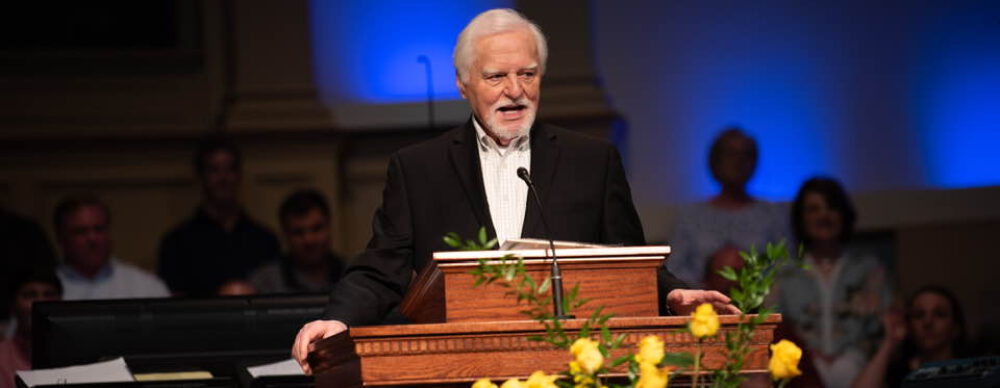
Predicting the end of the world? Please stop it!

Set a guard upon my mouth, O Lord.  Keep watch over the door of my lips.  (Psalm 141:3)

Keep back thy servant from presumptuous sins. (Psalm 19:13)   (A presumptuous sin, I believe, is what happens when you speak where the Lord is silent.  When we run ahead of what God has revealed.)

The other day I saw where Franklin Graham was predicting the world’s end any day now. And the return of Jesus Christ.

It sounds so realistic.  After all, doesn’t Scripture predict Jesus’ return? It does indeed.  And aren’t God’s people to be living in expectation of the Second Coming?  Sure.  So, therefore, isn’t it the godly thing to be telling the world “He’s coming” and “It could be any day now”?

That depends on how you say it. Tell what Scripture says–that Jesus is coming and that certain signs are to take place before that day.  Just don’t leave out one huge thing our Lord also said: No one knows when that will be.

He said it so clearly.  On several occasions apparently.

So, you would think it’s most spiritual to emphasize that.  But no. A huge segment of conservative Christianity–by which I mean Bible believers all!–seems to buy into the reasoning that to be godly means announcing that the end is upon us.

I’m writing this on Saturday, November 14, 2026, the day after the latest failed prediction.  (I’m indebted to an article on the internet I ran across earlier today.  I figure it’s accurate, but with the internet it’s hard to know.  But for our purposes here, it does not matter.)

In 1960 a physicist Dr. Heinz von Foerster published a paper in the journal Science predicting that by November 13, 2016–yesterday, a Friday the 13th by the way–humanity would reach the breaking point.  End of humanity. Not a Christian prediction, thankfully.  But just as wrong as every Christian prediction thus far.

The article says doomsday predictions date back to the first century when a Jewish sect interpreted an uprising against the Romans in A.D.66-70 as the signs of a coming Messiah.  They were wrong, of course, their Messiah had come and gone while they were playing their little games.

In the 1500’s, we’re told, Martin Luther predicted the world would end no later than 1600.  Puritan minister Cotton Mather kept updating his predictions.  He called for the end in 1697, then 1716, then 1736.  The article says he probably would have kept updating his predictions had he not died in 1728.

Continue reading →

One of Bethlehem’s shepherds speaks up

“Now there were in the same country shepherds abiding in their fields by night….” (Luke 2)

(Herewith we present a report from the youngest shepherd of that fateful night in the field outside Bethlehem, with the occasional editor’s remark in italics.)

I was not supposed to work that night, it being a school night. My friend Elihu asked me to fill in for him.  Now, my father is not real thrilled with me hanging out with some of these characters who work night shifts with the sheep.  Shepherding is the ultimate unskilled labor and only those who can’t do anything else–or hesitate to show their faces in public in the day–need apply.

But Father knows I’m a good student and agreed that we could use the money.

Anyway, that’s how it happened that I had the most amazing experience of my young life.

Did I say I’m only 15? So, it’s not like I have seen everything, but this is surely the high point of my life so far. I can’t imagine it getting any better.

Shepherding anytime is no fun, but at night it is the most boring work imaginable. The sheep are not grazing and not even wandering around. They’re asleep. Even dumb animals know night-time is when you shut down and get some rest.  But, I’m not complaining. It’s a job, and there aren’t many of those around for people my age.

Mostly, we were there to protect the flocks from the wild animals. Several small flocks were intermingled across the meadow. It’s too much trouble to herd the sheep back and forth from their farms each evening and morning, and labor being cheap, there we were.

There were four of us on duty there that night. What were we talking about? I ‘ve almost forgotten. Something about Elihu’s real reason for missing work, I think. Yitzhak seems to think he has a girl somewhere and she sneaks out to meet him when her father isn’t looking. Since Yitzhak has done that a time or two, we teased him about being such an expert on the subject.

Scholars say shepherds in First Century Judea were notoriously dishonest and often disreputable.  It says something interesting about the Heavenly Father that they were chosen as the very first welcoming committee for the Lord Jesus. In a similar fashion, in our Lord’s parable about guests in the royal wedding banquet of Matthew 22, those who accepted the invitation were “both evil and good” (v.10). Clearly, the Heavenly Father is no Pharisee!

Continue reading →

A few word studies you Bible students will enjoy

What made me want to study Greek and Hebrew in seminary was faithful preachers during my college years who sometimes gave us the meaning of a word in their sermons.  Not too much, of course.  It’s easy to overdo this.  And nothing very technical.  The guy in the pew does not care a whit about the aorist tense or pluperfect whatever, or that Josephus used this in one way and Herodotus another.

Pastors should do this sparingly, but when they do it wisely and well, a word study can enrich Bible study and inspire the hearers.  (I suggest no more than one word meaning from the Greek or Hebrew per sermon.  The average worshiper can absorb only so much, and we must not presume upon their kindnesses.)

Here are a few from Pau’s Letter to the Philippians…

“…so that you may approve the things that are excellent, in order to be sincere and blameless until the day of Christ” (Philippians 1:10).

The word “sincere” here is rich in meaning.  Our English word comes from the Latin “sin” meaning “without” and “ceres” meaning “wax.”  Without wax.  We’re told this refers to the shoddy practice of sculptors in the past.  While working on a piece of art, the marble might develop a crack.  Rather than discard the piece or try to repair it, the unscrupulous artist might fill it with wax.  It looked great and fooled the buyer….until he built a fire in the room where the piece was being displayed.  The heat melted the wax, and the fraud was discovered.  A truly sincere person is without wax, and can take the heat.

We used to speak of certain people being “plastic.”  By that we meant a cheap imitation of the real thing.

Continue reading →

God loves to use the ordinary. (Isn’t that encouraging!)

This is a piece from 2010.  I decided not to update it but run it as is.  Enjoy.

As a pastor, I sometimes trip over the words coming out my mouth when I try to say that “God uses ‘little people.’” There ought to be a better way of saying that.

Some of us remember how hotel owner Leona Helmsley offended the world by saying that “only little people pay taxes.” She is now comfortably serving a long sentence for tax evasion in some federal institution. The judge probably added another six months just for the “little people” put-down. (I found out she died in 2007.) 

How about “ordinary.” God uses ordinary people. Folks like you and me. He uses ordinary things. Ordinary days.

Look up the definition and you’ll quickly see the word means different things to different people. To some, it implies inferiority and the commonplace. In this article, it simply means: the normal, the usual.

A day like today. A person like you and me. A thing like this on my desk.

God delights in using the non-special.

Here’s a couple of songs on that theme.

ORDINARY DAY

I kiss my baby on the cheek

then she wraps her little arms around me

The rest of the world just melts away

As I’d hang on every word she would say

When I wake up and I see

The sun shining down on me

That’s when I thank God

For an ordinary day.

I drink my coffee on my swing in my back yard

The birds that are singing just don’t know how good they are

I’m so happy where I am right now

Isn’t that what life’s about anyhow

When I wake up and I see

The sun shining down on me

That’s when I thank God

For an ordinary day.

Continue reading →

I may be the most blessed person on the planet

I was trying to write an article for an editor of a Christian magazine in another country, the subject being “What I wish I had known when I was 25.”  It was to be primarily a piece about regrets, things I could have done differently.  And that’s how I came to realize…

I don’t actually have a lot of regrets.

I may be the most blessed person you will ever meet.

Consider, for instance….

  1.  My parents brought me up to love the Lord. Being born to Lois and Carl in a Christian family was not something I chose.
  2. When I was five, my mother got me started to drawing.  I became a professional cartoonist, among other things.  — Okay, what she did was to sit my little sis and me down at the kitchen table, give us pencil and paper, and tell us to “Sit there and draw!”  She was mainly interested in keeping her precocious son busy so she could get her housework done.  But–this is true–I discovered that day that I loved to draw. I kept at it and when I started at the first grade (Nauvoo, AL elementary school), the other children would gather around and watch me draw.  I figure I have sketched 100,000 people over the years and have done many thousands of cartoons for various publications.
  3. When I was eight, my coal-miner dad asked me to walk with him off the West Virginia mountain where we lived and up the railroad tracks to the next town (Sophia, WV)  There, we went into a variety store and he asked me to pick out a Bible. I chose a black (ha, they were all black!) KJV (ditto!) with a zipper around it.  It was lovely and cost $2.98.  Of the six children in our family, I was the only one to be so favored.  He never said why he did this.
  4. When I was perhaps 12 years old, a cousin got me into memorizing scripture.  When I could recite the verses on a page he had given me, he presented me with my very own New Testament.
  5. When I was sixteen, my older sister who had taken a job as a telephone operator, offered to pay for my correspondence course in cartooning with Art Instruction out of Minneapolis. It was $10 a month for thirty months.  I kept it up until they tried to teach me how to design draperies.  I still recall some of the lessons.  The wonderful Charles Schulz used to teach for this company.

Continue reading →