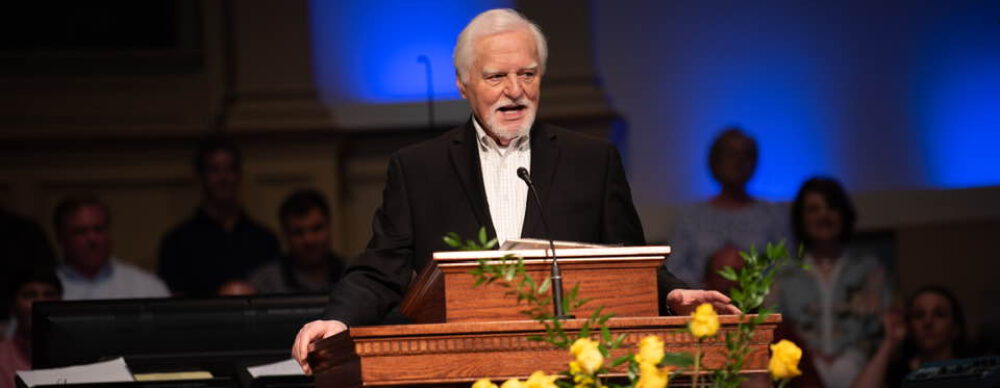
Ron Dunn’s stories about prayer

Ronald Dunn, now in Heaven, was a prolific writer and speaker on prayer and the deeper life.  He pastored in Texas and authored many books.  What follows are stories taken from his book “Don’t Just Stand There, Pray Something: The Incredible Power of Intercessory Prayer.” Published in 1991 by Thomas Nelson.

First story. (I’ve heard this from numerous speakers, but it’s Ron’s story.)

I was speaking at a banquet for a church’s intercessory prayer ministry when (this mother of a teenager) shared a recent answer to prayer. A few days before, as she was getting a pie ready to put into the oven, the phone rang,  It was the school nurse.  Her son had come down with a high fever and would she come and take him home?

The mother calculated how long it would take to drive to school and back, and how long the pie should bake, and concluded there was enough time. Popping the pie into the oven, she left for school. When she arrived, her son’s fever was worse and the nurse urged her to take him to the doctor.

Seeing her son like that–his face flushed, his body trembling and dripping with perspiration–frayed her, and she drove to the clinic as fast as she dared.  She was frayed a bit more waiting for the doctor to emerge from the examination room, which he was now doing, walking toward her with a slip of paper in his hand.

“Get him to bed,” he told her, handing her the prescription, “and start him on this right away.”

By the time she got the boy home and in bed and headed out again for the shopping mall, she was not only frayed, but frazzled and frantic as well. And she had forgotten about the pie in the oven. At the mall, she found a pharmacy, got the prescription filled and rushed back to the car.

Which was locked.

Yes, there were her keys, hanging in the ignition switch, locked inside the car.  She ran back into the mall, found a phone, and called home. When her son finally answered, she blurted out, “I’ve locked the keys inside the car!”

The boy was hardly able to speak. In a hoarse voice he whispered, “Get a wire coat hanger, Mom. You can get in with that.”

Continue reading

How should we address God in prayer?

When you pray, say, “Father.”  –Luke 11:2

We hear people praying, “O God, do this…and God, do that…please God….”

We do not criticize one another’s prayers.  Any prayer is better than none.  And yet, I wonder about addressing the Heavenly Father as “God.”

It certainly makes sense. God is who He is.  There is one God and no other.  When we say “God,” we are referring to no other Being in the universe because deity is a category occupied by Him alone.  He is the only one in that class.  So, it’s not wrong to address God as God, I suppose.

But it feels a little like addressing my earthly father as “Coal miner.” Or “Farmer.”  Because that’s what he was.  Only he was so much more than that.

Our Lord Jesus had something to say on this matter.  When you pray, say ‘Father.’

Say “Father.”

That certainly reads like a command, and not a suggestion.

One wonders why we take that so lightly.

Continue reading

Truths which Satan uses to stop us from praying

The forces of hell will do anything to keep us from praying.

Satan tells lies to keep us from praying.  He uses pleasures and misinformation and our laziness to keep us from praying.  He uses false teachers and busy schedules and great television to keep us from praying.

He also has been known to use truth.

As odd as it seems, the dark prince does not hesitate to speak the truth if it will make us think we shouldn’t pray.

Here are eight true statements Satan uses to put a stop to the most powerful force in the world, the prayers of God’s people…

1–God already knows what you need. No point in asking.

2–You are unworthy.

3–You are weak.

4–Your faith is small.

Continue reading

How to recognize God’s voice

“The sheep follow him because they recognize his voice” (John 10:4).

My friend, Pastor James Richardson, now in Heaven, told me his granddaughter Leanne, perhaps six or eight years old, put a great theological question to him.  “Papa,” she said, “How do I know when it’s God speaking to me and when it’s just me speaking to myself?”

James said, “Honey, that’s one of the hardest questions you’ll ever face in this life!”

The problem, says another friend, is that the Lord’s voice sounds a lot like mine.

Maybe for him.  Not for me.

In my experience, God has a tendency to say things I had never thought of, revealing insights new to me, calling me to tasks outside my comfort zone. Not once has He asked if i would “like” to do something or “find something convenient.”. He commands; I obey. It’s what servants do. His way is hardly the obvious, rarely the easiest and never the smoothest, but always the wisest and smartest. My constant prayer is “Not my will but Thine be done.”

I wrote that on Facebook one night. Then, next morning while on my pre-dawn walk, the Lord called it to my mind.

Continue reading

20 reasons why I pray

“And He was giving them a parable to show that at all times they ought to pray and not faint” (Luke 18:1).

At all times we ought to pray.

She knew I was praying for a certain family member who seems forever in some kind of predicament.  She asked, “Why do you pray?  I don’t see it doing any good.”

When I caught my breath–I could not believe a Christian asking such a question–I said, “Ask me why I breathe air.  It’s what I do to live.”

She did not let me off that easily. “Do you really think God is going to do what you ask? Is that why you pray?”

By now, I had settled down enough to try to verbalize a reasonable answer.

“That’s not up to me. How He chooses to answer my prayer is His business.”

“My job is to pray. To ask, intercede, to speak in faith what someone else needs. And so I ask for it.”

“How He answers is strictly up to Him. Or whether He even answers at all.”

Her question will not leave me alone. I imagine everyone who prays regularly–and keeps it up over the years, through good times and bad–has to answer this for themselves repeatedly, as well as for friends and skeptics alike.

It’s not as simple as it sounds. “Why pray?”

Continue reading

The pastor who teaches the congregation to pray

Now, it came to pass, as He was praying in a certain place, when He ceased, that one of His disciples said to Him, ‘Lord, teach us to pray as John also taught the disciples.’  (Luke 11:1)

The Lord’s people want to pray.

Most of the Lord’s people want to learn to pray.

You are the one to teach them effective praying, pastor.

You do know how, don’t you?

Granted, none of us do it very well. Even the great Apostle Paul said, “We do not know how to pray as we should” (Romans 8:26).  So, we are not saying any of us do it as well as we should, only that we know enough to be able to help others.

Here are some thoughts on the subject….

One. Model good praying for your congregation, pastor. “Being examples to the flock” (I Peter 5:3).

Two. Pray faithfully in the privacy of your home/office/car without ever telling anyone.  Let this be between you and the Lord.  Anything less turns us into hypocrites.  Telling people to do what we are not doing is never good.

Three. But in worship services, understand that people will be learning from you how to pray. They’re listening, and they are learning.

Four. Therefore, give advance thought to your public prayers.  Work on praying better and more effectively.

Five.  Always be aware that people are not only praying with you, but listening to how you pray so they will know how to do it better.  Even if they are not aware of it, they will be copying some of the things you do.

Six. . Teach them these things about public prayer:

Continue reading

10 signs your church is unhealthy

Recently, when an online magazine sent me an article on “5 signs you’re part of an unhealthy church,” I opened it eagerly. This subject is dear to my heart.

I am passionate about strong, healthy churches.

The writer’s five signs were good, as far as they went. No argument. I did not leave a comment one way or the other in response.

What I felt, however, is that my experience seems to be of another nature from the writer’s.

First, from that article here are “5 signs you are part of an unhealthy church”–

1) Leadership has no clear vision.

2) Leadership can never be challenged.

3) You are comfortable but never challenged.

4) Members are content with being pew warmers.

5) Outreach is never planned or preached.

All of these are true. But there is so much more.

Here, then, is my version of “10 signs (evidences, indications) that the church to which you belong is unhealthy”–

1. Prayer, if offered at all, is a formality, an afterthought, a burden.

While spending a long weekend at a pastors/wives retreat in Italy, I was struck by something. By the time I rose to speak, the service–by then a half-hour long–had experienced at least five prayers. The worship leader had followed a couple of songs with prayer, the presiding leader had prayed, and at least two more people with roles in the service had prayed. Each prayer had been spontaneous, heartfelt, and a joy. I knew then we were in for a rich time of Christian fellowship.

On the other hand, it pains me to remember the Sunday morning worship services where I was the guest preacher and noticed that by the time I stood to preach, not a single prayer–not one!–had been offered.

There is no more accurate indicator of a Christian’s spirituality or a church’s health than the vitality of our prayers.

Continue reading

I prayed for my preaching–and got answers I did not expect

(This is a reprint of an article I wrote for Leadership magazine sometime around 2001. It was later picked up and included in “The Art and Craft of Biblical Preaching,” edited by Haddon Robinson and Craig Larson, published by Zondervan, 2005. In conversations with pastor friends, I’ve learned that many never saw the article and some have asked where they could get a copy. Please feel free to copy and pass along to other servants of the Lord.)

I had been preaching for more than two decades, and I should have been at the top of my game. The church I served ran up to 1,500 on Sunday mornings, and the live telecast of our services covered a fair portion of several states. Most of my colleagues thought I had it made, and if invitations to speak in other churches were any sign, they thought I could preach.

But I didn’t think that.

My confidence was taking a beating as some of the leaders let me know repeatedly that my pulpit work was not up to their standards. Previous pastors carried the reputation of pulpit masters, something I never claimed for myself. To make matters worse, we had numerous vacancies on staff and my sermon preparation was suffering because of a heavy load of pastoral ministry. But you do what you have to do. Most days, my goal was to keep my head above water. Every day without drowning became a good day.

That’s when I got serious about praying for my preaching. Each night I walked a four-mile route through my neighborhood and talked to the Father. My petitions dealt with the usual stuff–family needs, people I was concerned about, and the church. Gradually, one prayer began to recur in my nightly pleadings.

“Lord,” I prayed, “make me a preacher.” Asking this felt so right I never paused to analyze it. I prayed it again and again, over and over, for weeks.

Continue reading

Twelve insights about prayer, some of which you may not have known

“Pray without ceasing.”  — I Thessalonians 5:17.

I do not imply that I know more about prayer than you.  I hate to hear anyone celebrated as “an expert in prayer,” for the simple reason that no child should be called an expert in talking to his/her parent.  What’s so hard about that?

Granted, we make it harder than it should be, with our rules, our religions, our legalism, our opinions, our blindness, and our sinfulness.  But in its essence, prayer is talking to the Father through the work of the Lord Jesus Christ.  Period.

What I do imply however (for this article) is that there are insights in Scripture on the subject of prayer many of us may have missed.  Here are a few……

One. Scripture says you do not know how to pray as you should.  That’s Romans 8:26. So, let’s not let that stop us.  God’s not looking for eloquence but faith.

Two.  Scripture says both the Holy Spirit and the Lord Jesus are interceding for us.  That is Romans 8:26 and 8:34.  Now, personally, I have no idea how this works, particularly when Romans 8:31 says “God is for us!”  So, it appears the Triune God is on our side!

Three. Scripture says the best pray-ers were Moses and Samuel.  That’s Jeremiah 15:1.

Continue reading

What the guy in the pew wishes his pastor knew about prayer

A typical worship service will be hemmed in by two prayers, the invocation and the benediction. In between may come a pastoral prayer, an offertory prayer, and occasionally an intercession involving some specific need. Some of those will be voiced by staffers or deacons, but most will belong to you, the pastor.

Pastor, could we talk about how you pray in the services?  The fellow sitting in the pews asked if I would say a word to you about how you pray.  Seriously.

Now, in many cases, he seems to have abandoned hope that you might invigorate your prayers with fresh thoughts and uplifting praise and strong intercessions. But, if I were a wagering man, I’d bet that the laity who read this will connect with it in a heartbeat.

What the guy in the pew wishes his pastor knew about his public prayers….

1) Remember that you are praying with me and for me.

This is not your private prayer time, pastor. You are voicing a prayer on behalf of the congregation. Therefore, say “We” and “our,” and not “I” and “my.”

At some point in recent history, some misguided influencer-of-preachers convinced them that no one can voice a prayer for someone else and that when you pray in public, you should use the first person singular pronoun. “I make my prayer in Jesus’ name, amen.”

My response is that this would be news to Jesus. He taught us to pray, “Our Father…give us…forgive us…lead us….”

So, make your prayers on behalf of the entire congregation. What are they feeling, where are they hurting, what do they need? What has God impressed you to request on behalf of your congregation? Then pray that.

Continue reading