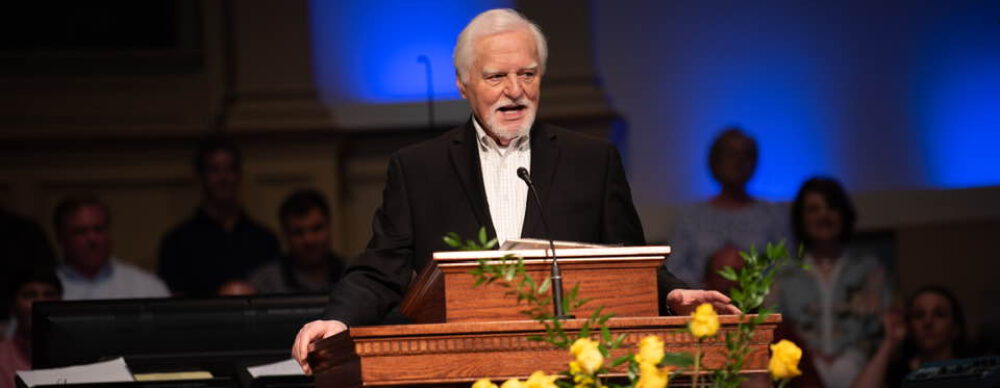
Your sermon offended? Good. It was supposed to.

“Lord, do you know the Pharisees were offended by your sermon?” –Matthew 15:12

Let me say up front that no church can long endure a steady diet of negative preaching.  No Christian, no matter how faithful, can withstand an unending barrage of sermons directed toward straightening them out. On a regular basis, we need messages reminding us we are loved, God is faithful, Heaven awaits, and there is no condemnation to those who are in Christ Jesus.

But sometimes the minister enters the pulpit with a burdensome task: to attempt a diagnosis, surgery, and amputation all in a 25 minute message.  At those times, the sermon must cut deeply.

Sometimes, the message hurts. It necessarily hurts.

How the Lord’s people ever came to expect their pastors to declare the riches of His Word without offending wrong-doers is beyond me.

It cannot be done.

“Offenders will take offense.” Remember that. As columnist Dear Abby once said, “You throw a rock in among a bunch of dogs. The one that hollers got hit.”

Delivering the commands of Scripture on how to live and think, how to re-prioritize our lives and change our behavior, and bring every detail of our existence under the Lordship of Jesus Christ without treading on anyone’s toes is expecting a little much of the preacher.

George Whitefield, the great British preacher of the 18th century, gave us an unforgettable line on this….

Continue reading

The most frightening thing about preaching

t’s actually several facets of the same thing:  I’m speaking for God.

Imagine such a thing.

Lives hang in the balance.

People are making decisions about God based on something I say.

People are making choices about their eternal destiny based on something I say.

Is this frightening or what?

What if I get it wrong?

What if I misrepresent God?

What if I leave out an important aspect, something that changes everything?

What if people draw nigh unto me and love me and think that’s the same as loving God?

What if I stupidly think because they love me that all is well with their soul and so ease up once I find they like me?

What if I manipulate those who trust in me into doing things for me, instead of for God?

What if I forget my place, that I’m only a messenger, and begin to believe this is all about me?

God help me.

God help all pastors.  Not all, we begrudgingly admit, are called of God or are spiritually mature or know their Bibles. Not all, we sadly confess, love the Lord nor His people nor His gospel.

Pray for your pastor.  When he does his work well, people live forever in the sunshine of God’s love and in the joy of His presence.  When he does it poorly, everyone suffers.

Your pastor knows something you may not realize: He is not adequate for the assignment God has called him to and for which your church has employed him.  Scripture says, “We are not adequate for these things; but our adequacy is of God” (2 Corinthians 3:5).

Unless he stays close to the Lord and the Heavenly Father safeguard him, instruct him from the Word, and guide him in the ministry of that word, his work will be carnal and infinitely flawed.

I have observed some ministers offering “infinitely flawed” service to the Lord, and it’s not a pretty sight.

Pray for your minister. Pray for the Lord to protect the pastor, give him wisdom and discernment, strengthen him to say ‘no’ to lesser things and ‘yes’ to righteousness, and to empower him in the study and in the pulpit.

After praying, do one thing more, a real biggie.  Leave the answer to your prayer with the Father. That is to say, do not look at what the pastor is doing to decide to what extent God is hearing and answering your requests.  Ask the Father, then leave it with Him.

Pray for the pastor, then trust the Lord.

Thousands will thank you in eternity.  I promise.

The pastor must be able to teach

“And the Lord’s bond-servant must not be quarrelsome, but be kind to all, able to teach, patient when wronged….” (2 Timothy 2:24).

I am a teacher.

When I was a senior in high school, a classmate gave me one of those unforgettable moments that lives in one’s mind forever.  Principal Andy Davis had summoned me to his office to help classmate Jerry Crittenden with a math problem. Now, Jerry was a big football player, lovable and kind-hearted, and a joy to be around.  But in math, the guy was lost.

Toward the end of our session, Jerry said, “Joe, you should be a teacher. I can understand it the way you explain it.”

Eighteen months later, following a frustrating freshman year of college that taught me one huge thing–I do not want to major in physics!–I realized that God wanted me to be a teacher. He had gifted me with a love for history as well as a delight in learning, and had surrounded me with some excellent teachers as role models.

At the time, I thought the idea was to become a history teacher in high school and later, after getting the necessary education, in college.  Then, a few years later, God called me to preach.  I’m confident members of my churches over these years would say that Joe never quit teaching.

And that’s good.

Able to teach.  What a strange thing the Apostle Paul did.  In the middle of calling his preachers to hold down the noise, to quieten the arguments, and still the controversies, he wants them gentle and patient and kind–and able to teach.

Pastor search committees would do well to put this skill high on their list of requirements when checking out preachers.

Continue reading

Dumb stories we preachers love to tell

“Whatever was I thinking?”

I’ve said that. And I’ve sometimes thought it about other preachers whose sermon illustrations just got entered into the competition for dumbest story of the year.

By dumb story, we refer to an account of something that distracts from God’s message, or sucks all the air out of the room so that no one hears anything for the next 15 minutes, or overpowers the sermon so the story is all anyone remembers for the next week, or is mind-bogglingly offensive. Or is just plumb stupid, did we say that?

Most of us preachers have been guilty of telling one or two of those over the years. Or a hundred.

Consider this a call for greater discernment in selecting stories and illustrations, parables and news items for our sermons.

1) A story that overpowers the sermon and smothers whatever point you were making needs to be tossed.

Have you heard the one about the dad who went fishing with his son and the boy’s friend?

If you have not heard this one, where have you been? (smiley-face goes here)  The other kid was not a Christian, so when the boat capsized and the father could save only one of the two, he grabbed the unsaved child and let his son drown since he knew his son was saved and would go to Heaven. (The sermon is supposed to illustrate something about witnessing, I suppose.)

That is a truly terrible story. And, I can just about guarantee you two things….

Continue reading

Pastor, your audience is always changing

Al Maury pulled the old beat-up Volkswagen bus into the bank parking lot on Decatur Street and killed the engine.  As the six seminary students bailed out, he opened the rear door and took out a microphone-on-a-stand and flipped a switch, turning on the transmitter.  “McKeever, you’re preaching tonight!”

Oh my.  A baptism by fire. Thrown into the deep water without a life preserver.

We were preaching on the streets of New Orleans’ fabled French Quarter.

The very thought struck terror into my heart. And yet, I had volunteered for it.

The year was 1964 and I was a new student at New Orleans Baptist Theological Seminary.  All first-year students were required to participate in one “field mission” ministry.  Each Tuesday, the student body gathered in Frost Chapel for a report and testimony time.  Choices for these ministries included helping start-up churches, hospital and nursing home ministry, the New Orleans Seamen’s Service, neighborhood mission centers, after-school tutoring, and such. Determined to rise above my fears of cold-turkey witnessing, I had chosen the scariest thing on the list.

Street preaching.

Yikes.

As the other seminarians took a handful of religious tracts and spread out to talk with people on the streets–a prospect fraught with its own brand of stage fright–Al Maury took me aside.

“Joe, listen to me closely.”

Continue reading

How pastors can mistreat worshipers

“….they treated the Lord’s offering with contempt” (I Samuel 2:17).

The first rule of worship leadership should probably be stated as Try Not To Get In Their Way.

When  people come to worship, if you cannot help them, at the very least try not to interfere with what they are doing.

The sons of Eli the High Priest were nothing but trouble. Hophni and Phinehas–who doesn’t love those names!– “were wicked men; they had no regard for the Lord or for the priests’ share of the sacrifices from the people” (I Samuel 2:12-13).

God literally calls them SOBs.  “Sons of Belial” is the Hebrew expression translated as “wicked men” or “corrupt.”

Scripture has not a single positive statement about these miscreants.

These men stand as warnings to every kingdom worker to tread softly and serve honorably.  We are stewards and not owners; servants, and not lords.  We should encourage worship and not place obstacles and burdens upon the worshipers.

We are to help people worship and not divert it into our own purposes.

The people can worship God without you, O thou shepherd of the Lord’s flock.

If we cannot help them do it better, we should back off and remove ourselves from the picture.

Continue reading

Pastor, if you could go back to your earlier churches…

If you’re a pastor, here’s an interesting game to play. And that’s all it can be, unfortunately–a game.

If you could go back to the churches you have served, what would you do differently?

Some people say, “If I could live my life over, I wouldn’t change a thing.” I hear that and think, “What? You never made a mistake? Never really blew it? Never did anything stupid?”

We all did, let’s face it. And surely, if we went back and knew what we know now, we would do many, many things differently.

Here’s my take on this subject.

The first church I served was a tiny congregation 25 miles north of Birmingham, Alabama. It was my first attempt at preaching and pastoring and I did poorly, I’m afraid. The good folks at Unity Baptist Church of Kimberly, Alabama, were patient with me for the 14 months I served them. At the end of that time, I resigned and for 6 months served as part-time associate pastor of Central Baptist Church in Tarrant, Alabama. We were living in Tarrant and I worked down the street from the church at the cast iron pipe plant as secretary to the production manager.

If I could do the 14 months over at Unity, the one thing I would do is seek out a mentor.

I would call up a pastor or two in Tarrant or Gardendale and ask if they would let me buy them a cup of coffee. As we sat across the table from each other, I would say, “I’m lost. I have to prepare three messages a week and don’t have a clue how to get started. Give me some advice.”

And, if the advice was something that worked for me, I would have asked if we could meet regularly for a while until I got this figured out.

The folks at Unity would have appreciated the effort and the congregations of subsequent churches would have benefited. As it was, by going alone, I took the far more arduous way to find out to make sermons and lead a congregation.

What would I do differently at Central Baptist of Tarrant City, Alabama, during my six months there? Very little, probably. My duties were to call on people who had visited our services and help Pastor Morris Freeman with anything he asked. For this, no money changed hands, but we received free use of the old parsonage, thus saving us rent.

The one thing I wish I had done was to take a layman with me visiting. It would have done me good, blessed the layman, and made a statement to the people we were calling on.

Both of those churches came in my pre-seminary years, 1962-64.

From 1965-67, while in seminary, I pastored 25 miles west of New Orleans. Paradis Baptist of Paradis, Louisiana was situated on Alligator Bayou. I took what I had managed to learn from Unity and Central and what I was trying to learn in seminary, and did some things right. The church almost tripled in the less-than-three-years we were there. (Note: That church relocated and is now West St. Charles Baptist in Boutte, LA.)

Continue reading

Why I’m angry at some preachers

You’ve heard them, I’m sure. Some well-intentioned but thoughtless man of God will stand before a gathering of the Lord’s people and in urging us to evangelize our communities will overstate the case.

“Jesus told us to become fishers of men! He did not tell us to be keepers of the aquarium!”

And, almost invariably, the statement will be met with a chorus of ‘amen’s.’

The only problem with that is it is not so.

In fact, it’s totally wrong.

Jesus did not send His disciples just to reach lost sheep–He certainly did that–but commanded that we are to “feed my sheep.” In John 20, He gave that command to Simon Peter three times.

In Acts 20:28, Paul tells the pastors of Ephesus that they are to “shepherd the church of God which he purchased with his own blood.”

And here’s another one, the one that set me off this morning.

In trying to motivate church members to get into the community with the gospel, the WIBT preacher* will say, “The Bible in no places commands the people of the world to come to church. It does, however, command us to go into all the world with the gospel.” (*Well-intentioned but thoughtless)

That’s so true, it’s almost totally true. But it’s missing something critical.

Continue reading

The best kind of learning is do-it-yourself

From time to time, as I’m sketching at a church or school, the question arises: “So, have you had training for this?” Or, maybe, “Are you self-taught?”

I don’t answer what I’m thinking.

What I say is usually a variation of, “I’ve had some formal training. But mostly, I’ve just worked at it. And I’m still trying to figure out how to draw better.”

But what I think is, “So, you think my stuff looks so amateurish I could not possibly have learned this from anyone?”

Can you imagine someone saying to Picasso, another artist of some renown (!), “Did you take training for this?” Or to Pavarotti or to Frank Lloyd Wright?

When my friend Mary Baronowski Smith was young, she made herself learn to sight-read a hymnal so she could play anything she wished on the piano. Even though she was taking lessons, this skill was self-taught.

She says, “My brother Lenny grew tired of my playing the same tunes over and over. To this day, he does not like the piano because he had to endure all those lessons my sister Myra and I were learning by playing them endlessly.”

“Anyway, one day Lenny came in and handed me a piece of sheet music. ‘Play this for me.’ I said, ‘How does it go? Hum it for me.’”

“He said this would never do, that I needed to learn how to sight read. So I got the Baptist hymnal down and decided I would teach myself.”

“I turned to page one–‘Holy, Holy, Holy’–and started in learning how to play it. It was hard. But gradually I got the hang of it. Then I went to the second one, “Love Divine, All Loves Excelling.” Eventually, I was able to play everything in the hymnal.”

She was 9 or 10 years old.

Continue reading

12 changes a pastor should consider for his mental health

“…that times of refreshing may come from the presence of the Lord” (Acts 3:19).

Like everyone else on the planet, we preachers get in ruts.  That’s not all bad, because sometimes we need to put it on automatic and not to have to make critical decisions about mundane things.  The morning ritual of showering and dressing, the drive to the office, and such should not require our undivided attention.

But from time to time, we need some variety. Our outlook needs refreshing. Our output needs sharpening. Our spirits need an uplift.  Our days could use a new perspective.

Here are some quick fix-its for the pastor’s mental health….

1. The pastor should sometimes vary his schedule.

And yes, this may include the routine things: shower at night, take a different route to the office, eat something different for breakfast.

2. The pastor should cross denominational lines and meet ministers outside his usual circle.  This assumes the pastor is already well-acquainted with those in his own denominational group.

The church down the street or across town has just welcomed a new minister.  Call and see if you can take him to lunch, or at least just drop by to say hello. Try nothing heavy here; just make a friendly visit. See if the Lord has something for you and that minister in the relationship. Some of the finest friendships a pastor can ever have are with colleagues doing the same work for Christ but in different settings.

3. He should attend a conference where he knows none of the speakers.

The first time I did this, I drove 500 miles for the experience.  I had seen the conference advertised in a national Christian weekly.  That was decades ago, but it remains fresh in my memory for a hundred reasons.

Continue reading