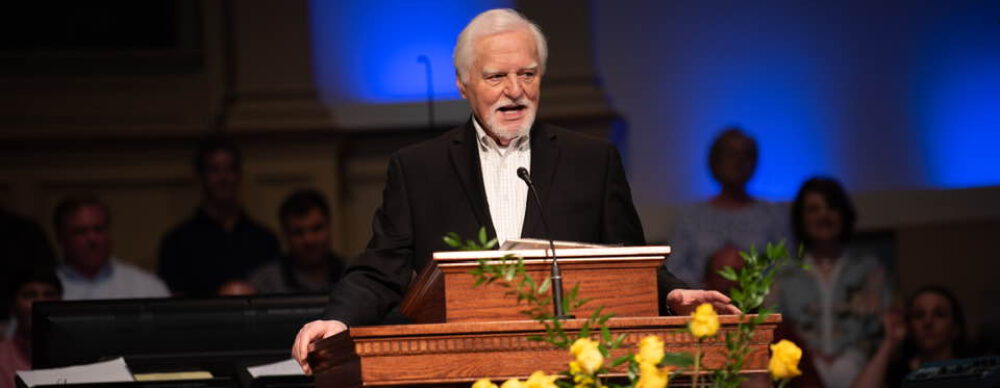
Three things a pastor cannot do (and should not try)

The best thing about being a pastor is you’re able to make such a difference in people’s lives for eternity’s sake.

There are so many great aspects to the ministry, things you can do which were not available to you until the Lord thrust you into the ministry.  People trust you, they hand you the key to their lives (in a sense), they receive you  into their homes as an honored guest (almost a family member from the first), and they listen to you as though yours was the voice of the Father.

That’s a heavy load.

However, there are limitations. Just because people trust you and hand you a trainload of esteem and truckloads of trust does not mean you can do everything you would like. There are some lines you should not cross, some fences you need to respect.

The no-no’s everyone thinks of first might include prohibitions such as these:

…Not to preach longer than 45 minutes (25-30 is best). Who made that rule? No one. But unless your name is Spurgeon, it’s probably a good one to observe.

Continue reading

The strangeness of church hospitality

“Be not forgetful to entertain strangers….” (Hebrews 13:2)

Recently some fellow wrote to advice columnist Judith Martin, aka Miss Manners, describing a strange situation….

“My wife and I received three unusual invitations.  In the first, we were invited to a cocktail get-together (not a formal party) where I was told that since I do not drink alcohol, I should bring something for myself to drink.”

“The second was from a friend who insisted that he and his wife wanted to get together for dinner, but he did not want to have it at his house or at a restaurant.  He went on to say he did not care if our house was not in order for a dinner party (construction is going on), but that it would be the best place for us to get together.”

“The third was from a man I have done outdoor activities with who invited me to lunch, told me he would stop by my house, and we could make something for lunch there.”

Gotta love it.

According to Miss Manners, such rudeness mocks the whole idea of hospitality. The couple should reply to these requests with, “I’m afraid that won’t be convenient,” and nothing more.

She has never heard of such before, the columnist says, and hopes she won’t ever again.

Ah, but we in the church get that all the time.

Continue reading

When the church apes the world

“Do not be conformed to this world but be transformed by the renewing of your minds” (Romans 12:2)

In the recording room of a large radio station in Charlotte, North Carolina, I was cutting 30 second spots our church had purchased.  A committee of our sharpest young adults had put together a package of radio ads on several stations hoping to get our message out and make the community aware of First Baptist Church.

After our first cut, the young lady producing the spots said, “Uh, pastor.  I need you to hear something.”

She fiddled with a few dials and turned up the volume on the car commercial running on the air at that moment.  “That’s what the ads on this station sound like.”

The commercial was fast-paced and loud, with a drum hammering a heavy staccato beat in the background.

I said, “I’m well aware of what your station sounds like.”

She said, “Well, you will want your ad to fit in with that.”

I said, “No ma’am. That is precisely what I do not want.”

“I would like to stand out from all that.”

She agreed to do it my way–just my voice talking quietly, nothing in the background–for the first round of ads.

A month later, at the next recording session, she said, “You’re right. I was wrong. What you are doing is working very well.”

Judging by the response we were receiving from the community, she was right.

Sometimes, when I see churches falling all over themselves to look like the world and sound like the world in order to speak to the world, I shake my head.

Continue reading

You are visiting in a church and the sermon offends you.

You’re on vacation or just traveling through, and you stop for church somewhere. As a minister of the gospel, you are so looking forward to being ministered unto.

You are beyond disappointed.

Question: Do you say something to the minister or not?

No. Almost always, the answer is “Absolutely not! There may be a hundred reasons why the preacher did not deliver today or the sermon bombed, and you don’t know any of them. Leave him to the Lord.”

When it comes to one preacher rebuking another for something, I fall back on Paul’s statement, “Who are you to judge the servant of another? To his own master he stands or falls….” (Romans 14:4).

However, that doesn’t stop us from wanting to.

I had spent several days ministering in an East Tennessee setting, and on Sunday morning asked my hosts to go to church with me.  Since we were old friends and they were new in that area and had not found a church home yet, I figured we’d be safe worshiping at the First Baptist Church there.

You would think.

Continue reading

Make me a servant, Lord–but, an “executive” servant, if you don’t mind.

Something inside us pastors tends to love impressive offices with nice furnishings.

We have to constantly work against this lust for the trappings of the ministry while neglecting the ministry itself.

The front page of Monday, August 26, 2013’s The New Orleans Advocate tells of LSU’s new president Dr. King Alexander’s way of introducing himself to students.  He’s helping them move into the dorms.

In the photo on the front page he’s wearing a t-shirt and ball cap and loaded down with boxes and bags.  Looking anything but presidential.  (Don’t you know he had fun with that!  “No, really, I am the president of the university.  Really! My name? It’s King.”)

Okie dokie.

I will say that in my quarter-century in Louisiana, this guy is unlike any chief executive LSU has ever had.

What makes this special is a conversation I had later in the day with a minister friend concerning a church he once served as a staff member.

“The pastor talked a great game,” he said. “He sounds a lot like (a well known radio preacher) who is his mentor.  Just listening to him preach, you would think this is one great pastor, someone I can really relate to.”

You would be wrong, he said.

Continue reading

What I miss most about the pastorate

Nothing.

As much as I loved pastoring, I do not miss it.

That might need a tiny bit of explaining.

I’ve not pastored since 2004, when I became the area-wide “director of missions” for the SBC churches in metro New  Orleans, a Southern Baptist position similar to the Methodist District Superintendent or some minor bishop (but, as we tell our Catholic friends, “bishop without the authority or funny hat”).  After 5 years, I retired to a ministry of itinerant preaching, writing, cartooning/sketching, and honey-doing.

I do not miss pastoring, even though I put in 42 years serving six churches and by all reports, did a fair job of it.

I do not miss the stress.

I do not miss the constant demands placed on a pastor and the sleepless nights that result.

I do not miss the relentless return of the Sabbath with its requirement for several new sermons and fresh presentations at every level.

Continue reading

Through no fault of their own: The preacher’s kids, caught in the crosshairs

The little boy was 7 years old and loved the church where his dad served as pastor.  So, he was not prepared for the bully who decided to take out his frustrations with the preacher on him.

Each week during the Sunday School assembly, the director of the children’s department would ask, “Has anyone had a birthday this week?” Now, he already knew the answer since the church bulletin carried this information. But, they would identify the children with birthdays and sing to them.

This week, little David had celebrated his 7th birthday and was eagerly anticipating that tiny bit of recognition from his friends in Sunday School. This day, however, the director chose not to ask if anyone had had a birthday that week.  David came home in tears.

His mother said to me, “How could I explain to my child that the director despises his father? And that he has fought us on everything over the past year. And that he took out his frustration on the minister’s child?”

She said, “These are things  we should not be having to explain to a 7-year-old child.”

“It really hurts.”

I suggested she tell David that church members everywhere will read his story here and will go out of their way to make sure this never happens again. His experience will end up blessing a lot of children.

Continue reading

Word-wrangling: A new rodeo event for preachers?

“Remind them of these things, and solemnly charge them in the presence of God not to wrangle about words, which is useless and leads to the ruin of the hearers.” (II Timothy 2:14)

I’m not sure most of us preachers fully believe the scriptural command to avoid word-fights.

After all, aren’t some words worth wrangling over?

“Wrangling about words” conjures images of cowboys at the corral trying to tame a bucking theological term that won’t hold still.

It’s an interesting translation of the Greek logomacheo, with the logo meaning “word” and macheo referring to fighting.  “Wrangling” is as good a translation as any. Maybe “wrestling,” or simply “fighting over words.”  (Logomacheo is found only here in the New Testament, but the noun logomachia, found in I Timothy 6:4, is translated “disputes about words, out of which arise envy, strife, abusive language, evil suspicions, and constant friction between men of depraved mind and deprived of the truth….”  A little free information there. )

Be that as it may, many of us preachers do love to argue about words.

Wonder why that is.

Continue reading

That little outpost of 1950 inside your congregation

In Brazil, there is a community of Alabama and Mississippi rednecks.

Really.

Okay, that needs a little explaining.

These are descendants of Southerners who migrated to South America right after the end of the Civil War. They call themselves “Confederados,” and according to Americans who have traveled there to study them, they sound like they’re all from Georgia.

The September 2013 issue of “American Civil War” magazine says as many as 20,000 southerners left the devastated southern states beginning in 1866 and continuing over the next few years.  Most settled in Brazil, although  some returned home, but those who remained accommodated themselves to their new culture, new language, etc., while making sure that their descendants grew up bi-lingual and with an appreciation for their southern heritage.  The city of Americana in the Brazilian state of Sao Paolo is 200,000 strong (not all of them Confederados, of course).

One member of their group says, “We’re the most Southern and the only truly unreconstructed Confederates that there are on Earth.  We left right after the war, and we never pledged allegiance to the d–n Yankee flag.”

As a citizen of the wonderful United States of America, I respond, “That’s your privilege, but you ought to get down on your knees every night and give thanks to Almighty God that the USA came together and has stayed intact. Imagine what Hitler and Stalin would have done in this world had North America been made up of a bunch of tiny, independent, competitive, argumentative nations instead of the United States becoming the leader of the free world!”

Anyway, as I was saying.

These transplanted southerners call to mind the Amish people inside our own country who maintain traditions and customs of former times.

Many a pastor knows what this is like.

Continue reading

We owe the pastor’s wife a great debt of love.

We’re all vulnerable.

Everyone who walks in the church door can be helped or hurt in what happens during the next hour. Whether saint or sinner, preacher or pew-sitter, oldtimer or newcomer, child or geezer, everyone is vulnerable, and should be treated respectfully, faithfully, carefully.

No one in the church family is more vulnerable than the pastor’s wife. She is the key figure in the life of the pastor and plays the biggest role in his success or failure. (Note: I am fully aware that in some churches the pastor is a woman. In such cases, what follows would hardly pertain to her household.)

And yet, many churches treat her as an unpaid employee, an uncalled assistant pastor, an always available office volunteer, a biblical expert and a psychological whiz.

She is almost always a reliable helper as well as an under-appreciated servant.

You might not think so, but she is the most vulnerable person in the building. That is to say, she is the single most likely person to become the victim of malicious gossp, sneaky innuendo, impossible expectations, and pastoral frustrations.

The pastor’s wife can be hurt in a hundred ways–through attacks on her husband, her children, herself. Her pain is magnified by one great reality: she cannot fight back. She cannot give a certain member a piece of her mind for criticizing the pastor’s children, cannot straighten out the deacon who is making life miserable for her husband, cannot stand up to the finance committee who, once again, failed to approve a needed raise or the building and grounds committee which post-poned repair work on the pastorium.

She has to take it in silence, most of the time.

It takes the best Christian in the church to be a pastor’s wife and pull it off. And that’s the problem: in most cases, she’s pretty much the same kind of Christian as everyone else. When the enemy attacks, she bleeds.

Continue reading